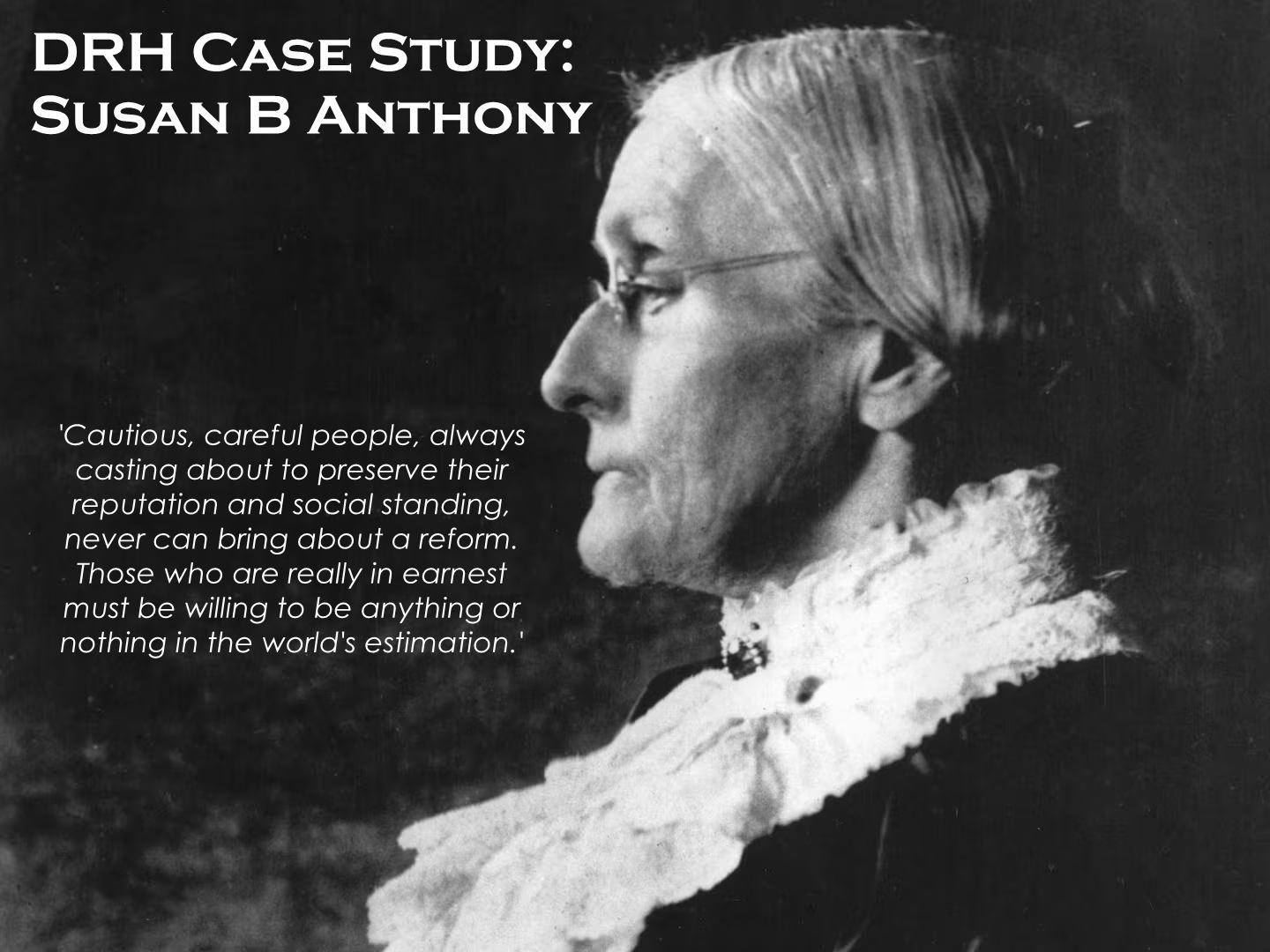
Susan B Anthony: A Life of Unyielding Individualism
Susan B Anthony was born in 1820 near Adams, Massachusetts, into a Quaker family that stressed equality of all people before God. Her father's Quaker faith - emphasising independence, peace and equality - deeply shaped her early world view. By age 13 Anthony formally joined the Society of Friends, whose teachings on the 'equality of all people before God' and insistence on education for girls gave her uncommon opportunities. She even worked in the family cotton mill and noted the injustice there: why, she wondered, would her father never employ a woman as overseer of his factory? These experiences - hearing her father avoid slave-grown cotton and seeing gender-based pay gaps firsthand - planted the seeds of a lifelong insistence that every individual be treated fairly. In Ludwig's terms, Anthony's Quaker upbringing and early curiosity exemplify an 'ultimate individual' ethos: acting on personal judgment and viewing all people as equals.
Abolitionist Awakening
In the mid-1840s Anthony's family moved to Rochester, New York, a hotbed of anti-slavery activity. Their home became a regular meetinghouse for abolitionists - Frederick Douglass and William Lloyd Garrison among them - and Anthony absorbed their conviction that slavery was a moral outrage. By 1846 she was teaching at an academy for girls and young women in upstate New York. There, as in Philadelphia, she saw men and women steered into very different lives: male teachers earned $10 a month, while women earned only $2.50. She challenged these norms as an intelligent young teacher: her experience with both education and manual labour made clear that the same work deserved the same respect, regardless of sex. In 1852 she refused to accept a man's veto at a temperance meeting - when organisers barred her from speaking because she was a woman, she promptly helped form the Women's New York State Temperance Society.
Anthony's own brand of activism now took shape. She threw herself into the abolition lecture circuit of the 1850s. In the decade before the Civil War, as fugitive slave laws tightened, she spoke wherever she could find an audience and even pressed Abraham Lincoln in 1861 to demand 'no compromise with slaveholders'. Her uncompromising stance at times provoked violent backlash: in Syracuse in 1863 a mob burned her in effigy and dragged a makeshift 'body' of her through the streets. Throughout, however, Anthony held firm. In 1863 she joined Elizabeth Cady Stanton and Lucy Stone to form the Women's Loyal National League - a coalition of women pressuring Congress for a constitutional amendment to abolish slavery - helping lay the groundwork that led to the Thirteenth Amendment in 1865. Even as an abolitionist, Anthony often stood apart from mainstream thinking. For example, Ludwig's Deindividuation Resister Hypothesis would note that she did not simply absorb the prevailing ‘any means' consensus but remained guided by principle. She put equal treatment at the centre of her reasoning (as seen in her insistence on no compromise with slave owners) and expected all people to be regarded with the same dignity. In this era, as now, one could say she was an intellectual ‘resister' to the common pattern of group-think: she defined herself by her own sense of justice rather than by prevailing trends.
Rise of the Suffrage Partnership
Anthony's abolitionism naturally linked to emerging women's rights causes. In 1851 she met Elizabeth Cady Stanton, who had co organised the first women's rights convention at Seneca Falls in 1848. The two forged a lifelong partnership. Stanton settled into writing and campaigning locally, while single Anthony - never one to be tied down - used her freedom to travel and lecture nationwide. Anthony never married (she reportedly received marriage proposals but always refused them), believing that marriage would curtail her independence. This decision - defying the 19th century expectation that a woman's life culminate in marriage - marked her as a nonconformist from early on.
By the late 1850s and 1860s Anthony was a recognised leader in women's reform. In 1868 she and Stanton co founded the American Equal Rights Association and launched the newspaper The Revolution. They insisted that all the same rights and protections offered to men be extended to women. The Revolution covered topics far beyond voting - education, marriage and divorce law, equal pay, labour rights and eight-hour workdays - reflecting Anthony's belief in broad social reform. Here again Ludwig's individual/collective spectrum is instructive: Anthony championed causes based on her own vision of equality, not merely following a single movement's agenda. She treated issues like race, class and gender as matters of equal-rights principle, and expected all marginalised people to be included.
In 1869 the movement split over strategy. Black abolition leaders like Frederick Douglass and White suffragists like Lucy Stone supported the 15th Amendment (which enfranchised black men but not women) as an incremental victory. Stanton and Anthony opposed it unless women were included - controversially arguing (with clearly misguided racial assumptions of the era) that educated white women should not be left behind by the black men's vote. Today we must note that position critically, but it illustrates how Anthony prioritised her own hierarchy of principles over simply going along with other reformers' plans. Later that year Anthony and Stanton formally split from Stone and others to form the National Woman Suffrage Association, concentrating on a federal amendment for women. Even as alliances shifted, Anthony's pattern held: she worked with those who shared her individualistic vision, rather than forfeiting her judgment to a group consensus.
Civil Disobedience: The 1872 Vote and Trial
By 1872 Anthony had moved from debate to direct action. Drawing on her Quaker heritage of bearing witness and civil disobedience, she launched a test case of the Fourteenth Amendment. That year she organised a group of women to attempt to register and vote in the presidential election. On November 5, 1872, Anthony herself cast a ballot for Ulysses S. Grant - fully aware that the law did not yet permit women to vote. Her argument was straightforward and individualistic: the Fourteenth Amendment recognised her as a citizen, therefore she had the same voting rights as any citizen. Boldly, she later declared, 'We, the whole people…formed [the Union] not to give the blessings of liberty…to the half of ourselves and our posterity, but to the whole people - women as well as men'. In effect, Anthony treated herself as an individual with the equal claim to rights that the Constitution guaranteed all persons.
Weeks later she was arrested at her home and brought to trial. The trial itself became a platform. Anthony travelled the county for three weeks lecturing on 'the crime of a citizen voting', challenging attendees to think about justice for women. In court, the judge directed the all-male jury to declare her guilty - a blatant denial of a fair trial. Anthony, forbidden to testify in her own defence, nonetheless never accepted the verdict. She refused to pay the $100 fine and planned to appeal up to the Supreme Court. (The judge astutely fined rather than jailed her, forestalling an appeal.) Her deliberate breaking of the law and steadfast refusal to comply with an unjust ruling embody the deindividuation resister in action: she rejected the legal collective's assertion that 'half of our posterity' need not vote. Instead, she asserted her own rational claim to equality. In Ludwig's terms, Anthony's dramatic civil disobedience shows an individual logic trumping collective labels - literally risking prosecution for her personal belief in universal suffrage.
Leadership in Later Life and Legacy
After the trial Anthony's stature only grew. In the 1880s she turned to chronicling the movement's history, co authoring (with Stanton and Matilda Joslyn Gage) History of Woman Suffrage in four volumes. In 1890 the rival suffrage groups reunited as the National American Woman Suffrage Association (NAWSA); Stanton became president and Anthony the vice-president, becoming president herself in 1892. She was now the 'grand dame' of the movement, mentoring a new generation. Even into her eighties Anthony lobbied presidents (meeting Theodore Roosevelt in 1905) and delivered stirring addresses - at 86 she famously said 'Failure is impossible!' by the collective power of women dedicated to the cause.
Throughout these later years, Anthony's career continued to reflect the NSM/DRH dynamic. She retained her distinctive personal style and focus (famously dressing in her Quaker black and always speaking in a single, firm voice) while supporting an organisational apparatus. In Ludwig's terms, she straddled collective action and individual integrity: she mobilised others for a common goal, yet insisted on shaping that goal by her own convictions. As NAWSA president she guided policy but passed the torch willingly (Carrie Chapman Catt replaced her) and documented her movement's story for posterity. When she died in 1906, fourteen years before women won the vote, the 19th Amendment was already being called the 'Susan B Anthony Amendment' - a testament to her unwavering influence.
Individualism in Context: Deindividuation Resistance
Viewed through the lens of the Deindividuation Resister Hypothesis, Anthony's life can be seen as a continuous assertion of self over social conformity. Ludwig's Neurological Spectrum Model describes one pole as 'the ultimate individual who acts based on their individual judgment alone, remains immune to any outside influences and regards everybody as an equal'. Anthony fits this profile well. From questioning factory supervision in childhood to confronting Congress as an old woman, she consistently placed her own reason and moral sense above the expectations of church or society. She refused to internalise the era's conventional limits on women's roles, instead thinking 'as an equal' in public affairs. Anthony's outspokenness often invited censure - as Ludwig notes, highly individuated people suffer a 'societal disadvantage' of exclusion for bucking norms. Indeed, Anthony was often mocked or attacked for her views. Yet these very traits gave her an 'intellectual advantage': by refusing deindividuation, she introduced ideas that the majority had neglected. In Ludwig's words, 'progress isn't the result of conformity; the world is changed by those who think and act individually'. Anthony's persistence - teaching herself law, arguing her case, recording history - exemplifies that truth.
In summary, Susan B Anthony's biography is not only a story of social reform but also a portrait of enduring individualism. At every stage - Quaker schoolgirl, abolition lecturer, suffrage strategist, and civil disobedient - she resisted being swept up in someone else's identity or agenda. Instead, she remained 'Susan B': an independent thinker who valued all people equally. That blend of independence and principle - her personal 'resistance to social conditioning,' as it were - is exactly what the Deindividuation Resister Hypothesis spotlights. Anthony's legacy reminds us that the shape of history is often determined by the same bold individuals who trust their own vision of justice over the comfort of the collective status quo.
Sources:
Detailed biographical timelines and analyseswere drawn from history museum and encyclopedia resources. Commentary on Anthony's traits and decisions is informed by Ludwig's Neurological Spectrum Model and Deindividuation Resister Hypothesis.