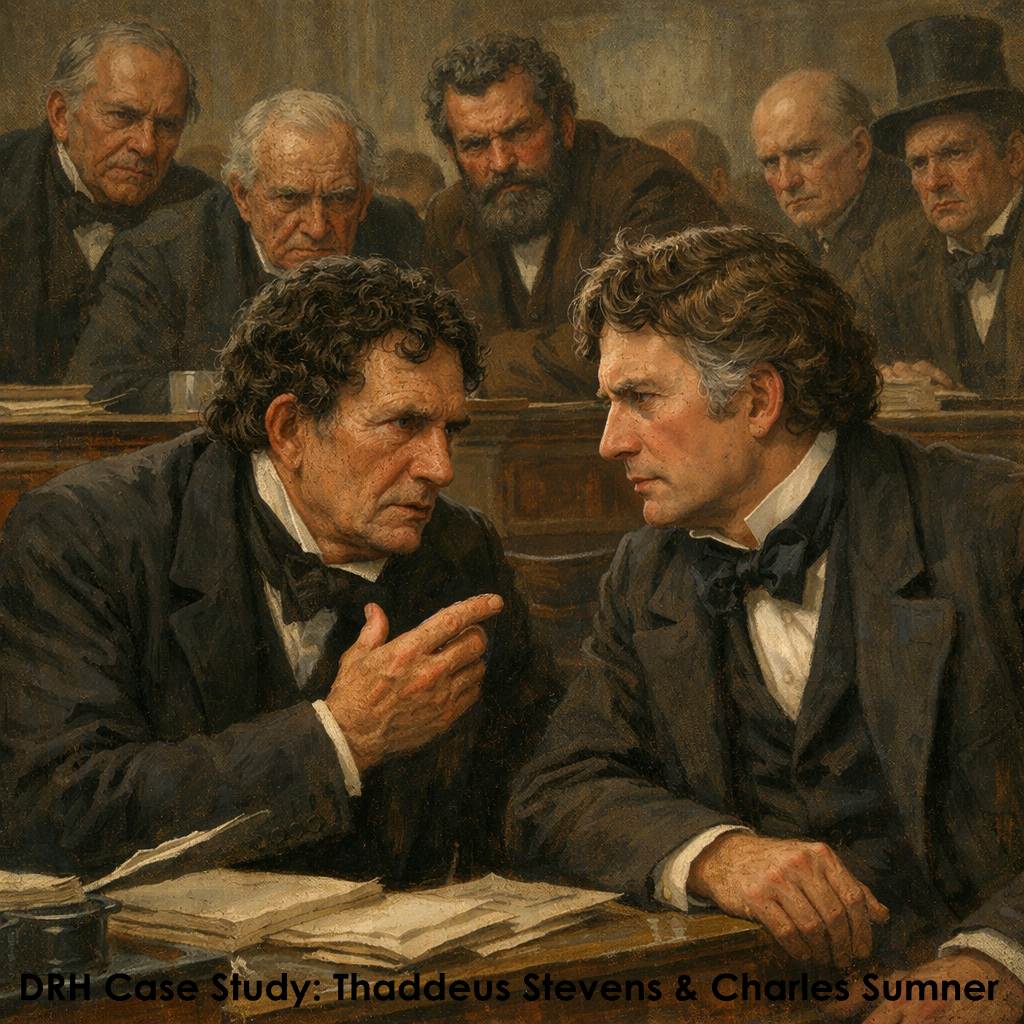
Thaddeus Stevens (1792–1868)
1. Early Formation of the Deindividuation Resister
Stevens' DRH profile begins early. Born into poverty, physically disabled (clubfoot), and raised by a single mother, he grew up structurally excluded from dominant social hierarchies. According to the DRH, such exclusion can foster either compliance (through over-adaptation) or resistance (through moral self-definition). Stevens clearly followed the latter path.
Instead of internalising shame or seeking acceptance, he developed:
• a hostility toward inherited privilege,
• a deep scepticism of social authority, and
• an identification with the structurally oppressed rather than the socially powerful.
These traits became permanent features of his political psychology.
2. Resistance to Group Moral Drift
Stevens is a textbook example of a DRH agent resisting normative deindividuation within his own in-group.
Although a Republican leader, he routinely:
• attacked moderates in his party,
• rejected 'reconciliation' rhetoric after the Civil War,
• insisted on racial equality as a non-negotiable moral principle, not a tactical aim.
Where many Republicans succumbed to collective fatigue - the desire to 'move on' after the war - Stevens refused to dilute his moral position for social harmony.
In DRH terms: Stevens did not experience moral judgment as a social process but as an individual obligation, insulated against peer pressure.
3. Radical Consistency and Social Cost
Stevens' proposals - land redistribution to freed slaves, permanent disenfranchisement of Confederate elites, constitutional equality - were not merely unpopular; they were politically dangerous.
Yet he persisted, even when:
• caricatured as vindictive,
• sidelined in negotiations,
• warned his positions would fracture the party.
This aligns with the DRH observation that deindividuation resisters often appear 'extreme' or 'unreasonable' precisely because they refuse to apply social discounting to ethical imperatives.
4. Private Life and Moral Independence
Stevens' unconventional private life - including his long, discreet relationship with Lydia Smith - further supports a DRH reading. He showed little concern for:
• social respectability,
• performative morality,
• conformity to elite norms.
His ethics were principled but not puritanical, suggesting internal coherence rather than rule-based conformity.
Charles Sumner (1811–1874)
1. Intellectual Individualism as Resistance
Sumner's DRH trajectory differs from Stevens' in origin but not outcome. Raised in a relatively privileged, intellectual environment, Sumner internalised:
• Enlightenment universalism,
• legal absolutism,
• moral cosmopolitanism.
Unlike many elites, however, he did not use abstraction to soften moral demands. Instead, he applied principles with rigorous literalism, refusing to adjust them to political convenience.
In DRH terms, Sumner's resistance stemmed from cognitive moral rigidity, not emotional antagonism.
2. Refusal of Strategic Silence
Sumner repeatedly violated one of politics' strongest deindividuating norms: strategic restraint.
He:
• publicly denounced slavery as a moral crime,
• named individuals rather than systems,
• rejected euphemism and incrementalism.
The infamous Crime Against Kansas speech exemplifies DRH behaviour: Sumner chose truth-expression over self-preservation, triggering violent retaliation (the near-fatal caning on the Senate floor).
3. Trauma Without Moral Retreat
After the assault, Sumner endured years of chronic pain and psychological trauma. A DRH-conforming pattern could be:
• withdrawal,
• ideological moderation,
• alignment with protective coalitions.
Sumner did none of these.
Instead, he:
• returned to the Senate unchanged in conviction,
• intensified his moral absolutism,
• remained politically isolated even among allies.
This reflects a key DRH feature: Trauma does not necessarily produce compliance; in some individuals, it hardens resistance.
4. Isolation and Misreading by Contemporaries
Sumner was often described as arrogant, self-righteous, or socially obtuse. From a DRH perspective, this is a common misinterpretation of deindividuation resistance:
• he did not lack empathy,
• he lacked tolerance for moral compromise.
Where others weighed consequences, Sumner weighed truth-value.
Both figures illustrate that DRH is not a personality type but a moral processing style:
• Stevens channelled resistance through strategic aggression.
• Sumner channelled it through uncompromising articulation.
DRH Implications
Stevens and Sumner exemplify why societies often:
• celebrate deindividuation resisters retrospectively,
• marginalise them in real time.
Their lives demonstrate your broader DRH thesis: the central conflict in moral history is not good versus evil, but individual judgment versus collective pressure.
Both men refused the psychological relief of moral outsourcing. In doing so, they advanced justice - and paid for it in loneliness, hostility, and suffering.