
John Lennon (1940–1980) was a singer-songwriter, cultural icon, and founding member of The Beatles, whose life and work reflected a persistent struggle between individual identity and social pressures. Using the Neurological Spectrum Model (NSM) and the Deindividuation Resister Hypothesis (DRH) as our lens, we can interpret Lennon's journey as that of a person who largely resisted social conditioning and retained a strong individual identity. The NSM posits that human behaviour lies on a spectrum between the Individual (someone who acts on personal judgment and remains true to self) and the Social Person (someone who absorbs group expectations and conforms completely). In Lennon's case, many of his traits - his rebellious wit, creative daring, disdain for authority, and outspoken quest for truth - place him on the individual end of this neurological spectrum. Throughout his life, Lennon often defied social norms and group identities in favour of his own values, and in doing so he became both a visionary artist and a lightning rod for controversy. This comprehensive biography examines John Lennon's life through the DRH lens, highlighting how his experiences and evolving behaviour illustrate the tension between individual authenticity and societal conformity. We will explore all major phases of Lennon's life - from his troubled youth and Beatlemania fame to his political activism, personal struggles, and legacy - emphasizing those traits and decisions that the DRH and neurological spectrum model explain particularly well. Psychological insights will be incorporated where relevant (grounded in known facts), to enrich our understanding of Lennon's character development. Early Life and Formative Years (1940–1956) John Winston Lennon was born in wartime England on October 9, 1940, in Liverpool. His early life was marked by instability and the fostering of an independent streak that would later define him. John's father, Alf Lennon, was a merchant seaman often away from home; his mother, Julia, faced difficulties raising him and ultimately entrusted his care to her elder sister, Mimi Smith. Thus, from the age of five, John was raised by his Aunt Mimi and Uncle George in a middle-class household at 251 Menlove Avenue (a house aptly named 'Mendips'). Aunt Mimi provided John with a stable environment and traditional values, but she was also strict and cautious. She famously disapproved of John's obsession with music, often telling him, 'The guitar's all very well, John, but you'll never make a living out of it'. This oft-quoted admonition did little to deter John's passion. In fact, John's early defiance of Mimi's expectations can be seen as one of his first acts of resisting social conditioning: rather than abandoning music for a conventional career, he doubled down on it, thereby asserting his individual identity over family pressure. Against the wishes of his aunt (his legal guardian at the time), who frequently told him he'd never make a living with music, young Lennon accepted a low-paying gig for his band in Hamburg – a bold move that set him on the path to stardom. Such resolve at a young age exemplifies what the DRH calls a deindividuation resister - someone who stays true to personal vision despite discouragement from their immediate social group.
Lennon remained close with his mother Julia during childhood, visiting her often even while living with Aunt Mimi. Julia was more supportive of John's musical inclinations: she taught him to play basic banjo chords and shared with him a love of American rock'n' roll records. Tragically, John's world was upended in July 1958 when Julia was struck by a car and killed. Seventeen-year-old John was devastated by the loss of his mother, an emotional trauma that would haunt him for years. Biographers and psychologists alike have noted that this loss contributed to Lennon's rebellious demeanour and deep-seated abandonment issues. The DRH framework might interpret John's reaction as that of an individual-minded youth under stress: rather than seeking consolation in social acceptance, John increasingly turned inward, channelling pain into art and erecting a tough, cynical exterior to protect his authentic self. Indeed, in later songs such as Mother (1970), Lennon gave voice to the lingering grief and anger from Julia's death, wailing 'Mother, you had me, but I never had you' - a raw expression of a wounded individual who refused to simply “move on” as society might expect.
At school, John quickly gained a reputation as an unruly but gifted child. He had a quick wit, a tendency toward sarcasm, and little respect for authority figures who he felt didn't merit it. Classmates from Quarry Bank High School remember him as the class clown and a troublemaker who nonetheless had leadership charisma. Paul McCartney, who would later become Lennon's songwriting partner, recalled: 'We all looked up to John. He was older and he was very much the leader – he was the quickest wit and the smartest'. This natural confidence and wit helped Lennon form a tight-knit group of friends who shared his love of the new rock'n' roll music coming from America. In 1956, inspired by Elvis Presley and skiffle king Lonnie Donegan, 15-year-old John started his own band, The Quarrymen, named after his school. Here again we see the individual at work: John wasn't content to just listen to music; he had to create his own, recruiting peers and even younger kids (like Paul, whom he met in 1957) based on their talent rather than their social standing. This openness to collaboration across age or social lines reflects what the neurological spectrum model calls the inclusive attitude of an individual-oriented person, one who 'approaches everybody else as an equal individual' and 'appreciates differences'. John's partnership with Paul McCartney blossomed quickly after they met at a church fete in July 1957, illustrating Lennon's ability to recognize a kindred spirit despite Paul being two years younger. Soon after, George Harrison (even younger, at 14) joined on lead guitar at Paul's insistence, and by 1960 the band - after cycling through names - settled on The Beatles.
Academically, Lennon's disdain for authority translated into poor performance. He was a 'dreamer' and a prankster in class, more interested in drawing cartoons and writing funny poems than in doing homework. Not surprisingly, he failed all his GCE O-level exams (standardized tests in the UK). Only through the intervention of an enlightened headmaster was John admitted to the Liverpool College of Art for higher studies. Art school proved only a marginally better fit for his restless spirit. While he enjoyed art and honed his skills in sketching grotesque, witty illustrations (some of which would later appear in his books In His Own Write and A Spaniard in the Works), he still balked at structured instruction. Lennon cut a distinct figure at art college - dressed in a Teddy-boy style, with a rebellious glint in his eye - often skipping classes and openly criticizing teachers. He became known for his biting humour; friends would gather just to hear John satirically riff on everything from religion to politics, foreshadowing the outspokenness that would later spark worldwide debates. Ultimately, Lennon dropped out of art college in 1959 before his final year, fully dedicating himself to music. This decision to abandon the conventional educational path in favour of an uncertain artistic pursuit was bold, especially in a working-class context. It illustrates a key DRH concept: remaining true to one's individual passion despite societal expectations (in this case, the expectation to finish school and get a 'proper' job). By refusing to conform to the safe route, John was effectively placing a bet on his own creative vision and 'thinking for himself', a hallmark of those on the individual end of the neurological spectrum.
During these Liverpool years, Lennon's individualism sometimes manifested as anti-social behaviour. He could be aggressive and engage in petty delinquency—traits that might be seen as paradoxical in someone who later became a peace icon. However, understanding John's psychology in context, these outbursts were partly the product of a troubled youth lashing out. For example, at age 18, in a drunken rage at a party, John viciously attacked his friend Bob Wooler for insinuating John had a homosexual relationship with Brian Epstein (the Beatles' manager) - an incident that left Wooler with broken ribs. Lennon later deeply regretted this violent overreaction, and it serves as a reminder that retaining one's individuality is not always positive if it means rejecting all social norms of behaviour. In DRH terms, John had not yet learned to direct his non-conformity constructively; he was an individual in raw form – unwilling to be told how to behave – but he lacked maturity to temper his impulses. Notably, John himself recognized the darkness within him and how it contrasted with his later message of love and peace. In a 1980 interview, reflecting on his younger days, he admitted: 'I used to be cruel to my woman, and physically – any woman. I was a hitter. I fought men and I hit women. It is the most violent people who go for love and peace… everything's the opposite”. This stark confession shows Lennon's self-awareness that his crusade for peace was, in part, a reaction against his own violent tendencies. It also underscores an insight within the neurological spectrum model: individuals who resist social conditioning aren't saints; they have flaws and conflicts, but they at least confront them on their own terms rather than hiding behind socially approved facades.
In summary, John Lennon's early years set the stage for a life marked by individualist rebellion. He emerged from childhood with a strong sense of self (nurtured by love for music and art) and a scepticism toward authority (fuelled by personal loss and a strict upbringing). By the time the Beatles embarked for Hamburg in 1960 - John just 19 years old - he had already demonstrated the DRH dynamic in action: a young man willing to risk alienation (from family and teachers) in order to stay true to his authentic interests. Little did anyone know that this very authenticity, this refusal to 'just follow orders' or expectations, would soon help Lennon and his band change the world.
Rise of The Beatles and the Challenge of Fame (1960–1966)
The Beatles' formative years (1960–1962) tested Lennon's ability to maintain his individuality while striving for commercial success. After honing their craft during long nightclub residencies in Hamburg (where the band learned endurance and showmanship amidst a wild environment of sex, drugs, and rock 'n' roll), the Beatles returned to Liverpool and caught the eye of manager Brian Epstein in late 1961. Epstein, a sophisticated local record store owner, loved their music but not their scruffy image. He proposed they swap leather jackets and jeans for matching suits and ties on stage. This famous transformation in early 1962 - from rowdy leather-clad rockers to clean-cut, 'lovable' mop-tops - was perhaps Lennon's first serious encounter with social conformity in his career. Remarkably, John agreed to Epstein's wardrobe and etiquette changes despite his own reservations about 'acting respectable'. Why? Likely because he calculated that playing the game a little could advance their larger goal of sharing their music (their true message) with the world. In DRH terms, Lennon made a pragmatic compromise: he adopted a temporary collective identity (the tidy Beatle in a suit) for the sake of the band's unity and success, yet he did so with a sense of irony and maintained his personal edge through humour. On stage and in press interviews, the early Beatles may have looked identical, but John's sharp tongue always stood out. He would slyly subvert interview questions with irreverent answers, poking fun at the press even as he smiled charmingly. For instance, when asked 'How did you find America?' during a 1964 press conference, John quipped, 'Turned left at Greenland.' Such quips were Lennon's way of infusing individuality into a highly packaged group identity.
By 1963-1964, Beatlemania was in full swing. The Beatles became a global phenomenon, with John as one of the chief songwriters and co-lead vocalist. The collective identity around the band grew to immense proportions: they were seen as the Four Fab British lads who could do no wrong, idolized by millions of young fans. This massive public adoration was a double-edged sword. On one hand, it validated Lennon's creative work; on the other, it threatened to subsume his identity. The DRH framework suggests that a person like John - innately an individual type - would chafe under being pigeonholed as just 'one of the Beatles'. Indeed, as early as 1964, John exhibited signs of discomfort with the squeaky-clean image. He wrote the book In His Own Write (a collection of absurdist poems and stories) which revealed a darker, satirical humour quite unlike the cheerful 'yeah yeah yeah' Beatle persona. The book's success showed that Lennon had a voice beyond the band, and he enjoyed that. Individual expression was a psychological need for him.
During the touring years, incidents occurred that highlighted Lennon's instinct to push back against group expectations. A famous example came on the 1964 U.S. tour when the Beatles were expected to attend a high-society ball and meet the British Ambassador. Bored and irritated by the pomp, John openly mocked the event. At one point he even spat (allegedly on a group of snooty attendees below a balcony) and made sarcastic remarks, shocking the establishment. Though such behaviour was risky, it was John's authentic self peeking through the PR veneer – he simply couldn't play along with hypocrisy for long. This echoes the NSM: 'The Individual says what they mean and what they know to be true', whereas 'The Social Person says what is expected of them'. Lennon, even at the height of Beatlemania, found it hard to just say what was expected; he preferred to voice his genuine feelings, even if they were controversial or impolite.
The ultimate controversy of Lennon's Beatle years came in 1966 with his now-infamous remark that The Beatles were 'more popular than Jesus'. The comment itself was part of a thoughtful conversation John had with journalist Maureen Cleave of the Evening Standard in March 1966, where he discussed religion and the changing interests of youth. John observed (with no small concern) that Christianity's influence on young people was waning, saying 'Christianity will go. It will vanish and shrink… We're more popular than Jesus now. I don't know which will go first - rock 'n' roll or Christianity'. In context, this was not a boast, but rather Lennon's cynical commentary on religion's decline and pop culture's dominance. However, when these words were republished in the American teen magazine Datebook that summer (just as The Beatles were touring the USA), they ignited a firestorm. In the American South and other Bible Belt areas, many took Lennon's quote as blasphemy. Radio DJs organized public burnings of Beatles records; conservative Christians lambasted Lennon for implying The Beatles were greater than Jesus. The backlash was intense, and there were even death threats. Here was a stark clash between individual expression and collective identity: John's personal remark about religion collided with the deeply held collective religious identity of many Americans. According to the DRH, when someone challenges a core collective belief (in this case, religious reverence), the group often reacts with hostility and tries to punish or 'cancel' the offender. Lennon experienced exactly that.
In an extraordinary move for someone who normally 'didn't accept authority over him', John decided to apologize publicly - not because he had changed his mind, but because he did not want to further fuel hatred. As he later explained, 'I'm not anti-God or anti-Christ… I'm sorry I said it really. I never meant it as a lousy anti-religious thing. I was just saying what I observed'. He clarified that if he had said television was more popular than Jesus, it probably would have passed unnoticed. This incident is revealing on multiple levels. Psychologically, it shows Lennon's capacity for humility and concern: he was genuinely disturbed that his words might have 'created another piece of hate in the world', prompting him to make amends. In DRH terms, though John briefly bowed to public pressure by apologizing, he did so in order to restore peace rather than to save face or conform. In fact, apologizing to an angry majority itself took a kind of courage - it was an appeal to reason and understanding, rather than a grovelling surrender. This desire to reduce conflict and promote understanding is consistent with an individual-oriented morality: The Individual cares about the well-being of others regardless of group differences. John didn't want Christian fans (or former fans) to hate him or the band; he'd rather build bridges, even as he maintained his right to speak his mind in the future.
The 'bigger than Jesus' episode also had a lasting effect on the Beatles. It hastened the band's decision to stop touring altogether. By late 1966, exhausted by constant public scrutiny, controversy, and the inability to even hear themselves play over screaming fans, the Beatles retired from live concerts. This allowed Lennon and the others to focus on studio work and personal growth out of the direct glare of Beatlemania. In a sense, this retreat was John reclaiming his individual space. No longer would he be merely 'Beatle John' performing the expected hits; in the studio (with groundbreaking albums like Revolver and Sgt. Pepper's), he could explore experimental ideas and introspective themes that were truer to his evolving self. Songs Lennon wrote during this period often defied conventions: the droning, one-chord mantra of Tomorrow Never Knows (1966) introduced psychedelic philosophy to pop; Strawberry Fields Forever (1967) was a dreamlike ode to his childhood memories, complex and personal; and All You Need Is Love (1967) became an anthem for the counterculture, reflecting John's idealistic belief in global unity through love, a belief that would only grow stronger in him. Notably, All You Need Is Love also subtly exemplified Lennon's flair for 'saying what he means' - its simple lyric belied a sophisticated musical structure and even included a snatch of the French national anthem, as if to say love transcends national identities.
By the mid-1960s, John Lennon was thus juggling a public collective role (as a Beatle, beloved by a mass audience that imposed certain expectations) and a private individual awakening (as an artist and thinker pushing against boundaries). It was a delicate balancing act, and ultimately the pull of individuality grew stronger. A key catalyst in tipping this balance was about to enter his life: a person who would encourage John to break free from many of the remaining conventions he still adhered to and to fully embrace his identity outside the Beatles.
John and Yoko: Love, Art, and Rebellion (1967–1969)
In November 1966, John Lennon attended a London avant-garde art exhibit by a Japanese conceptual artist named Yoko Ono. Their meeting at the Indica Gallery was, in John's telling, almost mystical. Ono's interactive art (he famously climbed a ladder to peek through a magnifying glass at a tiny word “YES” on the ceiling) intrigued him. Here was a woman who was independent, bold, and completely uninterested in Beatle fame - essentially, another individual spirit. They began an intense relationship in 1968, while John was still married to his first wife, Cynthia. This period was tumultuous: John's choice to be with Yoko challenged multiple collective norms at once - marital, cultural, and even within the close-knit Beatles group.
From a DRH perspective, Lennon's partnership with Yoko Ono is a remarkable example of an individual following personal truth over collective pressure. Many in John's circle (including bandmates and fans) disapproved of Yoko at first. She was an unfamiliar presence in the insular world of The Beatles - an older woman, of a different race and nationality, with an avant-garde artist's sensibility that clashed with rock'n' roll machismo. By aligning himself with Yoko, John broke the unwritten rules that a pop star should date conventionally attractive, deferential women or keep his love life separate from his work. Instead, John brought Yoko into the studio and into his creative process, despite the visible discomfort it caused in George, Paul, and others. The British press was often cruel to Ono, reflecting xenophobia and sexism, labelling her a witch or dragon lady who 'ensnared' John. But John refused to bow to these social pressures. He saw Yoko as his equal and collaborator. In 1969, he even appended 'Ono' to his own name, becoming John Ono Lennon as a declaration of their union. This act symbolized that he now identified not with the traditional male-dominated paradigms (where the wife subsumes her identity) but with a new concept of partnership - one that was '50-50', as John described it, completely individual to them and not bound by society's expectations.
Yoko Ono's influence on Lennon was profound. She is often credited with expanding John's political and artistic horizons, and John himself acknowledged this. He noted that Yoko, having had to fight her way as a woman in a male-dominated art world, was 'full of revolutionary zeal' when they met. She awakened in him a deeper awareness of issues like women's liberation, racism, war, and the superficiality of celebrity. John's previously latent progressive ideals now bloomed. In the NDS' terms, Yoko likely helped John move further toward the individual end - caring about global issues and oppressed groups, and questioning all forms of social dogma. John and Yoko quickly became partners in provocative art projects designed to make people think independently. One famous example is their series of Bagism events, where they gave interviews from inside a bag to satirize stereotyping (the idea being that if the interviewers couldn't see them, they'd have to focus on the words, not the appearance). It was absurdist and playful, yet carried a message about looking beyond labels - a very Individual vs. Collective message.
In March 1969, John and Yoko married in Gibraltar and staged their now-iconic Bed-Ins for Peace. Instead of a traditional honeymoon, the couple turned their hotel bedrooms (first in Amsterdam, later in Montreal) into public peace protests. They invited the press to observe them sitting in bed singing about peace and discussing an end to the Vietnam War. The Bed-Ins were performance art meets activism - ridiculed by some as naive or attention-seeking, but undeniably effective at generating discussion. It was during the Montreal Bed-In that Lennon wrote and recorded the anthem Give Peace a Chance (July 1969), essentially capturing the ethos of the counterculture in a simple chorus chanted by a roomful of friends and journalists. Here, Lennon fully embraced the role of social resister on the world stage: leveraging his celebrity (a product of collective adulation) to urge individuals everywhere to question the violent norms of their governments and to envision a more peaceful, authentic existence. In doing so, he was living out the DRH principle that 'human progress is driven by people who resist social conditioning and dare to speak out'. Many of his conservative Beatles-era fans were bewildered by this turn toward overt political statements, but Lennon did not flinch. As he and Yoko put up billboard posters in major cities proclaiming 'War is Over! (If You Want It)' during Christmas 1969, they were making a bold collective appeal - yet the appeal was for the individual awakening of each person to choose peace over conformity to war.
Meanwhile, the Beatles were disintegrating. The band's final album, Abbey Road, was recorded in mid-1969 amid tension. Lennon's mind and heart were clearly elsewhere. In September 1969, he privately informed his bandmates that he was leaving the Beatles. This decision, kept secret from the public for several months, was momentous: John was effectively renouncing the biggest collective identity he had been part of (the Fab Four) because it no longer aligned with his individual growth. He later said that by then, 'the Beatles were over, but John, Paul, George, and Ringo go on' - a nod to the fact that each of them were people beyond the band. When Paul McCartney pre-emptively announced his own departure in April 1970 (to promote his solo album), John was annoyed only that 'He gets all the credit for it [splitting the band]!', since John felt he had made the decision first. Regardless, the breakup became public and many fans were distraught, even angry at John (and Yoko, whom they scapegoated) for the end of the Beatles. From a DRH viewpoint, this was a classic scenario: the collective (Beatles fandom, and even British national pride - as the band were MBEs and national heroes) was upset at an individual's choice to break the mould. Lennon knew the cost, but proceeded anyway, believing that staying in the Beatles would have meant artistic stagnation and personal dishonesty. In one of his solo songs, God (1970), he would pointedly sing, 'I don't believe in Beatles… I just believe in me. Yoko and me. And that's reality.' This lyric was a clear rejection of collective idolatry - including the cult that had formed around his own band - in favour of personal reality and love. For someone who had once been the chief Beatle leading the world in song, it was a daring repudiation. But it accorded perfectly with the NSM's Individual ethos: the courage to say the uncomfortable truth as one sees it, regardless of the group's sentiment.
As the 1960s closed, John Lennon was effectively reborn as an individual artist-activist. Together with Yoko, he dived into experimental music and radical politics, distancing himself from the lovable moptop image. They released a trio of avant-garde albums (Unfinished Music No.1: Two Virgins, No.2: Life with the Lions, and Wedding Album), which mostly baffled both critics and fans. The cover of Two Virgins featured John and Yoko completely nude, an aggressive challenge to prudish norms that caused scandal. Record stores refused to stock it; newspapers were aghast. Yet John defended the cover as “art” and an expression of truth – 'just two slightly overweight ex-junkies' (as he later joked, acknowledging both their nude bodies and their recent heroin use). This was Lennon's anti-conformist art at an extreme: he was willing to face ostracisation and pathologisation (in line with DRH's observation of what happens to nonconformists) in order to 'be naked' literally and metaphorically before the world. It's worth noting that John and Yoko did struggle with a heroin addiction around 1969, a dark episode stemming from stress and perhaps the overwhelming pressure of their activism and media glare. They eventually got clean by the early 1970s, but John's willingness to later speak about his drug problems with frankness was yet another instance of honest individual self-disclosure over any attempt to maintain a polished image.
In 1969, Lennon's transformation from pop star to political provocateur was cemented by his symbolic gestures of renouncing establishment honours. Most famously, in November 1969 he returned his MBE medal to the Queen in protest. Back in 1965, the Beatles had been awarded the Member of the Order of the British Empire, a recognition from the Crown of their cultural contributions. At the time John went along with it, though he reportedly had misgivings (later noting he only accepted because Epstein encouraged it and it pleased his Aunt Mimi). But as the Vietnam War and other global conflicts raged, John's conscience gnawed at him. He wrote a letter to Her Majesty that read: 'Your Majesty, I am returning this MBE as a protest against Britain's involvement in the Nigeria-Biafra thing, against our support of America in Vietnam, and against Cold Turkey slipping down the charts.'. This letter - equal parts serious political statement and cheeky humour (mentioning his latest single's chart position) - exemplifies Lennon's blend of individual moral stance and wit. By handing back a medal that millions coveted, he demonstrated true nonconformity. British society at large was stunned; many veterans returned their own medals in solidarity or in anger. But John's point was made: he would not be a pawn of the establishment or a token Beatle-turned-'Sir'. In DRH terms, this was the act of a resister unwilling to be co-opted by collective symbols of power. Instead, he used the act to spotlight injustices (the Biafra civil war in Nigeria, the Vietnam War) that mainstream Britain was largely ignoring. A BBC interview at the time noted Lennon had been mulling the return for two years, prompted especially by the U.S. Army's My Lai Massacre in Vietnam. The NSM suggests that while Social Persons might revel in honours and fall in line behind national policies, Individuals like Lennon see beyond the prestige to the moral reality, and they do not hesitate to break ranks when their conscience demands. Indeed, as the DRH claims, 'when they deemed it necessary, [resisters] refused to conform and comply in the face of ostracisation, discrimination, persecution…' because they knew it was right. John's return of the MBE was precisely that sort of principled refusal to comply, made despite knowing it could make him unpopular in certain quarters.
By the end of the 1960s, John Lennon had thus consciously shed many layers of imposed identity. He was no longer 'Beatle John' or a British knight-in-the-making; he was, for better or worse, John Lennon - artist, activist, and iconoclast. He still had legions of fans, but many were puzzled by or resistant to his new direction. As Ludwig writes, 'Millions of fans much preferred the younger, chauvinistic John Lennon', the upbeat rocker of earlier years. Now Lennon spoke of peace, feminism, revolution, and he appeared besotted with an avant-garde woman who was nothing like the pop star wives or groupies people imagined. But John was undeterred by the criticism. He understood that progress often alienates the mainstream at first, and he was prepared to be labelled crazy or traitorous if that was the price of speaking his mind. 'If more children were allowed to retain their individual identities, this world could become a much better place', the DRH asserts. In a way, John was trying to model exactly that - retaining (or rather, reclaiming) his individual identity after years of being moulded into a teen idol, and using it to try to make the world better.
Radical Activism and Adversity in America (1970–1974)
In 1970, with The Beatles officially over, John Lennon embarked on a solo career that would be deeply intertwined with his personal and political convictions. The early 1970s proved to be Lennon's most activist period, but also one filled with adversity as he confronted the forces of social and political conformity on a grand scale. Nowhere was this more evident than in the United States, where Lennon and Ono moved and became entangled in battles with the Nixon Administration. Through it all, Lennon's guiding principle remained to 'think for [himself]' and 'stand up for what [he] believe[s] is right and just, regardless of affiliation', as the NSM's description of an Individual says.
John and Yoko settled in New York City in 1971, drawn by its vibrant art scene and the relative anonymity the city offered. Here Lennon found kindred spirits among the American anti-war movement and counterculture revolutionaries. He befriended figures like Abbie Hoffman, Jerry Rubin, and Bobby Seale; he performed at rallies and benefits for causes ranging from ending the Vietnam War to freeing prisoners (such as John Sinclair, a hippie jailed for a minor marijuana offense). In some respects, Lennon was adopting certain collective identities - e.g. 'anti-war activist' or 'countercultural leader'. However, unlike a typical joiner, John did not simply follow a party line. He brought his own style and perspective to each cause, sometimes frustrating his more doctrinaire activist friends. For instance, while radicals urged violent revolution, John insisted on nonviolent protest and art as activism (echoing his Give Peace a Chance ethos). He and Yoko believed change should come through awakening people's consciousness, not through bloodshed. This stance put him at odds with both the far-left (who thought him naive) and the right-wing establishment (who thought him dangerously subversive). It illustrates a crucial point in DRH: even when an individual aligns with a movement, they tend to do so on their own terms and often serve as a moderating or independent voice rather than a blindly loyal foot soldier.
Lennon's outspokenness soon attracted the ire of the U.S. government. By 1972, President Richard Nixon's administration was actively plotting to silence or deport John Lennon. The context was Nixon's re-election campaign and the ongoing Vietnam War. Lennon had been using his music and platform to urge young Americans to vote against Nixon and demand peace. Songs like Power to the People and the album Some Time in New York City (1972) explicitly addressed topics like women's rights (Woman is the Nigger of the World was Lennon's shocking-titled feminist anthem), the Attica prison rebellion, and the Vietnam conflict. The FBI put Lennon under surveillance, and the White House moved to deport him on a technicality - a 1968 conviction in London for marijuana possession. Officially, the U.S. Immigration and Naturalization Service (INS) claimed John's visa was invalid due to that drug record. But internal memos (later revealed) showed the true motive was political: as one government memo warned, Lennon might 'combine rock music with politics' and organize the youth vote against Nixon. This scenario was a literal embodiment of the DRH theme of the establishment vs. the resister. Lennon was a high-profile example of someone at odds with the prevailing power structure, and the collective machinery of state power mobilized to neutralize him.
Thus began John and Yoko's long immigration battle (1972–1975). The couple received a deportation order in 1972, and for the next several years their lives were consumed by legal appeals and uncertainty. Lennon did not back down or agree to moderate himself in exchange for leniency; instead, he fought the case vigorously, turning it into a free speech cause. He gathered an extraordinary array of support from cultural and political figures. Letters poured into the INS from famous authors, musicians, and thinkers arguing that John Lennon was a valuable voice America should cherish, not expel. (Notably, even mainstream figures like TV host Mike Douglas and New York Mayor John Lindsay supported Lennon's right to stay.) One letter from folksinger Joan Baez lectured the government that 'keeping people confined to certain areas of the world' only perpetuates war - a very DRH-like statement emphasizing how arbitrary national boundaries feed conflict. The support campaign highlighted an interesting dynamic: while Lennon the individual stood nearly alone against the U.S. government, he inspired a network of more moderate allies who used their influence to help him. This mirrors the DRH observation that 'resisters rely on mainstream helpers who have connections', since those at the extreme collective end (e.g. Nixon and his base) will never support progress, but more moderate people can be swayed to assist. In Lennon's case, artists who weren't as radical as he was still felt compelled to defend him as a matter of principle. Even the composer Leonard Bernstein wrote to the INS praising Lennon's cultural contributions, and novelist John Updike (hardly a hippie) said John and Yoko 'might do the country some good' if allowed to stay. This coalition bore fruit: in a landmark 1975 court decision, a judge finally reversed Lennon's deportation order, granting him the right to remain in America as a permanent resident. The victory was not just personal but also set legal precedents, limiting the government's ability to deport immigrants for ideological reasons in the future. John's persistence in asserting his individual rights against the most powerful collective (the U.S. government) underscores his fearless identity. As he wryly said during the struggle, 'Time wounds all heels' - trusting that truth would outlast the oppressors.
While the legal battle raged, Lennon's personal life went through major swings between 1972 and 1974. The same intensity that fuelled his activism also took a toll on his marriage to Yoko and on his own mental health. By mid-1973, John and Yoko's relationship had become strained (partly due to the stress of the deportation case and perhaps John's continued restlessness). In an unconventional arrangement, Yoko suggested that John take a temporary separation in Los Angeles with their assistant, May Pang, as his companion, hoping time apart would heal their marriage. Lennon embarked on what he later called his Lost Weekend, an 18-month period of heavy drinking, partying, and productive but chaotic musical work in LA and New York. This era (1973–74) saw Lennon at some of his most unhinged and vulnerable, revealing that even a staunch individualist can lose his way. Separated from Yoko - who had become a stabilizing, guiding force for him - John reverted at times to adolescent rock-star excess. He ran with singer Harry Nilsson and former Beatle Ringo Starr in notorious escapades: they were ejected from clubs (one famous incident had a drunken John wearing a sanitary pad on his forehead and heckling the Smothers Brothers, leading to a brawl and his ejection from the Troubadour club). He also got into a public scuffle with a young musician at the Troubadour, showing that the old quick-tempered Lennon was not entirely tamed.
Yet, even in this reckless phase, John's core good nature and wit often shone through. He produced two musically strong albums (Mind Games in 1973 and Walls and Bridges in 1974) and amazingly scored his first #1 U.S. single, Whatever Gets You Thru the Night, during this period. Moreover, Lennon's sense of fairness and nonviolence wasn't lost: he took up causes like co-hosting The Mike Douglas Show in 1972 for a week, where he invited anti-war activists and performed songs of peace, trying to communicate to Middle America in an accessible way. And in one legendary episode during the Lost Weekend, John Lennon demonstrated a remarkable moment of conflict de-escalation that has since become rock'n' roll lore – the Jerry Lee Lewis incident.
In 1974, at the height of Lennon's drinking spree in Los Angeles, he attended a concert by rock pioneer Jerry Lee Lewis at the Roxy. Lennon's presence in the audience unintentionally stole focus; fans began gawking at him instead of Jerry Lee. The mercurial Lewis, feeling upstaged, grew furious. He halted the show to rant that 'The Beatles were shit' and boasted that only he could play real rock'n' roll. A tipsy Lennon good-naturedly egged him on from the balcony, shouting in a mock southern drawl, 'Yeah, you're right, man, The Beatles are shit!' The crowd laughed, but Jerry Lee misunderstood Lennon's tone and believed John was heckling him. Enraged, Lewis stormed off stage. Backstage, the atmosphere was tense; Jerry Lee Lewis was known to carry guns and everyone feared violence. A friend of Lennon's, musician Rory Gallagher (who had played with Lewis), went to try calming “The Killer” down, bringing along his burly roadie for protection.
What happened next is a story that highlights Lennon's quick thinking, humility, and peacemaking instinct - qualities not often attributed to his wild LA period. Unable to resist witnessing the backstage drama, Lennon soon walked into Jerry Lee's dressing room himself. In the room were Jerry Lee (still fuming), Rory, and Rory's massive bodyguard Tom. Upon seeing Lennon, Jerry Lee likely bristled, but before any reaction, something unexpected occurred: Tom, the bodyguard and an avid Beatles fan, dropped to his knees, took John's hand, and exclaimed, “I've been waiting 20 years to get the autograph of the king of rock'n' roll!”. It was a gesture of pure fan reverence - but unfortunately one that further infuriated Jerry Lee Lewis. To Lewis, it was as if even here, Lennon was being hailed and Jerry Lee was being insulted (since he fancied himself the king of rock). Lewis reached for what he thought was a gun in his boot (it wasn't there) and started looking around for something to throw. In that charged moment, John Lennon swiftly took control. Realizing Jerry Lee's wounded pride was the issue, John borrowed Tom's pen and paper, and he turned the tables: Lennon approached Jerry Lee Lewis, knelt in front of him, kissed Jerry Lee's hand, and said, 'I've been waiting twenty years to get the autograph of the king of real rock'n' roll.'. This completely disarmed Jerry Lee. The older rocker broke into a delighted smile, helped John up, and cheerfully signed an autograph for him. The room's tension evaporated instantly; laughter and conversation followed, with Jerry Lee and John chatting amiably as if nothing had happened. Rory Gallagher, who witnessed it all, described it as 'a wonderful moment'. This anecdote, recounted in a 1995 Hot Press article titled “Ancestor Worship,” is more than just a rockstar footnote. It reveals Lennon's character in action: faced with a volatile situation, he used empathy, humour, and a touch of theatricality to de-escalate it. Instead of matching Jerry Lee's aggression or letting his own ego get involved (after all, John could have been indignant at the insults), Lennon instinctively saw that Jerry Lee needed respect and validation. So John gave it to him - humbling himself with a playful gesture that acknowledged Lewis' status. This is classic conflict resolution by an individual thinker: not following the typical alpha-male script of confrontation, but laterally thinking of a solution that restores peace and even camaraderie. In DRH terms, Lennon was refusing to engage in a collective identity shouting contest (60s rock vs 50s rock, who's greater?) and instead treated Jerry Lee as an individual who deserved appreciation. He diffused 'us vs. them' with a moment of human-to-human recognition. One might even say Lennon acted out the Golden Rule that the individual end of the spectrum tends to live by - treating others as equals, with care for their feelings - even if that meant subverting conventional status hierarchies. This quick thinking prevented potential violence (especially crucial given Lewis' armed reputation) and turned a near-disaster into a bonding experience. Such stories burnish Lennon's legacy as not just a great artist but a person capable of extraordinary grace under pressure.
By late 1974, Lennon's “Lost Weekend” was winding down. Fittingly, it ended on a high note both personally and professionally. In November 1974, at a Madison Square Garden concert by Elton John, John Lennon made a surprise guest appearance - it would end up being his last major concert performance. He sang Whatever Gets You Thru the Night (a song Elton had contributed to in the studio) and a couple of Beatles classics, and the crowd roared with approval. Backstage that night, Yoko Ono - who had also attended - reunited with John. The separation was over; they reconciled fully, and John left the wild LA days behind to return to Yoko in New York.
Reflecting on the 1970–1974 period, one sees a man who pushed the limits of dissent in the public arena and learned some hard personal lessons. Lennon had confronted one of the mightiest collectives (the U.S. government) and prevailed, thanks to perseverance and public support. He had championed unpopular causes (like calling for women's equality and peace in a time of war fervour), aligning with what DRH calls 'progressives, artists, and human rights activists' on the individual end of the spectrum. Yet, he also grappled with his own demons of anger and addiction, proving that resisting society's currents doesn't mean one is free of inner currents that can pull one under. What stands out is that Lennon owned up to his failings and changes. He didn't hide the fact that he'd been a jealous partner or an absent father or a drunk; he aired these truths in songs and interviews, effectively integrating his identity. In doing so, he rejected the collective notion that celebrities must maintain a flawless façade. Instead, he lived the more authentic, if messier, path of 'saying what is true' and accepting personal responsibility, another Individual trait. This honesty would pay dividends as he moved into the next chapter of his life, one focused on family and personal contentment.
House-Husband and Father: A New Identity (1975–1980)
On October 9, 1975—John's 35th birthday—Yoko Ono gave birth to their son, Sean Ono Lennon. The arrival of Sean marked a profound turning point in John Lennon's life. Having reconciled with Yoko and finally won his battle for U.S. residency (granted in 1975 after years of court fights), John made a decision that shocked many: he stepped back from the music business entirely to become a stay-at-home father. For roughly five years, from 1975 through 1980, John Lennon released no new music and lived quietly out of the public eye, focusing on domestic life in New York's Dakota Building where they resided.
To understand how radical this choice was, one must recall that Lennon was one of the most famous musicians on the planet, with an enormous fan base hungry for his work. Rock stars of that era simply did not 'retire' in their mid-thirties to bake bread and change diapers. In fact, the collective expectation was that rock icons burn out or fade away on stage, not voluntarily quit at their peak. Yet here was John Lennon, a man who had always zigged when others zagged, doing perhaps his most unexpected non-conformist act: devoting himself to fatherhood and domesticity, roles traditionally and socially undervalued for men, especially ;macho' rock'n' rollers. Many of his fans (and indeed his industry peers) were bewildered or even disappointed. As noted earlier, some of the public preferred the 'younger chauvinistic John' and could not reconcile this new image of Lennon as a content homemaker. But John did not mind. By this stage, he had little interest in chasing others' approval. He had achieved worldly success and found it wanting in some respects. Now he sought something more private and, to him, more meaningful: raising a child with love, something he felt he hadn't properly done with his first son Julian.
This choice can be seen as the culmination of Lennon's individual journey. The NSM emphasizes that an Individual 'considers their children individuals in their own right and assists their development by encouraging their interests and individual expression'. John's approach to Sean was very much in that spirit. He doted on the boy, reportedly spending hours reading stories, drawing whimsical sketches for him, and instilling a sense of creativity from the start. He famously learned how to make bread and became an avid cook - a far cry from the hedonistic rocker image - because he wanted Sean to have home-cooked meals. In interviews years later, Yoko attested that John truly embraced the role of house-husband, taking care of the household while she managed business affairs. Some sceptics at the time wondered if John had lost his muse or become lazy, but his personal communications suggest otherwise: he was simply at peace focusing on a small circle (Yoko and Sean) after years of needing the world's attention.
From a psychological perspective, this period allowed Lennon to heal and reflect. He had been through a whirlwind since adolescence; now he experienced everyday life's simple rhythms without public performance. It's likely he was also motivated by a desire to avoid repeating the mistakes of his past. With Julian Lennon (his son from his first marriage, born 1963), John had been largely absent during the Beatles years and then had a bitter divorce from Julian's mother Cynthia. He later expressed deep regret about not being there for Julian's childhood. 'He was 17 and I hadn't spent time with him…', John lamented in one of his last interviews. Thus, with Sean, John saw a chance at redemption - to be the father he wished he'd had and the father he failed to be the first time. This aligns with the DRH notion of personal responsibility and growth: unlike a social person who might repeat cycles or blame others, the individual is more apt to learn from past errors and consciously change behaviour. Indeed, John's evolution from a self-absorbed young rock star into a mature, nurturing father figure is a testament to his capacity for change and self-determination. He chose to prioritize love and care in a very intimate context, even if society found that unexciting.
During these house-husband years, Lennon kept a relatively low profile. Occasionally, he would appear at events (like a brief guest performance on stage with Elton John in 1975 just before Sean's birth, as mentioned, or visiting an old friend). But by and large, he did not grant interviews or release music. He was often spotted strolling in Central Park with Sean, blending into city life as just another dad at the playground. It's endearing to imagine the author of Imagine quietly pushing a stroller by the Dakota, no entourage, no fanfare. One could argue this was Lennon at his most liberated - he had stepped off the carousel of fame, defying the unspoken rule that famous people must constantly remain in the limelight or maximize their career output. As Yoko later described, John was 'baking bread and looking after the baby' while occasionally strumming a guitar at home, creating music purely for personal enjoyment.
Of course, an artist like Lennon couldn't stay completely away from songwriting. He did write a few songs during this period; he just didn't rush to publish them. In 1977, sailing on a small boat to Bermuda (one of his solo adventures during a short break from full-time parenting), Lennon had a creative burst, writing several new songs inspired by his contentment and also by some ongoing world concerns. By 1980, as Sean grew a little older (age 4–5), John felt ready to re-engage with his music professionally. Re-energized and carrying a batch of new songs, he and Yoko decided to collaborate on a comeback album. This would become Double Fantasy, named after a flower John saw in Bermuda that symbolized their 'double' life (man and woman, husband and wife, mother and father, artist couple). The project was a true partnership: half the songs were John's, half Yoko's, reflecting their equality. In the summer of 1980, John, now 39, entered the recording studio again. He was jovial, by all accounts, during those sessions - perhaps a bit nervous if the public would welcome him back, but confident in the strength of his material which spoke honestly about love, marriage, and family.
When Double Fantasy was released in November 1980, the initial critical reception was mixed (some didn't know what to make of John's domestically-themed songs and Yoko's avant-garde tracks interwoven). However, tracks like (Just Like) Starting Over, a retro-styled love song, and Watching the Wheels, where John addresses those puzzled by his house-husband phase ('People say I'm crazy doing what I'm doing… I just had to let it go'), quickly gained admiration. In Watching the Wheels, Lennon good-naturedly explains that stepping off the merry-go-round of fame was a conscious choice for his sanity and he's happier for it - a direct rebuttal to those who pressured him to act as the perpetual celebrity. Another song, Beautiful Boy (Darling Boy), is a tender lullaby to Sean, in which John whispers words of encouragement and famously assures, 'Before you go to sleep, say a little prayer / Every day in every way, it's getting better and better'. The optimism and contentment radiating from these songs showed a transformed Lennon. The angry young man was largely at peace, advocating love on a very personal scale. One could say John had integrated the individual caring and loving side of his nature (which the neurological spectrum associates with individuals who 'care about the wellbeing of others, regardless of differences') and had let go of the more destructive rebelliousness (yet without compromising his authentic self).
> Tragically, this peaceful chapter was cut short. On the night of December 8, 1980, just three weeks after Double Fantasy's release, John Lennon was assassinated. As John and Yoko returned home to the Dakota from a recording session, a deranged fan named Mark David Chapman shot John four times at the entrance of his residence. Chapman had been a Beatles fan who became obsessed with John, but also angered by what he perceived as Lennon's 'hypocrisy' (Chapman cited, for example, the lyric 'imagine no possessions' versus Lennon's wealthy lifestyle - a misunderstanding of John's message, which was an aspirational vision, not a claim he was perfect). There was also evidence Chapman's fundamentalist Christian upbringing made him condemn Lennon for the 1966 'Jesus' remark - a chilling illustration of how collective fanaticism can fuel violence against an individual who voiced a dissenting view many years prior. In any case, Chapman's act was one of senseless hate, the very antithesis of everything John Lennon had come to stand for. It was as if the 'raging mainstream' (to use a DRH phrase) struck down one of the resisters it could not convert.
The world mourned John Lennon in an unprecedented outpouring of grief. He was pronounced dead on arrival at Roosevelt Hospital at 11:15 pm on December 8, 1980. He was 40 years old. Yoko Ono, in shock and sorrow, made the decision not to hold a funeral, stating, 'John loved and prayed for the human race. Please pray the same for him'. In the days following, tens of thousands gathered in Central Park and around the globe in vigils, singing Give Peace a Chance and Imagine. It was a remarkable collective tribute to a man who had, throughout his life, championed individual expression and peace even when met with ridicule or anger. The irony was not lost that a man who preached nonviolence was felled by violence - a cruel reminder of the work still to be done in the world he envisioned.
Legacy and Reflections Through the DRH Lens
John Lennon's legacy is immense and multifaceted: he left behind an unparalleled catalogue of music with the Beatles and as a solo artist, he inspired generations with his messages of peace and love, and he remains a symbol of the 1960s counterculture and the universal human yearning for a better world. Analyzing his life through the Deindividuation Resister Hypothesis and the neurological spectrum model provides a unifying thread to many of these facets. Lennon exemplified, in many ways, the archetype of the Individual in opposition to pressures to de-individualize. His story illustrates how a person can 'retain their individual identity despite the repercussions' and how doing so can lead to both creative brilliance and personal trials.
Let's highlight some key traits and behaviours of Lennon that DRH/the neurological spectrum explain well:
Nonconformity and Independent Thought: From his schoolboy days mocking authority, to his refusal to keep quiet about controversial opinions (religion, Vietnam, etc.), Lennon consistently acted from his own convictions rather than toeing any party line. He once quipped, 'You don't have to be a dissenter to disagree' - encapsulating that he wasn't rebelling for rebellion's sake, but because he genuinely saw things differently. This aligns with the DRH notion that some people have a resistance to social conditioning that allows them to see through mass consensus and speak their truth. Lennon's sharp critiques of nationalism ('Imagine there's no countries… nothing to kill or die for'), organized religion ('Imagine no religion too'), and warfare were ahead of their time in mainstream discourse, showing an ability to think and create beyond society's comfort zone.
Courage to Challenge Group Norms: Lennon not only held independent opinions, he often acted on them in very public ways. Whether it was returning the MBE medal, staging peace bed-ins, or taking on the Nixon Administration, he showed remarkable courage in standing up to large institutions and popular sentiments. The NSM suggests Individuals 'don't accept authority based on hierarchy' and 'don't just follow orders or the crowd'. John embodied this: he questioned unjust authority (e.g., calling out Nixon and Vietnam) and refused to follow the crowd when the crowd was in the wrong (e.g., distancing himself from America's prevalent anti-communist, pro-war fever of the early '70s). His opposition to the Vietnam War, at a time when it could earn one the label of 'unpatriotic', demonstrates the moral conviction typical of a deindividuation resister.
Embracing Outsiders and Diversity: A striking aspect of Lennon's life is how he increasingly embraced those who were different or marginalized. He fell in love with Yoko Ono, a divorced older Asian woman in an era when interracial marriages were still stigmatized - and he did so openly and proudly. He welcomed avant-garde artists, radical activists, and even people like street musicians or fringe personalities into his circle, judging them by personal connection rather than social class or image. This reflects the Individual's tendency to 'approach everybody else as an equal individual - no less and no more… appreciating differences'. Lennon's collaborations ranged from working with the extremely experimental Yoko to jamming with rock 'n' roll founder Chuck Berry on TV, to singing with a Harlem church choir on Angel Baby. He was eclectic in his associations, unhampered by the us-versus-them mentality that often constrains those on the collective end of the spectrum.
Accountability and Self-Reflection: One might not initially associate accountability with the rebellious John Lennon, but as he matured, he demonstrated an increasing willingness to own up to his actions and change himself. The neurological spectrum notes that the Individual 'accepts responsibility for their own actions' while the deindividuated person shirks it. We see John practicing this in how he publicly acknowledged his past failings (his violence and absenteeism as a husband/father, for instance) and took concrete steps to make amends – such as devoting himself to raising Sean differently. His music also became more of an honest mirror: songs like Jealous Guy were apologies in melody, and Watching the Wheels explains his life choices candidly to listeners without defensiveness. This level of introspection and forthrightness in a global celebrity was unusual and arguably part of what makes people still find him authentic and relatable.
Creative Innovation and Intellectual Freedom: As an artist, Lennon's refusal to be pigeonholed led to constant innovation. From the Beatles' pop to psychedelia to raw confessional songs and political sloganeering, he never wanted to stagnate or repeat formulas. This ties to the idea that individuals 'welcome progress… and think for themselves'. John was always experimenting - writing songs in new structures, using avant-garde techniques (like tape loops in Revolution 9 or the primal scream vocals in Mother). He wasn't afraid of alienating fans if the art felt true (the Some Time in New York City album's agit-prop style is a case in point; it was panned, but John defended its honesty). His intellectual curiosity had him reading everything from the Tibetan Book of the Dead (inspiring Tomorrow Never Knows) to sociopolitical literature. He evolved from a guy who once casually made ignorant remarks (like the young John's quip about women 'being foreign if they're ugly' in the 1966 Cleave interview) to a man deeply concerned with feminist theory and racial equality (co-writing Woman is the Nigger of the World with Yoko to critique sexism, and carefully consulting black activists to ensure the message was understood). This intellectual and creative growth is symptomatic of a mind not trapped by dogma - Lennon was willing to learn and shift perspective (e.g., his journey from chauvinism to feminism), something people high in individual identity do when presented with new insight, rather than clinging stubbornly to tribe or ego.
Resistance and the Consequences: The DRH also highlights that society often ostracizes or pathologises those who resist deindividuation. Lennon experienced plenty of backlash: the U.S. government's attempt to deport him, the British tabloids' relentless attack on him and Yoko, being labelled 'the nasty Beatle' for his acerbic manner, and even death threats throughout his career. He was called unpatriotic, blasphemous, a troublemaker. Yet, as the DRH would predict, these pressures did not break his spirit or force him to conform. If anything, they reinforced his resolve that he was doing something significant. The love-hate relationship he had with the public (idolized by some, vilified by others) comes with the territory of being a social resister. Lennon once said, not arrogantly but matter-of-factly, 'You have to be put on a cross before you're appreciated'. He recognized the pattern that many innovators or truth-tellers are attacked in their time and celebrated later. Indeed, after his death, even former critics acknowledged his impact. Today, events like Liverpool's airport being named John Lennon Airport with the slogan 'Above us only sky' (a line from Imagine) illustrate how mainstream society eventually embraced the once-radical messages of Lennon. This is reminiscent of the DRH's insight that what starts as fringe (individual-led progress) can become the new norm once enough people catch on – Lennon helped move the cultural needle on peace, on how celebrities engage politically, on the role of artists as activists.
In conclusion, John Lennon's life can be seen as a case study in the power and challenges of maintaining one's individual identity amid intense social currents. He started as a working-class Liverpudlian with humour and talent, resisted pressures to 'know his place', and dared to dream of global change driven by art and love. He achieved more than anyone could have imagined, yet never lost a certain scepticism about the very fame he attained. He used his platform to question and provoke, not to reinforce the status quo. In doing so, he inspired millions to think differently - whether that was through a simple lyric or a grand gesture of protest.
John's journey also shows that being an Individual in the DRH sense is not about being perfect or always righteous; it's about authenticity and growth. Lennon was open about his imperfections and evolved significantly over time. This humanises the concept of the deindividuation resister: such people are often 'troublemakers… not listening to adults', as a teacher said of climate activist Greta Thunberg (as quoted in the DRH), or 'insane' in the eyes of the last-men-type conformists Nietzsche described. Lennon certainly was called all that and more. But decades later, he is widely revered as a visionary. His concept of 'Imagine all the people sharing all the world' endures as a utopian ideal for humanity, reflecting the same optimistic humanism that DRH champions - a world where we shed the divisive collective identities of religion, nationality, etc., and unite in peace and mutual respect.
Yoko Ono once described John as 'a very progressive thinker, even if he didn't use that word' - he was always a few steps ahead, challenging friends and society to catch up. The Deindividuation Resister Hypothesis would agree, seeing Lennon as someone who exceeded the level of individuality society was comfortable with, and who therefore met resistance - but who also, by virtue of that, drove progress. 'It's our failure to conform… it's our failure to accept the status quo that have driven human progress', as the DRH says, and in John Lennon's 40 short years, we find ample evidence of this truth. He failed spectacularly to conform, and as a result, he and his music changed the world.
In the end, John Lennon's biography through this lens is more than the story of one man - it's an illustration of a fundamental tension in human society between the individual and the group. Lennon summed up this tension brilliantly in one of his last interviews, saying, 'You have to give them facts, not theories. You have to be them, but a bit ahead'. He understood he was part of society ('one of us') yet also striving to lead it forward by example ('a bit ahead'). His life's arc - from rebellious youth to cultural revolutionary to devoted father and contented man - demonstrates that maintaining one's individual spirit is not only possible but can leave a legacy that educates and elevates the collective in the long run. John Lennon's story, viewed through the DRH and NSM framework, thus stands as a testament to the necessity of autism (in the metaphorical sense Lennon embodied an 'excess of individuality' by societal standards) for human progress. It reminds us that those who imagine a better way, who refuse to dim their inner light to match the crowd, are the ones who light the path for everyone else.
Sources:
• Beatles Bible - John Lennon biography
• The Deindividuation Resister Hypothesis - by Frank L. Ludwig
• The Neurological Spectrum: Between Individual and Collective Identity – by Frank L. Ludwig
• Hot Press (July 1995) - Rory Gallagher recounting Lennon & Jerry Lee Lewis incident
• Los Angeles Times - John Lennon and Yoko Ono's deportation battle
• Wildes & Weinberg Law - John Lennon's Deportation Order Reversed
• Playboy Interview with John Lennon (1980)
• Evening Standard (Maureen Cleave, 1966)
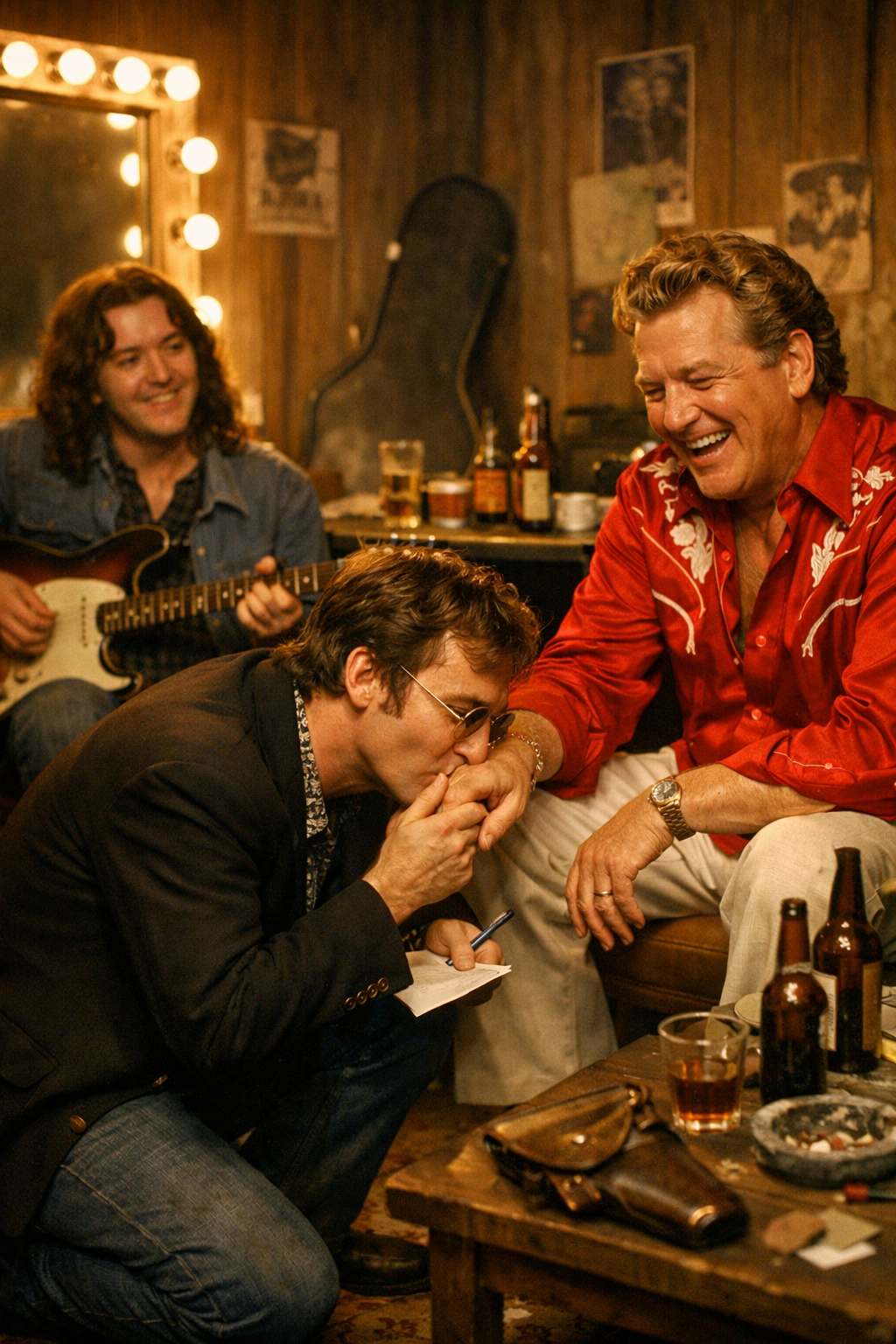
Rory Gallagher watches John Lennon kiss Jerry Lee Lewis' hand