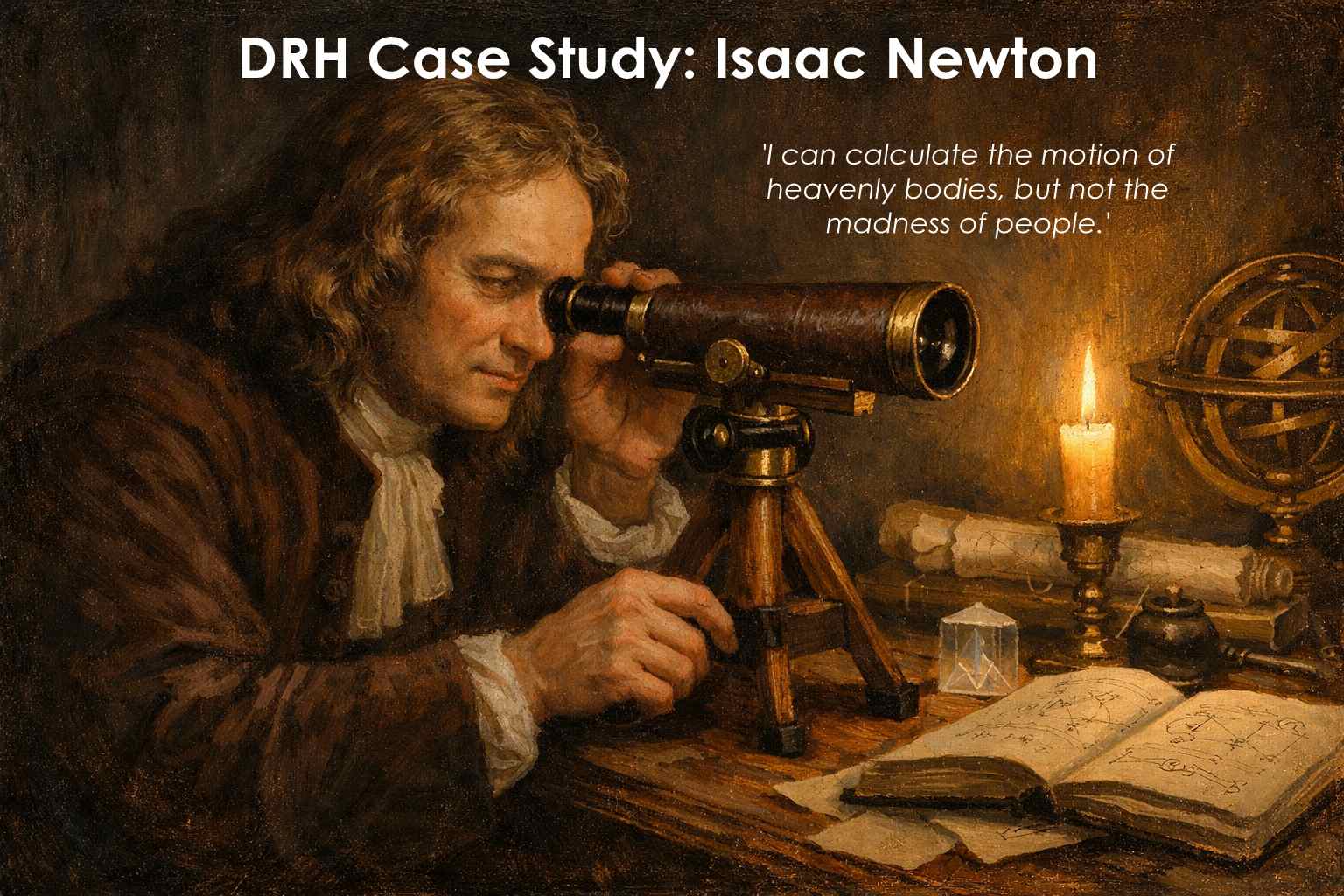
Isaac Newton: A Case Study in Individual Resistance
Isaac Newton was born on January 4, 1643 (Gregorian calendar) in Woolsthorpe, England. His father died before his birth and, as Britannica notes, Newton was tiny and weak at birth. By age three he had been placed in his grandmother's care while his mother remarried, a separation that lasted years. This uncommon childhood of parental loss and early displacement - being raised apart from his mother - may have fostered his independent outlook. From the start he was scarcely social: contemporary accounts say he 'was not expected to survive' infancy and grew up 'far ahead of the children in his country district' in mechanical skill. In 1655 he finally entered the King's School at Grantham, and in 1661 began at Trinity College, Cambridge. There he studied the standard curriculum but soon explored modern thinkers like Descartes and Hobbes. Indeed, during the 1665–66 Great Plague, when Cambridge closed, Newton returned home and in isolation began formulating his key theories - inventing calculus and studying light and motion while sitting under the apple tree. These early experiences - separation, solitary study, creative exploration away from authority - align with the Deindividuation Resister Hypothesis (DRH) premise that innate individuality can flourish when freed from social conformity.
Education and Early Career
At Cambridge, Newton excelled beyond the classics. He built the first working reflecting telescope in 1668 and received his Bachelor's and Master's degrees by 1669, also being named Lucasian Professor of Mathematics. Demonstrating his commitment to original inquiry, he joined the Royal Society in 1672 and presented his groundbreaking optical experiments there. Newton showed that white sunlight is a mixture of colours, proposing a particle theory of light. His findings provoked a sharp critique from Robert Hooke - a dispute that escalated into a bitter controversy. The History Channel notes that Newton engaged in heated correspondence with Hooke over optics, and that this conflict contributed to a nervous breakdown and his temporary withdrawal from public life in 1678. Despite the turmoil, Newton's academic path illustrates his resistance to external authority: he ignored prevailing scholastic norms and pursued self-directed study (even scribbling mathematical questions in his notebook titled Quaestiones Quaedam Philosophicae at age 21). This behaviour - privileging personal curiosity over convention - exemplifies the NSM's 'individual' orientation, much as DRH suggests that Newton's unique identity was preserved while many peers conformed to collective expectations.
Personality and Social Relations
Contemporaries consistently described Newton as intensely introverted and privately irascible. He was 'deeply insecure, given to fits of depression and outbursts of violent temper, and implacable in pursuit of anyone by whom he felt threatened,' according to modern biographers. Even as a youth 'he was never known…to play with the boys abroad,' and as an adult he formed few close friendships. One biographer recalled Newton was 'singularly unable to form intimate friendships' and 'morbidly suspicious and secretive,' prone to sudden rage even at friends. Newton himself admitted to writing only in code about trivial 'sins,' indicating a fiercely private nature. He routinely shunned social norms: at Cambridge he 'very rarely went to dine in the college hall,' dressing slovenly (shoes untied, hair uncombed) when he did. He even made his Principia intentionally abstruse - preferring dense math that would 'put off the uninitiated' - rather than explain himself more accessibly. In short, Newton's reclusive, individualistic temperament - often battling authorities like Hooke, Flamsteed and later Leibniz - fits the profile of an NSM 'individual' type. As Ioan James notes, figures on the autistic spectrum (to whom the NSM alludes) 'go their own way' with intense focus. Indeed, Newton's solitary dedication parallels later descriptions of Albert Einstein, who famously said 'I'm not much with people'; he 'freed himself…to become entirely self-sufficient'. Like Einstein (and others cited in DRH theory), Newton deliberately minimised social entanglements to maximise his independent creative work.
Scientific Achievements
Newton's creative independence yielded epochal contributions. He reinvented calculus (calling his method 'fluxions'), deriving it during his isolated mid-1660s studies. His 1687 Philosophić Naturalis Principia Mathematica (Principia) laid out the three laws of motion and universal gravitation - laws so powerful that Principia is still hailed as the foundation of modern physics. For example, Newton showed that every object stays in uniform motion unless acted on (Law 1), that force equals mass times acceleration (Law 2: F=ma), and that every action has an equal and opposite reaction (Law 3). These laws united celestial and terrestrial mechanics under a single framework, confirming heliocentrism by explaining planetary orbits. Newton's achievements in optics were equally groundbreaking: he demonstrated that white light splits into a spectrum by refraction and that light behaves as particles. His work provoked peers' scepticism (Hooke vs. Newton) but ultimately led to the publication of Opticks in 1704. His ingenuity extended to astronomy (inventing the reflecting telescope in 1668) and beyond - the techniques he developed established 'the scientific method' for subsequent thinkers. In all these endeavours, Newton resisted intellectual dogma: he tested prevailing ideas against experiment and reshaped them (e.g. discarding Descartes' vortex theory of planets). This independent experimentation exemplifies a deindividuation resister's impact on progress. (His name remains attached to the gravitational constant g and the Euler–Newton binomial theorem, among others.)
Religious Beliefs and Theology
Outside science, Newton's convictions also defied authority. A devout reader of scripture, he spent decades studying Biblical prophecy, chronology and theology. Importantly, he rejected the Trinity, a stance far from orthodox in his time. As historian Thomas Pfizenmaier notes, 'Very early in life Newton abandoned orthodox belief in the Trinity,' coming to view Christianity through a strictly Judaic monotheist lens. He concluded that the established doctrine of three coeternal persons was a later corruption, insisting 'the revealed God was one God'. In other words, Newton's spirituality followed his scientific pattern: he questioned received dogma and drew his own conclusions. He wrote at least a million words on theology, compiled chronologies of ancient empires and investigated alchemy as a spiritual symbolism. (Though these pursuits were secret in his lifetime, they were published posthumously.) Newton's faith can thus be seen as another frontier where he preserved his individual identity against prevailing currents - a classic DRH signature. In Ludwig's terms, Newton resisted the social-conditioning of religious orthodoxy, maintaining his unique interpretations of scripture even under the shadow of persecution.
Public Service and Later Years
Newton's individuality even coloured his public roles. He was an active Protestant who opposed King James II's attempts to reintroduce Catholicism in 1687, and in 1689 he was elected to represent Cambridge in the new Parliament. In 1696 he was appointed Warden of the Royal Mint, and by 1699 Master of the Mint. He threw himself into reforming England's currency, famously changing the pound from silver to gold and vigorously prosecuting counterfeiters to stabilise the economy. These tasks drew on his analytical mind, but he never became a courtier or nobleman; he declined higher office when offered and did not marry (lacking any conventional family life). In 1703, upon Robert Hooke's death, Newton became President of the Royal Society - a largely honorary role at this stage - and in 1704 published Opticks, his second magnum opus summarising years of optical experiments. Queen Anne knighted him in 1705. Even in office, Newton kept to his own path: for example, he poured over complex alchemical and chronological manuscripts privately, eschewing the usual social aspects of learned societies.
In his final decades Newton retreated almost completely from public view. Having never married, he lived near London with his niece, drawing a comfortable retirement. He suffered bouts of depression and even a psychotic episode in 1693 (likely aggravated by mercury from alchemical work), but ultimately recovered. He continued writing on mathematics and theology until his death on March 31, 1727, at age 84, and was buried with great honour in Westminster Abbey. By then he had become 'a giant among the brilliant minds of the Scientific Revolution,' revolutionising humanity's understanding of the natural world.
Newton and the DRH/NSM Frameworks
Viewed through Ludwig's Deindividuation Resister Hypothesis, Newton stands out as a prime example of an individual who resisted collective conditioning. The DRH holds that nearly all people gradually yield to social identity, but progress is driven by those rare individuals who do not. Newton consistently refused to conform: he broke from his Puritan upbringing only insofar as it fostered his piety, then adopted beliefs (like Arianism) that set him apart. He ignored academic conventions, often publishing scant details so that only a few could follow, rather than popularising his work. Even his personal manner - secretive, distrustful of crowds - kept his private identity intact. In doing so he bore the DRH 'cost': many contemporaries thought him eccentric or unstable (for instance, locking horns with other scholars and even accusing friends of betrayal). Yet this very aloofness may have been why he could see connections others missed. On Ludwig's Neurological Spectrum Model, Newton maps to the Individual end: akin to autistic figures who show intense focus and low conformity. Indeed, as one biography noted, Newton shared traits with autistic geniuses: he was 'singularly unable to form intimate friendships' and 'had not within himself the resource… to inculcate [social] motives,' a disposition apparently innate. In contrast, the Collective pole would include minds more anchored in group identity.
In sum, Newton's life exemplifies the DRH/NSM profile of the brilliant outlier. He resisted the prevailing dogmas of both church and college, maintained fiercely independent habits, and produced pioneering ideas largely in seclusion. His breakthroughs in science and mathematics emerged not from collaboration or conformity, but from solitary genius.
Comparative Perspectives
Newton's pattern of individualism is echoed in other historical figures cited by DRH theory. For example, Beethoven likewise 'rejected authority and convention' in music, composing as an iconoclast rather than following courtly expectations. Albert Einstein - whose relativity theory later superseded Newton's physics - similarly displayed a 'difficulty of making friends' and a decision early on to be 'an entirely separate entity' free from societal influence. Like Newton, Einstein avoided rigid formalism and challenged established ideas (he quipped that logic could not constrain human imagination). Figures such as Mahatma Gandhi or Martin Luther King Jr (not scientists, but intellectual resisters) also kept personal principles above group pressure. In each case, the DRH/NSM view highlights how resistance to social pressure and adherence to individual vision can correlate with world-changing contributions.
Newton's achievements and traits thus align with those of other celebrated individualists. His legacy shows that retentive individuality - even at personal cost - can drive transformational ideas. In the DRH/NSM framework, Newton is as archetypal as any figure of the Enlightenment: he pushed human knowledge forward not by blending in, but by staunchly being himself.
Sources:
The above biography incorporates factual details about Newton's life and work from authoritative historical sources, along with interpretive commentary framed by the Deindividuation Resister Hypothesis and related literature on individual genius.