Part 1: The Child Who Could Not Look Away
1. Introduction: The Uncompromising Gaze
When Greta Thunberg first captured international attention by sitting alone outside the Swedish parliament in August 2018, her act was often described as 'bold' or 'courageous'. But through the lens of the Neurological Spectrum Model (NSM) and the Deindividuation Resister Hypothesis (DRH), it was something deeper: an authentic moral reaction from a mind situated at the Individual end of the neurological spectrum - a person whose identity had not fused with the social conventions of the group. From early childhood, Greta's behaviours showed a striking resistance to social assimilation and a consistent alignment with direct perception, moral coherence, and autonomy - hallmarks of a Deindividuation Resister.
2. Family and Cultural Context: A Stage Already Lit
Born in Stockholm on January 3, 2003, Greta Tintin Eleonora Ernman Thunberg entered a world of performance and public scrutiny. Her mother, Malena Ernman, was a celebrated opera singer who represented Sweden in Eurovision 2009, and her father, Svante Thunberg, was an actor turned producer. She is also descended from Svante Arrhenius, a Nobel Prize–winning chemist and one of the first scientists to explore the greenhouse effect.
Her early environment was paradoxically both nurturing and pressurised - imbued with artistic expression, discipline, and exposure to audiences. This context fostered a tension between Greta's need for truth and the performative demands of social life. Her NSM orientation would become apparent in how she related - or refused to relate - to these demands.
3. Early Traits of an Individual
Greta's early childhood was, by her own account, marked by hypersensitivity, intensity, and extreme focus - features often mischaracterised by clinical psychiatry but which, under DRH, indicate a refusal to conform to imposed filters. She described becoming 'very quiet' and struggling with school interactions. Her inability to accept the world's contradictions, especially moral ones, manifested early - particularly regarding animal welfare and climate change. These reactions weren't passing emotions. They were visceral, immobilising insights. When she first learned about climate change in school around age 8, she reportedly couldn't understand why adults weren't treating it like an emergency. She stopped eating, spoke very little, and fell into selective mutism, later diagnosed as part of her broader neurological profile.
Here we see a classic DRH response: her cognitive dissonance was not neutralised through social absorption. Instead, it paralyzed her. She did not repress her horror to preserve group belonging - she acted on it, even if at great psychological cost.
4. Diagnosis: Autism, Selective Mutism, and the Medicalisation of Divergence
At age 11, Greta was diagnosed with Asperger syndrome, obsessive-compulsive disorder (OCD), and selective mutism. Mainstream interpretations treated these as deficits or pathologies. But according to the DRH, this diagnosis represents something more politically loaded: the medicalisation of social noncompliance. Greta was not failing to adapt to group norms; she was actively resisting them.
• Her selective mutism was not silence from incapacity but silence from moral protest.
• Her 'obsessions' were not irrational fixations but acts of radical moral focus.
• Her 'rigid thinking' was actually moral consistency - a refusal to lie to herself in the face of collective denial.
This distinction is essential. Greta later reframed her condition in her own words: 'Being different is a gift. I see the world differently, I sense things differently. I don't fall for lies as easily as others.' That is the language of the individual.
5. Family Response: Navigating the Social vs the Individual
Her parents, especially her mother, initially tried to shield Greta from climate content, fearing it would worsen her mental health. But this impulse - to spare the child while maintaining social norms - was ultimately reversed. Greta's insistence changed them. As Malena recounts in their co-written book Scenes from the Heart, Greta's integrity slowly transformed their own lifestyle: they stopped flying, adopted veganism, and made their public lives part of Greta's truth.
Under the NSM, this reversal reflects how a strong individual can actually reshape the social persons around them - not by authority or charisma, but through moral congruence. Greta was not 'influential' in the conventional sense. She was simply right, and her refusal to budge compelled reflection from those around her.
7. The Individual Takes Shape
By age 15, Greta was not a polished speaker or a trained activist. She was a singular voice formed by the friction between inner truth and outer hypocrisy. Her neurological divergence, far from a hindrance, allowed her to stand outside of mass rationalisations. Greta was, in the full DRH sense, a resister - not in opposition to others, but in opposition to the collective denial others had learned to accept.
In NSM terms, she had not absorbed the expectations of society and school. She had instead remained fundamentally individual - witnessing, thinking, and judging based on her own observations, not the script handed to her. In a world where most children are socialised into silence and conformity, Greta's refusal was radical. And it would soon erupt into public action.
Part 2: The School Strike - When the Individual Refuses to Wait
1. A Small Sign with Global Consequences
In August 2018, at the age of 15, Greta Thunberg sat alone outside the Swedish Parliament with a handmade sign: 'Skolstrejk fφr klimatet' (School strike for climate). Her action was radical not for its scale, but for its refusal to compromise. She was not negotiating, campaigning, or protesting in the familiar ways. She was withdrawing - refusing to participate in a system she judged immoral.
This aligns precisely with the Deindividuation Resister Hypothesis: Greta did not lose herself in the roles of student, child, or citizen. Instead, she suspended those roles entirely to act from individual conscience. She was not demanding permission. She was declaring a truth.
In terms of the Neurological Spectrum, Greta's action represents a move from the inner Individual pole to a publicly individual stance - carrying her non-assimilated identity into the collective domain.
Though Greta began striking alone outside the Swedish Parliament in August 2018, her protest quickly drew the attention of local journalists and passersby. Her hand-painted sign and unwavering presence sparked online discussion, and photos of the solitary teenager - sitting cross-legged with schoolbooks beside her - circulated rapidly. What stood out was not spectacle but consistency: she returned each Friday, regardless of weather or media presence. Her Instagram posts, written in a factual, almost austere tone, began reaching climate-concerned communities worldwide. Within months, other students in Europe, Australia, and North America began replicating her tactic, forming decentralised protest groups under the name Fridays for Future. In true DRH fashion, her act was not designed to organise others - it was designed to remain true to reality. But that very refusal to recruit or persuade paradoxically gave others permission to act from their own conscience, catalysing a movement that now spans more than 150 countries.
2. Non-Participation as Ethical Clarity
Greta's school strike wasn't a tantrum or a disruption. It was a logical moral consequence. The Swedish government, like most others, had endorsed the Paris Agreement and committed to climate targets, yet continued subsidising fossil fuel projects. Greta understood the contradiction. Most adults around her understood it too - but accepted it. She didn't.
'Why should I be studying for a future that soon may not exist, when no one is doing anything to save that future?' - Greta Thunberg, 2018
This reasoning is emblematic of NSM-defined Individuality
• She did not measure her actions by social approval.
• She applied logical and moral consistency across domains.
• She expected adults to be accountable to their own words, not to uphold the appearance of responsibility.
Most importantly, she refused to participate in a system that delegitimised itself through its own contradictions. Her withdrawal from school was not a protest against learning - it was a protest against meaninglessness.
3. The Emergence of a Non-Performative Voice
From her first media appearances, Greta's style was blunt, emotionally unfiltered, and direct. She was often accused of being 'too serious', 'too cold', or 'lacking nuance'. But within DRH, this isn't a failure to conform to discourse norms - it's a refusal to engage in socially camouflaged dishonesty.
Her early interviews and speeches reveal several DRH traits:
• Literalism as resistance: Greta treats facts as facts. She does not soften them to match audience expectations.
• Disruption of emotional norms: Her 'lack of smile' or stern expressions undermine the performative empathy often used in politics.
• Ownership of dissent: She does not distance herself from her critique with polite hedging. She is the dissent.
When asked why she doesn't 'act more hopeful', Greta replied: 'When I'm angry, I'm angry. When I'm sad, I'm sad. I speak the truth.'
This is DRH in its clearest form: truth over conformity. She refuses to self-edit to preserve group comfort.
4. The World Responds
As the school strike gained momentum - first in Sweden, then in Europe, then globally - it triggered a spectrum of responses. Children around the world began staging weekly strikes, coordinated under the banner Fridays for Future. By March 2019, over a million students in more than 120 countries had joined.
But Greta's Individuality made her difficult to absorb into familiar roles. Unlike many young activists who are recruited, mentored, or shaped by adult-led movements, Greta emerged fully formed in her moral vision. This disrupted the usual patronising narratives:
5. Media Spotlight and Deindividuation Tension
Mainstream media quickly became both fascinated and uneasy with Greta. She didn't smile on cue. She didn't tell uplifting stories. She didn't tolerate greenwashing or hypocrisy. When she spoke at the UN Climate Action Summit in 2019 and declared, 'How dare you!', the emotional rawness broke through the diplomatic veneer.
6. Conclusion: The Individual as Mirror
By 2019, Greta Thunberg had become not just a climate activist, but a mirror held up to global society. In refusing to be appeased, patronised, or managed, she compelled people to confront their own discomfort. And that is one of the most defining qualities of a deindividuation resister: they do not absorb the projections of others. Instead, they reveal them.
Greta's school strike was never just about carbon emissions. It was about integrity in the face of mass denial - about the right to remain sane in a system that demands silence. That clarity, drawn from her neurological divergence and her position on the Individual end of the spectrum, made her not only effective but essential.
1. From Protest to Tribunal: Speaking Truth at the Summit
After the viral success of her school strike, Greta Thunberg was invited onto some of the world's largest stages: the United Nations Climate Action Summit, the World Economic Forum in Davos, and the European Parliament. But unlike most invitees, Greta didn't adapt her message to flatter her hosts. She radicalised it. Her speeches did not thank world leaders for listening - they condemned them for decades of inaction. She did not advocate compromise or reform but demanded honesty, transformation, and justice.
'I don't want your hope. I want you to panic... I want you to act as if the house is on fire. Because it is.' - World Economic Forum, Davos, 2019
In the Deindividuation Resister Hypothesis, Greta's confrontational tone is not rudeness but the result of a neurological resistance to the group's need for false reassurance. Her language is stripped of euphemism because euphemism - like groupthink - is a social anaesthetic she refuses to administer.
2. Refusing the Ritual: Her Non-Performance in the Global Arena
At Davos and the UN, Greta broke the ritualistic function of activist participation. Unlike most speakers, she didn't perform as a hopeful young voice ready to partner with powerful institutions. She did not say 'we must all do our part'. She said: 'You have stolen my dreams and my childhood.'
3. Power's Reaction: Backlash, Mockery, and the Need to Assimilate
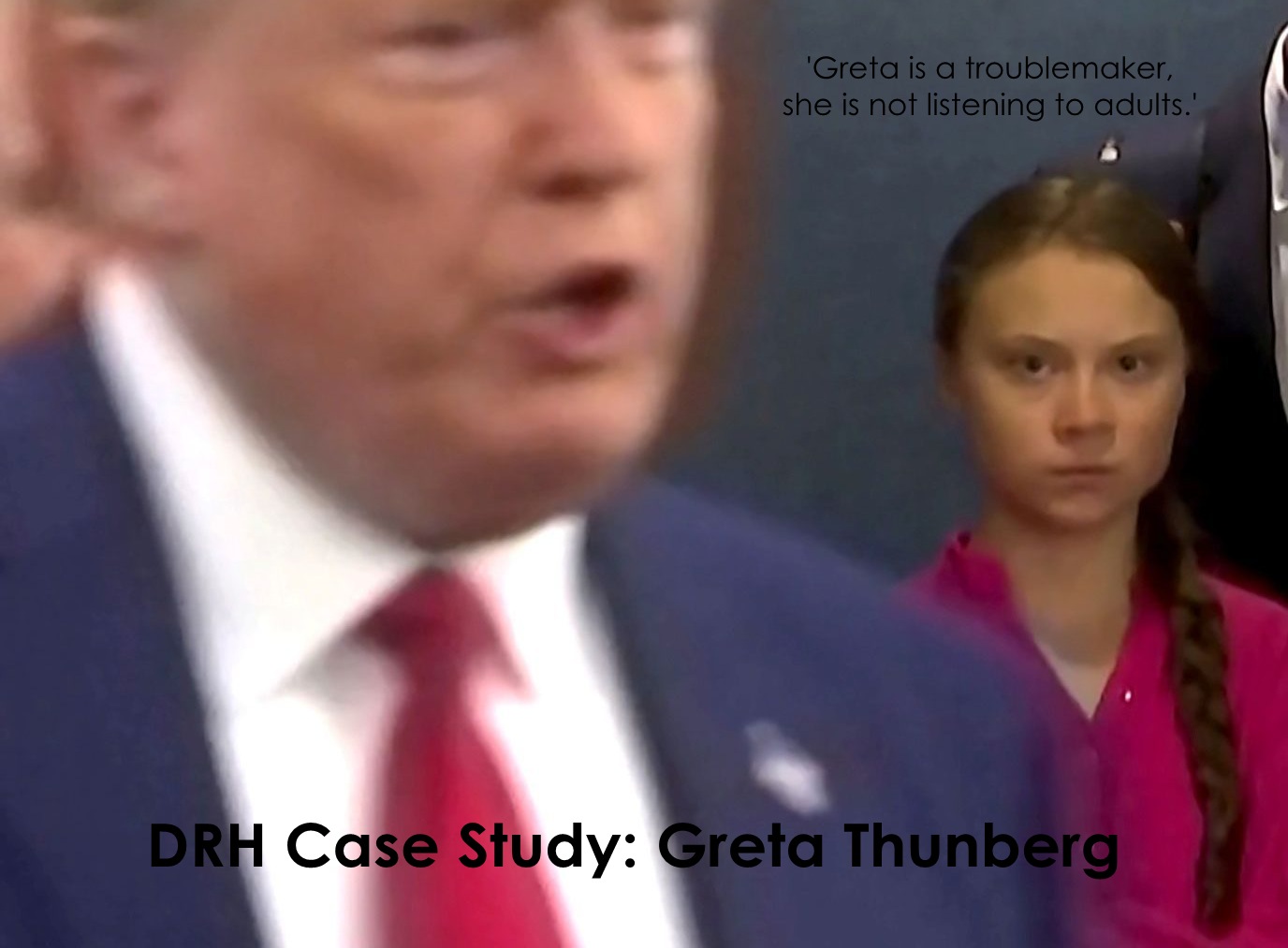
Her defiance drew intense backlash - especially from political and corporate figures. Leaders called her 'poorly informed', 'a puppet' or 'mentally disturbed'. Donald Trump sarcastically tweeted she 'seems like a very happy young girl looking forward to a bright and wonderful future', and Vladimir Putin claimed she lacked understanding of complex global issues.
4. Attempts at Co-optation: The Softening of a Resister
As Greta's fame grew, so did the attempts to domesticate her image. Some NGOs sought to turn her into a brand ambassador. Media outlets praised her composure but avoided quoting her strongest critiques. Time Magazine named her Person of the Year, using an iconic photo of her standing at sea - but omitted the accusatory tone of her actual speeches.
She resisted. She continued to say: 'We are not holding hands and singing kumbaya. We are striking because we have no choice.'
When she dared to join protests demanding human rights for Palestinians, many advised her to stay in her lane and stick to climate change issues (much like Martin Luther King was told to stick to desegregation issues when speaking out against the Vietnam War) to which she replied that 'we cannot have climate justice without social justice.'
5. Rhetorical Consistency and Individual Integrity
Unlike many activists, Greta never diluted her message over time. She maintained:
In a world governed by group calibration, Greta is non-calibrated - a fixed reference point in a sea of shifting incentives.
6. Conclusion: The Ethics of Non-Compliance
Greta Thunberg's confrontation with global institutions represents a highly unusual pattern in public activism: she was invited to speak, and instead of thanking the room, she held it accountable.
She embodies a form of moral resistance almost unrecognisable in our performance-saturated age. Her divergence - neurological, ethical, rhetorical - is not an accident. It is the source of her power. She stands not against society but outside it, holding a mirror and saying, without flattery: This is who you are. Change begins with truth.
In the framework of the Deindividuation Resister Hypothesis and the Neurological Spectrum Model, Greta is not just an activist. She is a case study in how authenticity can confront institutional inertia, not with charisma or conformity but with clarity.
Part 4: Backlash and the Pathologising of Moral Clarity
1. When Conscience Disrupts Comfort
As Greta Thunberg's international visibility grew, so did a powerful and often vitriolic backlash. It did not focus primarily on the substance of her climate demands - emissions targets or global treaties - but rather on her personhood. Critics attacked her tone, appearance, behaviour, facial expressions, voice, and - most tellingly - her neurological profile. Through the lens of the Deindividuation Resister Hypothesis (DRH) and the Neurological Spectrum Model (NSM), this reaction is predictable: societies that rely on group conformity will interpret moral clarity from outside the group as threatening, unstable, or pathological.
2. The Threat of Emotional Unavailability
Many of Greta's detractors accused her of being 'angry', 'ungrateful', manipulated' or 'robotic'. Conservative media repeatedly characterised her as humourless, joyless, and authoritarian. The common thread wasn't just disagreement - it was discomfort with her emotional posture.
3. The Uses of Pathology
A consistent thread of attack on Greta focused on her autism. Commentators and political figures framed her as:
4. Caricature and Co-optation: Two Sides of the Same Response
When backlash fails to neutralise a resister, co-optation often follows. Greta has been:
5. Greta's Refusal to be Framed
Greta's response to these pressures has been remarkably consistent. She has never made herself palatable to her critics. She has:
Her refusal to 'perform wellness' for others has reinforced her position at the Individual pole of the neurological spectrum. She does not ask for acceptance. She asks for action. And in doing so, she bypasses the Social Person's deepest need: to feel good about themselves without changing.
6. Conclusion: Mirror, Not Mascot
Greta Thunberg is not merely a moral voice - she is a mirror that many cannot bear to face. Her refusal to adopt emotional scripts, symbolic gestures, or rhetorical polish has led not only to widespread admiration but also to a social autoimmune reaction: a society attacking the very clarity it claims to admire.
1. Greta's Impact Beyond Climate
While Greta Thunberg emerged as a climate activist, her deeper legacy lies in how she disrupted norms - not just of environmental policy, but of communication, power, and identity. Through the lens of the Neurological Spectrum Model (NSM) and the Deindividuation Resister Hypothesis (DRH), her influence cannot be measured solely by legislation or carbon targets. It must be understood as a cultural shockwave initiated by one Individual's refusal to lie.
In challenging world leaders, media narratives, and even activist performance itself, Greta redefined what dissent looks like. She:
2. A Generational Catalyst: Empowerment Without Assimilation
Millions of young people around the world cite Greta as their reason for political engagement. But what she inspired wasn't typical activism - it was autonomous thinking.
The NSM sees this as a ripple from the Individual pole:
3. How Power Responds to the Unassimilated
Greta's long-term challenge to institutions is that she is not co-optable. She refuses awards, declines honours, and avoids symbolic victories. She demands:
Her legacy thus exposes something profound: institutions are not designed to receive unfiltered moral input. They depend on group calibration, euphemism, and deferred accountability. Greta bypasses all of these. She becomes, in effect, a moral feedback loop the system cannot digest.
4. The Cost of Remaining an Individual
Greta's refusal to dilute herself has come at great personal cost:
5. Conclusion: The Future of Resistance
Greta Thunberg may eventually be remembered not only as a climate activist, but as one of the clearest embodiments of neurologically anchored moral resistance in the 21st century. She did not become a symbol by conforming - she became a symbol by refusing to.
In a world facing multiple converging crises, Greta's clarity is not a provocation. It is a lifeline. And her Individuality may be what collective survival ultimately depends on.
• Thunberg, Greta et al. Scenes from the Heart (2018) — Family memoir detailing Greta’s early life, emotional challenges, and family’s climate awakening.
• She was not seeking validation.
• She was not asking politely.
Many adults, journalists, and politicians responded with defensive hostility. Accusations ranged from 'naοve' to 'manipulated' to 'mentally ill'. Some far-right commentators invoked her autism as a sign of her irrationality.
But these attacks reflect precisely what DRH predicts: when an individual resists the performance of collective norms, especially as a child or outsider, they are pathologised, ridiculed, or slandered.
Her delivery violated nearly every rule of collective deindividuation etiquette:
• She shamed the group.
• She named contradictions.
• She refused hope as a substitute for action.
This is why, in NSM terms, Greta represents an advanced individual-identity actor. She doesn't perform within the group to change it; she stands outside of it to expose it. Her speeches are not calls for consensus - they are moral interventions.
Part 3: Institutional Confrontation and the Ethics of Non-Compliance
This refusal to collaborate in collective absolution is precisely what the NSM defines as the Individual pole. Her stance:
• Rejects the collective lie that shared guilt = shared redemption.
• Rejects hierarchical reverence, speaking to heads of state and billionaires as equals.
• Rejects social rewards, offering no feel-good endings or conciliatory gestures.
In DRH terms, she stands in stark contrast to the Social Person, who upholds group optics over personal truth. Greta consistently prioritises moral coherence over institutional access.
These are classic collective defence responses predicted by DRH:
• Infantilisation: Undermining moral critique by painting the speaker as naοve.
• Pathologisation: Equating neurological divergence with irrationality.
• Mockery: Punishing moral clarity by framing it as extremism.
The Social Person, confronted with the discomfort of the Individual's gaze, attempts to re-socialise the threat - either by discrediting it or by absorbing it into the group. But Greta would not be absorbed.
This selective celebration reflects an institutional strategy: praise the individual's symbolism while neutering their substance. In DRH terms, this is a reduction of resistance to spectacle. Greta's image could be used to decorate the very institutions she rebuked - so long as her message was trimmed.
• Unwavering alignment with science, citing IPCC data over personal emotion.
• Continual refusal to name hope as a strategy, insisting that change required discomfort, not comfort.
• Public rejection of praise when undeserved, such as declining climate awards or donations from 'greenwashed' entities.
This unwavering stance, under NSM, is a hallmark of high-Individuality:
• She does not fluctuate with audience mood.
• She does not perform ideological loyalty for institutional approval.
• She does not adjust her truth to minimise backlash.
• She does not engage in emotional validation of her audience.
• She does not soothe collective guilt with optimism or empathy.
• She does not perform emotional vulnerability in a familiar, feminine, or Western-polite way.
From an NSM standpoint, Greta is an Individual who does not emotionally calibrate to the group, and therefore she is punished not for what she says, but for how she refuses to soften it. Her integrity is read as 'rigidity', her grief as 'hostility', and her restraint as 'arrogance'. These misreadings are classic responses to DRH figures: You do not reflect the group, therefore you are morally suspect.
• A pawn of adult extremists.
• Emotionally unbalanced or mentally ill.
• Incapable of understanding complex geopolitical tradeoffs.
Even those attempting to defend her often couched it in clinical terms, as though her activism was a symptom to be managed rather than a conscious ethical stance.
Under DRH, this is the textbook pathologisation of resistance:
• Her direct language is reframed as obsessive or unnatural.
• Her moral focus is reinterpreted as rigidity or social dysfunction.
• Her non-performance is labelled as lack of empathy or psychological deficit.
These inversions - seeing moral clarity as instability - demonstrate the social function of psychiatric labelling in group defence. It allows the social-person majority to maintain the illusion that group norms are the baseline of health while discrediting individuals who don't share their psychological adaptations.
• Made into internet memes.
• Transformed into inspirational posters (stripped of her confrontational tone).
• Embraced by corporate environmental campaigns that she herself condemns.
These responses are two halves of the same process: reduce the threat by distorting the source. The DRH framework identifies this as a predictable stage in society's attempt to manage the discomfort of the individual:
• Caricature diminishes her legitimacy by exaggerating traits perceived as alien.
• Co-optation dilutes her meaning by assimilating her image without her message.
NSM explains the motivation: the social person, feeling exposed by the individual's clarity, attempts to recategorise the resister into a safer narrative - either as broken or as harmless.
• Repeatedly referred to her autism as a 'superpower', not a burden.
• Explicitly called out attempts to soften or reframe her language.
• Publicly rejected awards, titles, and symbolic honours that weren't backed by substantive change.
Through the DRH lens, this backlash reveals the fragility of collective identities when exposed to authentic, neurologically unfiltered dissent. Greta, standing as an individual, reminds us not just of what is true but of how deeply society is conditioned to deny it.
Part 5: Legacy, Reframing Power, and the Future of the Individual Voice
• Withdrew from systems rather than negotiating within them.
• Spoke with unsocialised moral clarity rather than rhetoric.
• Made her neurological difference visible and central, rather than hidden or overcome.
Her neurological profile - initially considered a liability - became her shield, her compass, and, ultimately, her gift to collective awareness.
She didn't tell others what slogans to use or how to behave. She modelled what it looked like to see clearly and act accordingly, regardless of approval. This empowered others not to follow her, but to find their own nonconformity.
• Instead of acting as a central leader, Greta became a signal amplifier - amplifying moral reality that others already sensed but had muted.
• Her visibility normalised difference as power, especially for neurodivergent youth.
• Her presence legitimised disobedience based on conscience, not ideology.
• Material compliance with reality, not performance.
• Restoration of the future, not restoration of public image.
• Truth-telling without consolation.
According to the DRH, this is the unresolvable problem of the resister: they do not want access to the system - they want the system to align with truth. This puts them in permanent tension with structures whose function is not to serve truth but to mediate it.
• Relentless media scrutiny.
• Threats, slander, and sustained online harassment.
• Exhaustion, depression, and burnout (which she has spoken about openly).
But she has never presented herself as a saviour. Instead, she demystifies her role: 'I am not special. I'm just one of many. Anyone can do what I did.'
This humility reinforces her NSM alignment: she does not draw power from status, charisma, or social identity, but from alignment between perception and action. Her endurance as a resister depends not on fame, but on never letting go of the initial truth that began her strike.
She showed what happens when an Individual:
• Does not yield to social training.
• Sees through euphemism.
• Acts on what they see.
And she did it without asking permission.
In the framework of the DRH and NSM, her biography becomes more than a timeline - it becomes a diagnostic tool for evaluating the health of collective systems. If societies punish or pathologise voices like hers, they are not only unjust - they are unviable.
Sources:
• The Guardian, BBC, and NPR coverage (2018–2023) — Documenting the origins of the school strike, Fridays for Future, and Greta’s speeches to parliaments and the UN.
• UN Climate Action Summit (2019) — Greta’s “How dare you!” speech. Transcript and video published on UN official channels.
• World Economic Forum, Davos (2019) — Speech and interview transcripts where she said: “I don’t want your hope. I want you to panic.”