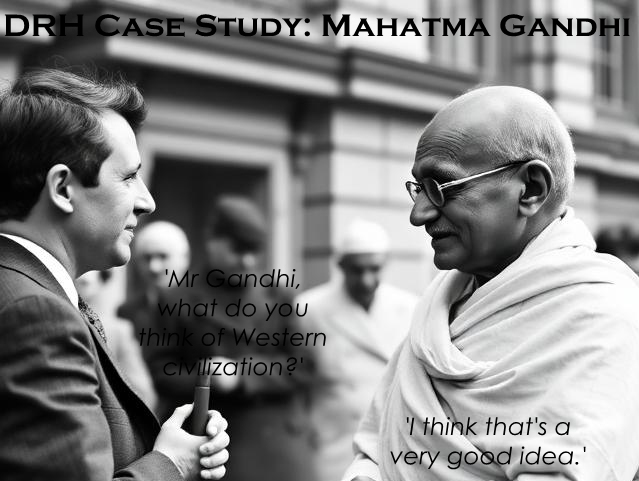
Mahatma Gandhi: A Deindividuation Resister on the Extreme Individual End of the Spectrum
Introduction
Mohandas Karamchand 'Mahatma' Gandhi (1869–1948) is renowned as a leader of India's independence movement and an innovator of the philosophy of nonviolent resistance, or satyagraha. In this case study, we chronologically examine Gandhi's life through two analytical lenses: the Deindividuation Resister Hypothesis (DRH) and the Neurological Spectrum Model (NSM). According to the DRH, human progress is propelled by rare individuals who resist social conditioning and retain their personal identity, often at great personal cost. The NSM likewise posits a spectrum of neurological orientation from the Individual - one who thinks and acts independently of group pressures - to the Social Person - one who subsumes their identity into group norms. Gandhi, as we will see, exemplified an extreme Individual on this spectrum, a 'deindividuation resister' whose unwavering personal conscience set him apart from his peers.
Gandhi's independent spirit was evident even from a young age. Reflecting on his youth, he noted that his 'independent spirit was a constant source of trial' - he often found himself at odds with social expectations. Yet it was precisely this principled individualism - manifest in his resistance to unjust authority, rejection of discriminatory customs, literal truthfulness, emotional restraint, and strict personal discipline - that empowered his moral clarity and fuelled his impact as a human rights advocate. In what follows, we trace Gandhi's life from childhood to his major campaigns and legacy, highlighting how his traits align with DRH and NSM. Gandhi's story offers a vivid portrait of how neurodivergent cognition and an 'extreme Individual' orientation can challenge mainstream society while catalysing profound social change.
Formative Years: Childhood and Adolescence in India (1869–1888)
Gandhi was born on October 2, 1869, in Porbandar, Gujarat, into a Hindu family of the Vaishya caste. As a child he was notably shy, morally earnest, and uncomfortable in social settings. He later remembered that during his early school days, 'I used to be very shy and avoided all company. My books and lessons were my sole companions… I literally ran back [home], because I could not bear to talk to anybody'. Young Mohan (as he was called) spoke softly, feared speaking up, and had almost no interest in games or typical childhood socialising. His only friends were a few books and stories that shaped his values. For example, he was deeply moved by tales of the legendary King Harishchandra who suffered greatly for the sake of truth, resolving never to depart from truthfulness himself.
This fierce commitment to truth manifested in a famous incident during primary school. An inspector once administered a spelling test of English words. Gandhi misspelled one word, and his teacher covertly gestured for him to copy his neighbour's answer. Gandhi refused. As a result, he was the only boy in class with an error and was scolded for it, but 'deep inside he knew that what he had done was right'. Resisting pressure to cheat, even at the cost of a reprimand, the young Gandhi demonstrated an Individual's instinct to follow personal ethics over authority or peer approval. Such early episodes illustrate what the NSM calls an Individual's refusal to 'just follow orders' and insistence on acting by his own moral judgment. Gandhi was willing to stand apart from the group - a pattern that would continue throughout his life.
Gandhi's adherence to personal principles was also evident in his home life. Raised in a devout Vaishnava Hindu household, he was taught the virtue of vegetarianism and self-restraint. In his early teens, a mischievous friend convinced him that eating meat would make him strong like the English and that it was necessary to overthrow British rule. Eager to test this claim, Gandhi secretly ate meat on a couple of occasions. However, the deception tormented his conscience - he felt compelled to lie to his strictly vegetarian family, which violated his truthful nature. Ultimately, he could not continue the experiment and vowed never to eat meat again so as not to 'deceive his parents'. This incident shows how Gandhi's moral rigidity and need for authenticity overrode even the tantalising idea of strength. Unlike a typical youth who might conform to a friend's urging, he experienced such guilt that he individually charted his own path back to principle. The DRH framework suggests that while most children can be conditioned into group norms through such peer pressure, a resister like Gandhi holds onto inner values despite the urge to fit in.
As an adolescent, Gandhi also grappled with other temptations common to youth - and responded in his characteristic conscientious fashion. He fell in with the same friend in minor rebellions like smoking cigarettes. To finance this habit, Gandhi once stole a bit of gold from his brother's bangle. Immediately remorseful, he penned a confession to his ailing father, accepting full responsibility for his theft. Gandhi's father forgave him silently, tearing up the note, and Gandhi wept in shame and relief. The boy learned the power of truth and transparency in that moment. Thereafter, 'telling the truth became a passion with him'. This episode underscores a key Individual trait: taking personal responsibility for one's actions, in contrast to the Social Person who might excuse misdeeds if they were done under group influence. Indeed, Gandhi's willingness to hold himself accountable - even when it meant self-criticism or punishment - remained a constant in his life (later, as a political leader, he would fast and chastise himself if movements he led turned violent).
Gandhi's independent spirit often put him at odds with social expectations in his conservative society. At the age of 13 he was married through an arranged marriage to Kasturbai (Kasturba) in keeping with regional custom. Gandhi later candidly admitted that as an adolescent husband he was possessive and 'lustful' toward his young wife, reflecting the normal impulses of a teen wed too soon. Yet he would eventually come to feel deep guilt for prioritising his desires over duty: at age 16, Gandhi was at Kasturba's side instead of his dying father's bedside, and his father passed away while Gandhi was away. The trauma of this 'torture of separation' - Gandhi wrote that if 'animal passion had not blinded me, I should have been spared the torture of separation from my father during his last moments' - seared into him a lifelong lesson about self-control. He retrospectively regarded this as a moral failure due to lack of restraint, which likely influenced his later vow of celibacy. In line with his all-or-nothing approach to principle, Gandhi eventually responded to youthful lapses by imposing even stricter discipline on himself as an adult (embracing celibacy, or brahmacharya, and other ascetic practices, as we will see).
Another striking example of Gandhi's early defiance of social norms came when his family decided to send him to England for higher studies. His mother feared the foreign sojourn would expose him to meat-eating, alcohol, and other moral corruptions; Gandhi solemnly vowed to her that he would abstain from meat, liquor, and women while abroad. Having satisfied his mother's conditions, the 18-year-old Gandhi prepared to depart India in 1888 to study law in London. However, his move violated a deeply entrenched collective norm of his caste: at the time, crossing the ocean was considered religiously impure for Hindus. Elders of his Modh Bania caste community insisted that travelling abroad was against the caste's rules. Gandhi's response was characteristically blunt and independent. When the community head (sheth) tried to dissuade him, Gandhi replied, 'I think the caste should not interfere in the matter.' This candid retort, utterly lacking in the expected deference, so offended the caste leader that he excommunicated Gandhi on the spot. The young Gandhi accepted the social ostracism as the price of following his own path. He would later be readmitted to his caste when he returned from England, but at the time this was a bold break with collective authority. Gandhi's willingness to become an outcast rather than surrender his individual choice illustrates the essence of a deindividuation resister. He resisted the 'social conditioning' that demanded conformity, whereas most in his place would have succumbed to the fear of ostracism. This episode from his youth prefigures the many showdowns he would have with social and political authorities, in which he consistently refused to bend when a principle was at stake.
In sum, Gandhi's formative years already revealed hallmark traits of an extreme Individual on the neurological spectrum. He was shy and socially aloof, preferring solitary study to camaraderie. He was guileless and emotionally frank, tending to assume others were as honest and well-meaning as himself - a naiveté that sometimes made him vulnerable to manipulation by bolder peers. At the same time, he showed an unusually strong moral compass: an instinct to tell the truth, keep promises, and do what he felt was right even if it meant defying teachers, elders, or friends. These are classic attributes of a deindividuation resister: someone 'wanting in conformity and compliance' who holds fast to personal identity and values despite external pressures. Gandhi's authentic self would be tested further during his next life chapter in England, where he faced the challenges of adapting to a foreign culture without losing his principles.
The Shy Law Student in London (1888–1891)
At 18, Gandhi sailed to London to study law, carrying with him his vows of vegetarianism and abstinence. His journey by sea and his years in England vividly illustrate his social awkwardness, intense self-discipline, and narrow focus of interests - traits consistent with what we now recognise as a neurodivergent (specifically autism-spectrum) profile. Gandhi himself attributed some of his reserve to his unfamiliarity with English language and customs, but the degree of his withdrawal suggests a deeper disposition. He describes how, on the voyage, 'I felt shy even in speaking to the steward… I could not speak to [the other passengers]. I had to frame every sentence in my mind before I could bring it out.' Uncomfortable with Western dining etiquette and worried about hidden meat in the menu, he avoided the ship's common dining room altogether, surviving instead on a supply of sweets and fruits in his cabin. While other passengers strolled the decks and mingled, Gandhi 'hid himself in the cabin the whole day, only venturing up on deck when there were but few people'. A compatriot on board urged him to socialise, advising that as a lawyer he needed a 'long tongue,' but, Gandhi writes, 'nothing could make me conquer my shyness'. This almost pathological social anxiety - essentially clamming up in any group setting - persisted through his student years. Even in London's Vegetarian Society, where he served on the Executive Committee, he found himself paralysed in meetings: 'Not that I never felt tempted to speak. But I was at a loss to know how to express myself… Just when I had mustered up courage to speak, a fresh subject would be started'. On one occasion, he felt strongly about an issue (he opposed expelling a member for promoting birth control, reasoning that it was irrelevant to the society's vegetarian mission) but he literally could not get words out in the discussion. Instead, Gandhi wrote down his argument and had someone else read it aloud to the assembly. 'Thus in the very first battle of the kind,' he recalls, 'I found myself siding with the losing party. But I had comfort in the thought that the cause was right… This shyness I retained throughout my stay in England. Even when I paid a social call, the presence of half a dozen or more people would strike me dumb.'. These descriptions show a profound anxiety regarding social interaction and communication, hallmarks of autistic cognition. Gandhi desired contact with others but simply 'failed to understand the reciprocal nature of normal social interaction,' leading to clumsy, one-sided attempts or withdrawal. He later admitted that even in small gatherings he often 'struck [people] dumb' by his silence or ended up literally writing what he wanted to say.
While living in London, Gandhi's lifestyle was defined by obsessive routines and ascetic self-control that set him apart from his peers. He was utterly devoted to his twin passions - diet reform and religious/philosophical study - and paid scant attention to anything outside these interests. He read voraciously on vegetarianism and comparative religion, eagerly consuming everything from Henry Salt's writings on food ethics to texts of Christianity, Islam, Hinduism and Buddhism. He joined London's Vegetarian Society and made like-minded acquaintances there, as well as in the Theosophical Society - essentially seeking out niche intellectual circles that matched his fixations. Beyond these, he had few friends. He briefly tried to 'polish' himself by taking lessons in dancing and French violin, but quickly abandoned those after a few sessions, finding no genuine interest in them. Such single-minded focus and narrow range of interests - combined with rapid loss of interest in activities not aligned with his core goals - are often observed in autistic individuals, who might pursue a 'very narrow spectrum of interests… obsessively' and excel in those domains. Gandhi's intense study of diet and ethics paid off in making him an expert in those areas, but it also meant he lived in a sort of self-imposed cultural bubble while in England.
Despite being in the heart of the British Empire, Gandhi scrupulously stuck to his Indian vegetarian diet and moral vows. He wore modest English attire but avoided dining in fashionable society or indulging in London's pleasures. When pressured by well-meaning English friends to broaden his habits - for example, to eat meat for health or to attend social dances - he politely demurred, clinging to the strict routines that made him comfortable. He later even experimented with preparing his own foods to ensure purity. This rigidity in daily habits foreshadows the even stricter routine he would adopt in later life (when he awoke at 4 AM daily, took walks at fixed times, ate simple meals at set hours, and became 'upset if he had to make any changes to this routine'). Such an aversion to change and reliance on routine is characteristic of autistic personalities, for whom 'the strict observance of routines' provides a sense of security. Gandhi's adherence to his mother's dietary vow was unshakeable - he would rather starve than break it. Indeed, during the voyage out and early days in England, he nearly did starve until he found a vegetarian restaurant. This stubbornness in principle earned him a reputation: the young law student was seen as 'rigid' and old-fashioned by some compatriots. Yet it also garnered respect among the London vegetarian circles, who appreciated his commitment. In NSM terms, Gandhi consistently acted as an Individual guided by internal principles (vows, ethics) rather than social cues about what was fashionable or 'normal'. He did what he believed was right, regardless of others' approval.
Gandhi's social naiveté occasionally led him into awkward situations in England. Unfamiliar with British humour and norms, he sometimes misread social cues. In one reminiscence, he describes playing bridge (a card game) with an English family. The other men began telling risqué jokes. Gandhi initially sat uncomfortably, then tried to join by repeating some of the off-colour humour - but he 'overdid it,' not sensing the subtleties of decorum. Suddenly he felt a pang of conscience, 'as if a good friend had warned me: ‘Whence this devil in you, my boy? Be off, quick!'' Shocked at himself, Gandhi fled the scene: 'I… expressed within myself gratefulness to my friend. Remembering the vow I had taken before my mother, I fled from the scene… quaking, trembling, with beating heart, like a quarry escaped from its pursuer.'. This anecdote highlights several aspects of his neurodivergent character. First, his difficulty gauging the social appropriateness of his behaviour - he didn't realise he'd gone too far until a kind soul gave him a nudge - aligns with the common autistic challenge in reading social cues. Second, once he recognised the misstep, his response was extreme: total retreat in guilt and fear, reflecting his internal black-and-white moral code (either he was pure or he was sinning - a 'devil' had led him astray). His all-or-nothing mentality about virtue, in which even minor lapses triggered intense self-reproach, became a defining feature of his personality. Gandhi would eventually channel this intensity into vows of abstinence (from sex, from indulgent foods, etc.), exhibiting what some called almost fanatical self-control - but which he regarded as necessary discipline to align his life with Truth. 'Inhibitions imposed from without rarely succeed, but when they are self-imposed, they have a decidedly salutary effect,' he later wrote, explaining why he constantly set strict rules for himself. This perspective is emblematic of his Individual mindset: rather than obey external authority, he preferred to be his own lawgiver, imposing rules on himself that he would never have accepted if forced by others.
During his time in London, Gandhi also showed an innocence in matters of social tact that sometimes caused unintentional offense. One amusing example is his visit to an English friend's home for dinner. Observing the meal, Gandhi - a zealous vegetarian - 'spoke derisively of the piece of meat on [the host's son's] plate and [in] high praise of the apple on mine.' The comment, though earnest, was taken as rude, and it 'was his last visit to that family.'. Gandhi simply did not realise that openly disparaging his hosts' food choice (even out of moral conviction) violated social courtesy. This kind of candid bluntness, divorced from awareness of social niceties, was something he struggled with lifelong. As he admitted, 'I lacked the art of diplomacy in my argument'. Such lack of social filter is frequently noted in autistic profiles, where the individual may state truths or opinions without gauging the expected norms of politeness - often valuing truth over social harmony. Gandhi certainly prioritised honesty and principle above etiquette; fortunately, his genuine goodwill usually shone through enough that people forgave his occasional faux pas. The American missionary E Stanley Jones later observed that Gandhi uniquely combined 'candor and courtesy… He spoke exactly what he thought, and yet did it so gently and courteously that you loved it even when it was cutting across your own views'. This was not always the case in his younger days (as the dinner incident shows), but with time Gandhi learned to temper his frankness with a humble tone. Still, he never mastered diplomacy in the conventional sense; he remained disarmingly straightforward to the end.
Academically, Gandhi managed to pass his law examinations by 1891 and qualify as a barrister. Yet he was plagued by self-doubt and feelings of inadequacy. Despite earnest study, he wrote, 'there was no end to my helplessness and fear. I did not feel myself qualified to practise law.'. Indeed, when he attempted his first law case in an Indian courtroom after returning from England, he froze completely. Rising to cross-examine a witness, 'my head was reeling… I could think of no question to ask.' The judge and lawyers must have chuckled as the nervous young barrister abruptly sat down and admitted defeat. This episode was deeply humiliating to Gandhi. It underscores his difficulty with public speaking and quick social thinking, which had not magically disappeared with his London education. In fact, throughout his life Gandhi's speaking voice remained, by most accounts, soft and monotonic, almost 'free of intonation'. He did eventually overcome the paralysis in court, but only by finding a cause worth speaking for. At this early stage, his anxiety over performance was crippling - he lacked the typical lawyer's confidence or glibness. One reason, perhaps, is that he refused to engage in the boastful, networking behaviour common in the profession. For example, Gandhi was uncomfortable with the idea of soliciting clients or greasing palms. He refused to pay commissions to court clerks ('tout fees') even though it was an accepted practice to get cases. When his elder brother, himself involved in a legal tangle, begged Gandhi to leverage an acquaintance in high office to help, Gandhi balked. He felt it would be wrong to 'exploit friendship' for personal gain, advising his brother to go through proper channels and face the outcome honestly. Pressed into making a recommendation letter, Gandhi complied once - and suffered for it. The British official, annoyed at this attempt to use influence, threw Gandhi out of his office. Mortified, Gandhi vowed 'Never again shall I try to exploit friendship in this way'. He kept that vow for life, thereafter shunning favouritism and nepotism. This idealistic adherence to fairness over 'old boy networks' cost him in the short run (he struggled to establish his law practice), but it kept his integrity intact. In NSM terms, while the Social Person might accept bending rules or using connections to get ahead (because that's 'how the world works'), Gandhi's Individual conscience would not permit it. Such incorruptibility became one of his hallmarks. Ironically, it was his failure as a lawyer in India - a result of his timid speaking and refusal to cut ethical corners - that set the stage for his greatest transformation. In 1893, when an offer came to take a legal case in South Africa, Gandhi jumped at the opportunity, hoping to escape the 'constant trial' his independent spirit had been in India and perhaps find a fresh start.
Transformation in South Africa (1893–1914)
Gandhi arrived in South Africa in 1893 as a 23-year-old lawyer, contracted to assist an Indian merchant in Natal. It was in South Africa's segregated society that Gandhi's latent qualities - his courage, moral tenacity, and empathy across racial lines - fully bloomed. The 21 years he spent there not only transformed him from a shy lawyer into a bold leader, but also crystallised his philosophy of satyagraha (truth-force). Throughout this period, Gandhi's behaviour reflected the deindividuation resister archetype: he consistently refused to 'absorb the expectations' of racist colonial society or to accept oppression as normal. Instead, he asserted his individual dignity and inspired others to do the same, all while maintaining the personal idiosyncrasies that set him apart.
One of the first formative incidents occurred shortly after his arrival. Gandhi experienced overt racial discrimination when he was asked by a white train official to move from the first-class compartment despite holding a valid first-class ticket. Gandhi refused to surrender his seat simply because of his skin colour. At Pietermaritzburg station, he was physically thrown off the train into the cold night for his defiance. He spent that night shivering in the waiting room, angry and hurt, pondering whether to return to India or stay and fight the injustice. By morning, he had made up his mind: he would resist. This decision marks a critical turning point - the awakening of Gandhi's activist spirit. The NSM framework would note that most people in his position, faced with such hostility in a foreign land, might quietly retreat (identifying with their vulnerable in-group and avoiding further trouble). Gandhi, however, reacted as an Individual thinking in universal principles: it was not just about him but about the rights of all Indians to equal treatment. His personal affront became a cause. In DRH terms, Gandhi had 'retained [his] individual judgment' – he knew the racial prejudice was wrong by his own moral reasoning, even though South African society's norm accepted it. And crucially, he had the inner strength to act on that judgment rather than yield to the collective pressure.
More humiliations followed. In another incident soon after, Gandhi entered a Durban courtroom wearing his turban. The magistrate ordered him to remove it. Gandhi refused and left the court rather than obey an arbitrary rule that he saw as an insult. (He did later concede on the turban in a higher court after protesting the rule - pragmatically choosing to 'reserve [his] strength for fighting bigger battles' - but only after making his point.) He was also kicked off footpaths and beaten for daring to walk where only whites were allowed. Each time, Gandhi's response was to question the legitimacy of these norms and to organise the Indian community to assert their rights. In 1894 he founded the Natal Indian Congress to unite Indians in pressing for their civic rights. Remarkably, Gandhi's campaigns in South Africa did not rely on stirring ethnic solidarity against Europeans (which would be a typical group-identity response). Instead, he appealed to universal human values of justice and utilised nonviolent protest - approaches that stemmed from his individual-centred worldview. He was immune to the contagion of racial hatred; despite the racist attacks he suffered, he did not demonise all whites, nor did he encourage Indians to develop a resentful group mentality. Consistent with being an extreme Individual, he tended to view each person, even adversaries, as fellow humans capable of reason and conscience. This ability to empathise beyond group lines - what the DRH author calls 'empathy beyond affiliation' - was exemplified when Gandhi urged Indians to support the British during the Boer War (he organised an Indian ambulance corps), reasoning from a humanitarian rather than sectarian perspective.
Yet even as he was stepping onto the world stage as a social leader, Gandhi's personal quirks and learning curve in social perception were evident. An anecdote from his early months in South Africa illustrates his innocence in worldly matters. The Captain of the ship on which Gandhi travelled took a liking to the young attorney. Once in Natal, the Captain invited Gandhi and an English friend for an outing. They were brought to 'some Negro women's quarters' - effectively a brothel - and each man was shown into a room with a woman. Gandhi writes, 'I simply stood there dumb with shame. Heaven only knows what the poor woman must have thought of me.' He fled the room as soon as he was called, having understood nothing of what was expected until that moment. The Captain later realised Gandhi truly had 'not the least notion' about such sexual outings and meant no offense by leaving. This story, beyond its humour, is revealing of Gandhi's social naiveté and personal purity. He was, by his own account, nearly oblivious to sexual implications in social situations - an almost childlike trait consistent with neurodivergent development. It also underscores his strict adherence to his moral vows; many in his place might have yielded to temptation or peer pressure, but Gandhi's instinct was to remove himself from the compromising situation immediately. His autistic-like innocence in these scenarios often elicited bemusement or frustration from more worldly colleagues, but it also meant he was incorruptible in an environment rife with vices.
As Gandhi settled in South Africa, he underwent a profound personal evolution. Initially, he was as tongue-tied in public meetings as he had been in London. But the urgency of defending his community pushed him to overcome his fear. In 1894, at a large gathering of Indians in Pretoria aggrieved by discriminatory laws, Gandhi rose to make a speech - 'the first public speech in my life,' he noted. Though his voice quavered and lacked flourish, he managed to convey his message. Over time, he became more confident in addressing crowds, though his oratorical style remained plain and gentle, devoid of dramatic oratory. (Contemporary accounts often remarked that Gandhi's speaking was conversational and sometimes hard to hear, yet the conviction and sincerity in his words moved people deeply.) This transformation - from stage fright to moral spokesman - reflects how having a clear ethical purpose can empower an Individual who otherwise shies away from social spotlight. When he spoke on behalf of injustice, Gandhi could set aside his personal discomfort. In psychological terms, his passion for truth and justice overrode his social anxiety, enabling him to do things his younger self could not imagine. Indeed, many autistic activists report a similar phenomenon: while routine social interaction is daunting, they can become eloquent and bold when championing a cause they believe in, precisely because their focus shifts to the principles at stake rather than the social dynamics.
During the two decades in South Africa, Gandhi refined the tools of nonviolent resistance that would later liberate India. He launched campaigns against specific injustices: the unfair £3 poll tax on indentured Indian labourers, the invalidation of non-Christian marriages, and the requirement for Indians to carry registration passes (the infamous Black Act). In developing satyagraha, Gandhi drew upon diverse intellectual sources - Hindu and Jain concepts of ahimsa (non-harm), Christian teachings (like the Sermon on the Mount's injunction to 'turn the other cheek'), the writings of Leo Tolstoy and Henry David Thoreau - but above all upon his own experience of what stirred people's conscience. The term satyagraha, which he coined around 1906, means 'holding onto Truth' or 'truth-force'. It was conceived not as a weapon of the weak, but as a 'soul force' accessible to any individual with the courage of conviction. Satyagraha rejects using brute force against opponents, aiming instead to 'transform or "purify" the oppressor' through patient suffering and love. This philosophy is a direct extension of Gandhi's Individual-centric worldview: it 'arms the individual with moral power rather than physical power', emphasising personal integrity and sacrifice over collective violence. In essence, Gandhi took the stubbornness often associated with his personality - that legendary unwillingness to compromise his principles - and elevated it to a method of social struggle. Civil disobedience, a key part of satyagraha, meant that an individual would deliberately break an unjust law and accept the punishment, thus appealing to the conscience of the oppressor and public. This requires a high degree of personal autonomy and courage - qualities Gandhi had in abundance as a deindividuation resister. Most people 'just follow the crowd' or obey authority even if they feel something is wrong; satyagraha calls upon people to do the opposite, to follow their inner voice at all costs. Gandhi's success in inspiring others to join him in such actions (for example, burning their registration passes en masse and going to jail cheerfully) indicates how his individual-driven model proved contagious in a positive sense. He often said that in matters of conscience, the law of the majority has no place - every person must act according to their own sense of right, not society's dictates. This is virtually a restatement of the NSM's Individual ethos.
Gandhi's principled individualism sometimes verged on moral absolutism, which could put him in conflict even with those close to him. A vivid instance is his commitment to brahmacharya, or celibacy. In 1906, at age 37 and still married, Gandhi took a public vow of lifelong chastity. He believed that abstaining from sexual relations was essential to conserve spiritual energy for the struggle and to relate to others (men and women) purely. He even convinced the members of his Phoenix Settlement commune to take similar vows, imposing his strict standards on his small community. This was undoubtedly a controversial choice - some of his associates found it extreme, and his wife Kasturba is known to have struggled with it. Yet in Gandhi's mind, it was a logical extension of self-discipline. He approached it with a kind of clinical detachment characteristic of his rational side. Much later, in his late 70s, Gandhi would conduct disconcerting 'experiments' to test his celibacy by sleeping beside naked young women (including his grandniece) without touching them. To him, this was a way to ensure he had fully conquered lust; but to others, it was inappropriate and scandalous. His companions had to point out how such behaviour could be misinterpreted and harmful. Gandhi was initially defensive - he felt pure in his intentions, so he struggled to see why anyone else would object. This again reveals a blind spot in interpersonal perception: an inability to readily imagine others' viewpoints or the societal implications of his personal actions (what psychologists term a deficiency in 'social imagination'). Eventually, in 1947, even Gandhi conceded and stopped these experiments, acknowledging the counsel of his friends. The episode is telling: it shows Gandhi's tendency to push his ideals to extremes while sometimes missing how they appear to observers - a pattern often seen in those with neurodivergent cognition who follow an internal logic to a fault. It also highlights that, while Gandhi was incredibly self-aware in some respects, he could be startlingly oblivious in others, necessitating trusted confidants to check him - much as an autistic individual might rely on a close friend to navigate certain social nuances they personally find perplexing.
Another area where Gandhi's Individual approach created friction was his rejection of the Indian caste system, particularly the notion of 'untouchability.' Although a devout Hindu, Gandhi emphatically opposed any tenet of Hinduism that violated his moral sense. 'If untouchability could be a part of Hinduism, it could only be a rotten part,' he declared, 'I could not understand the raison d'être of a multitude of sects and castes'. He publicly questioned the divine authority of scriptures like the Vedas when they clashed with principles of equality. Throughout his life, he campaigned against caste discrimination: co-founding an ashram in India that welcomed untouchables (to the shock of many high-caste supporters), personally cleaning the latrines as untouchables traditionally did, and urging Indians to abolish this 'excrescence' on Hinduism. At times, even Kasturba Gandhi was uncomfortable with her husband's insistence on treating scavengers as equals and living with them - a very radical stance for their era. Gandhi coolly notes, 'It is likely that many of my doings have not her approval even today. We never discuss them; I see no good in discussing them.'. This almost unemotional remark exemplifies how he handled interpersonal disagreement: rather than seek compromise or dwell on feelings, he would quietly continue doing what he felt was right, assuming others would either come around or agree to disagree. It didn't occur to him to be socially 'diplomatic' about abolishing untouchability; for him it was a non-negotiable ethical truth, and he proceeded regardless of criticism from family or society. In terms of NSM, Gandhi here again acted as an extreme Individual, refusing to 'promote the moral values' of his group if those values conflicted with universal justice. Instead, he promoted the values he personally lived by - truth, nonviolence, human equality - even when that put him at odds with orthodox Hindus. The DRH hypothesis would classify this as classic resistance to social conditioning: Gandhi had not internalised the caste hierarchy even though he was raised within it, which is precisely what most people do internalise due to conditioning from birth. In Gandhi's case, something innate (or perhaps the influence of his mother's egalitarian Pranami faith) immunised him to caste prejudice. This enabled him to lead social reform on an issue that most Indian leaders tiptoed around.
By the time Gandhi left South Africa in 1914, he had become a seasoned organiser and a moral force. He had led successful satyagraha campaigns - enduring imprisonment and even encouraging women and indentured labourers to protest nonviolently - which eventually pressured the South African government into compromises (for instance, recognising Indian marriages and abolishing the poll tax). Importantly, he had gained confidence in his mission. He began to see himself as an instrument of a larger purpose. While always humble about himself, he felt God (i.e. Rama) or fate had chosen him to pursue justice. This gave him a kind of self-assuredness beneath his modest demeanour. As one observer noted, 'underneath [Gandhi's] gentle ways was an iron will. When once he had made up his mind, nothing could deflect him from the course mapped out'. Yet paradoxically, he could also change course in response to higher principles - for example, he would later suspend a major agitation if it betrayed nonviolence, as we shall see. These 'pairs of opposites' in him - stubbornness and flexibility, candour and tact, humility and assertiveness - made Gandhi a complex leader. But they all revolved around the core of unshakeable integrity that came from within, not from social convention. The skills and reputation he built in South Africa set the stage for his return to India, where the struggle for independence awaited his leadership.
Leading India's Independence Movement (1915–1945)
Gandhi returned to India in 1915 as a minor celebrity among nationalists, but he was careful to first reacquaint himself with the country after a long absence. Still dressed in Western attire when he arrived, he soon adopted the loincloth and shawl of a peasant, reflecting his identification with the masses rather than the elite. Over the next three decades, Gandhi would emerge as the foremost leader of the Indian freedom struggle, pioneering large-scale nonviolent campaigns. Throughout this period, his deindividuated-resistant personality both fuelled his effectiveness and sometimes led to miscalculations in social dynamics. He was able to galvanise ordinary Indians by appealing to universal justice and personal conscience, yet he occasionally failed to anticipate the more collective passions of society (such as outbreaks of violence or sectarian sentiment) that fell outside his own psychology.
Gandhi's activism in India began with localised struggles that demonstrated his method and moral resolve. In 1917, he led his first Indian satyagraha in Champaran, Bihar, on behalf of desperately poor indigo sharecroppers. The peasants were being forced by British planters to grow indigo under harsh terms. Gandhi was invited to assess their plight. Local authorities, nervous at his involvement, ordered him to leave the district. Gandhi defied the official order, calmly declaring that he would disobey what he saw as an unjust directive and accept the legal penalty. He was promptly arrested. This was a calculated move on his part - by courting arrest, he dramatised the cause. The government, facing public outcry, released him and eventually agreed to negotiate reforms. The Champaran episode showcased Gandhi's approach of principled civil disobedience: 'They may arrest me, break my bones, even kill me. Then they will have my dead body, not my obedience,' he had said. Such rhetoric, coming from a frail figure armed with nothing but conviction, electrified the people. Why? In part because it was so clearly genuine - Gandhi was transparently ready to suffer for truth. His personal example awakened the individual conscience in others. Thousands found the courage to speak out against authority because Gandhi modelled it for them. This reflects a key claim of DRH: one individual's resistance can spark collective progress, as others who might otherwise conform are inspired to step out of line and follow the moral path. It also illustrates NSM dynamics: Gandhi, an extreme Individual, in effect pulled others toward the individual end of the spectrum by encouraging them to think and act on their own sense of justice rather than blindly obey the colonial collective order.
In 1919, Gandhi's leadership expanded nationwide when he organised a mass protest against the Rowlatt Act (a repressive law that allowed detention without trial). This agitation was a precursor to the first Non-Cooperation Movement (1920–22), in which Gandhi called upon Indians to withdraw their cooperation from British institutions - to boycott government schools, courts, jobs, foreign cloth, and honours. He promoted swadeshi (use of homemade goods) and spinning khadi (homespun cloth) as both an economic strategy and a symbol of self-reliance. This movement marked the first time millions of Indians, including the illiterate rural populace, were mobilised in nonviolent resistance. Gandhi's appeal lay in its moral clarity and simplicity: everyone could participate through small acts of defiance (like refusing to buy British cloth or pay certain taxes), and everyone was urged to remain nonviolent no matter the provocation. Gandhi travelled tirelessly to spread the message, often on foot or third-class train, living with the masses. His personal austerity and identification with ordinary people won him a reverence perhaps unprecedented for a political figure. The honorific 'Mahatma' (Great Soul), first bestowed by poet Rabindranath Tagore, became universally used. Yet Gandhi remained curiously detached from the adulation - another aspect of his Individual mindset. He did not let himself be absorbed into a cult of personality; he regularly reminded followers to think for themselves and not turn him into a demi-god. In fact, he could be blunt with crowds about their shortcomings, scolding them if they deviated from nonviolence or cleanliness, much like a strict but caring teacher. This combination of affection and stern principle reinforced his image as the nation's conscience-keeper.
However, Gandhi's assumption that others shared his discipline was tested. The Non-Cooperation Movement was abruptly suspended by Gandhi in February 1922, after an incident of mob violence at Chauri Chaura. A group of protesters, provoked by police, attacked and burned a police station, killing 23 officers. Gandhi was horrified and grief-stricken. He had repeatedly implored people to resist injustice without hatred or violence, yet here anger had exploded into murder. Gandhi immediately called off the entire movement, calling the violence a 'Himalayan blunder' on his own part. Many of his political allies were dismayed by this sudden retreat - the momentum for independence was at its peak, and now it was squandered. But for Gandhi, the ethical principle of nonviolence was absolute. He would not compromise on means for the sake of ends. This is a prime example of his 'stubbornness and yieldingness' working in tandem: stubborn in holding to ahimsa, yet yielding in strategy the moment that principle was breached. It also reveals a limitation in his social foresight. Gandhi admitted he had not imagined that the oppressed peasants might retaliate violently when provoked. In retrospect, this seems naive - was it realistic to expect every Indian to show restraint in the face of brutal repression? Probably not, but Gandhi's own mind did not entertain violence as an option, so he struggled to anticipate it in others. His lack of 'social imagination' in this regard - an inability to predict collective behaviour that he personally found unconscionable - was evident. The DRH analysis might say that Gandhi, as a deindividuation resister, viewed everyone as rational individuals capable of moral choice, underestimating how group dynamics (anger of a mob) can sweep people into acts that violate norms. This was a costly lesson. Gandhi spent the next couple of years in prison for sedition, during which he reflected and redoubled his commitment to educating the public in nonviolent discipline.
Throughout the 1920s and 1930s, Gandhi continued to lead by personal example and uncompromising values. He took up the cause of the 'untouchables,' whom he renamed Harijans ('children of God'), fasting in 1932 to successfully oppose a British plan that he felt would politically segregate them and deepen caste divisions. He maintained his austere lifestyle even as his fame grew - travelling with minimal fuss, spinning his own yarn daily, and insisting on simple village living at his ashrams. He developed what one might call sensory routines that gave structure to his life: pre-dawn prayer, spinning wheel sessions, nature cure techniques for ailments, evening walks, etc. As noted earlier, by the latter part of his life he awoke at 4 AM and went for walks at 7 AM and 6:30 PM like clockwork. He limited his diet drastically - often taking only fruits or goat's milk - and even set rules like 'never eat after dark' and never take more than five items in a meal. When visiting others, he imposed these restrictions on himself so rigidly that he 'got quite upset' if asked to deviate. These habits mirror stereotyped, ritualistic behaviours and sensory sensitivities sometimes observed in neurodivergent individuals. They also reflect Gandhi's belief in self-purification: he thought such voluntary discomfort built willpower and set an example of simplicity. For him, any 'inconvenience' in adhering to a discipline was trivial compared to the moral benefit it conferred. Indeed, Gandhi saw his life as a series of 'experiments with truth,' testing the limits of body and soul in the quest for perfect integrity. Many of these experiments - like fasting or nature cures - were unconventional and drew scepticism from the medical establishment, which he often distrusted. He once put his gravely ill wife on a strict saltless, pulse-less diet against doctor's orders (eschewing meat broths), and when she recovered he quipped that he had 'added to his reputation as a quack'. Such anecdotes illustrate how far outside the norm Gandhi operated; he truly marched to his own drumbeat, confident in his reasoning even if experts derided it. This independence of mind is precisely what DRH lauds as the engine of progress - the willingness to 'think originally' where others simply follow conventional wisdom.
Arguably the zenith of Gandhi's mass campaigns was the 1930 Salt Satyagraha, which beautifully exemplified his use of individual action to spark collective awakening. The British law forbidding Indians from making their own salt (forcing them to buy heavily taxed salt) was chosen by Gandhi as a target to protest colonial oppression. Many were puzzled - salt seemed a trivial issue - but Gandhi, with his keen common-sense empathy for the poor (everyone needed salt), understood its symbolic power. He announced that he would walk 240 miles to the seaside village of Dandi and there make salt from the ocean, in open violation of the law. This simple act of civil disobedience by one 61-year-old man captured the nation's imagination. As he marched, thousands joined; by the time he reached the sea and bent to pick up a lump of salt, millions of Indians were defying the salt laws across the country. Gandhi was arrested, but the Salt March proved to be a masterstroke that shook the British Empire. It worked largely because Gandhi understood the moral authority of individual sacrifice. Images of the frail, half-clad Mahatma trudging day after day for justice - and later, of nonviolent protesters being clubbed by police as they attempted to peacefully raid the Dharasana Salt Works - created a narrative of righteousness versus tyranny that the world could not ignore. It put the British in a lose-lose situation: enforce the unjust law and look brutal, or relent and lose face. In the end, the Salt Satyagraha led to negotiations and Gandhi's presence at the Round Table Conference in London. Though political gains were limited at that point, Gandhi's stature as the authentic voice of Indian aspirations was cemented. The pattern here aligns with NSM's view of the Individual's impact: Gandhi's solitary principled act (making salt) became the catalyst for mass civil disobedience, yet he insisted each participant act from their own conviction of right and wrong. He famously said that 'a Satyagrahi (nonviolent resister) is born to be deceived', meaning one must trust in the truth and be ready to suffer deceit or injury without retaliation. It takes a rare kind of person to embrace such vulnerability in pursuit of justice - precisely the kind of person DRH would label a deindividuation resister, immune to the usual fear of standing alone or being hurt for not fitting in.
The final chapter of Gandhi's public life was dominated by the tragedy of partition and communal violence. During World War II, Gandhi had launched the 'Quit India' movement in 1942, demanding an end to British rule. He and most leaders were imprisoned for years, but by 1946 the British indicated their intent to leave. As independence drew near, Hindu-Muslim tensions, which had simmered for decades, erupted. The Muslim League, under M A Jinnah, demanded a separate Muslim-majority nation (Pakistan), while Congress leaders (and Gandhi) preferred a united India. Gandhi was caught unawares by the fervour for partition. He had spent years fostering Hindu-Muslim unity - even in 1946, he walked through the riot-torn villages of Bengal and Bihar, pleading for harmony. He could not fathom why communities that had lived together would seek to tear the country apart. When he was confronted with Jinnah's two-nation theory and the mounting demand for Pakistan, Gandhi's reaction was 'one of bewilderment, almost of incredulity'. He simply had not imagined that so many Muslims would feel unsafe in a Hindu-majority India, or that religion would trump the shared identity of being Indian. This was another instance of his social imagination gap: Gandhi judged others by the measure of his own heart, which held no communal bias, and thus he grossly underestimated the depth of sectarian mistrust in the wider populace. Once partition became inevitable in 1947, Gandhi was broken-hearted. He refused to participate in the independence celebrations in Delhi on August 15, 1947, instead spending the day in fasting and prayer in Calcutta, trying to quell Hindu-Muslim rioting there. In the face of violence, his instinctive solution was personal suffering to awaken consciences. Indeed, his last major acts were hunger strikes - in Calcutta and later in Delhi - which successfully pressured warring communities to halt bloodshed. Remarkably, he managed (at age 78) to bring peace to riot-stricken neighbourhoods by the force of his moral presence alone. Here we see Gandhi at the apex of his Individual power: a single man, wielding no weapon, effectively dictating terms to frenzied mobs and even to the new government (he fasted until the Indian government released withheld funds to Pakistan, shaming them into honouring their obligation). It was as if his personal integrity was so luminous that others felt compelled to respond. This kind of influence defies ordinary explanation; one might say it approaches the spiritual. Yet from a psychological viewpoint, it was the culmination of decades of consistent principled action that had earned Gandhi unparalleled trust and moral authority.
Tragically, Gandhi's very impartiality and humane concern for all - Hindus, Muslims, even the enemy British - made him a target of hatred from extremists. To a Hindu fanatic who, due to his collective identity, hated Muslims, Gandhi's insistence on fairness to Pakistan was anathema. On January 30, 1948, Gandhi was assassinated in Delhi by Nathuram Godse, a Hindu nationalist who saw him as 'too pro-Muslim.' Gandhi died with the name of God (Rama) on his lips, forgiving his killer. The assassination illustrated in the most painful way the clash between the Social and the Individual: a man consumed by group ideology and hatred killed the one person who stood beyond narrow identities in the name of universal love. In Gandhi's worldview, there were no 'others' - no enemy community - only human beings, flawed but redeemable.
Unfortunately, not everyone shared this worldview, and Gandhi's life was cut short by the very intolerance he fought against.
Legacy and Reflections Through the DRH/NSM Lens
Mahatma Gandhi's life, rich with contradictions and heroic achievements, can be understood as a powerful instance of the Deindividuation Resister Hypothesis in action. He was, in essence, one of those rare people who retained the individual identity every child is born with and who never allowed the world to break it. Whereas most people eventually succumb to social conditioning - adopting the prejudices, hierarchies, and 'normal' behaviours of their surrounding culture - Gandhi consistently resisted deindividuation. He did not lose himself in a collective identity, be it caste, religion, nation, or political faction. Instead, he retained the childlike clarity of recognising everyone as equal individuals, which is why he could not abide untouchability or racism. He operated from the moral reasoning of universal principles, not the situational ethics of ingroup vs. outgroup. As the NSM describes, Gandhi was located at the extreme Individual end of the spectrum - he acted based on his own judgment and conscience and was largely 'immune to outside influences' of the crowd. This is why he often stood out as almost immune to fear and intimidation. Observers noted that Gandhi could face angry opponents or hostile officials with uncanny calm. Part of this was deliberate courage, but part might have been an atypical response to threat: as some autism researchers and advocates have noted, autistic individuals may not pick up on menacing cues or may not display fear in the expected way, thus appearing remarkably fearless. In Gandhi's case, British officers and other adversaries frequently found themselves treating him with respect, perhaps because he gave the impression of unshakeable determination (even at times when inwardly he was still gathering resolve). This dynamic - the opponent's reaction strengthening the resister's resolve - was observed by Gandhi himself and became a virtuous cycle in his campaigns.
Gandhi's alignment with many traits of neurodivergent cognition (specifically autism) is striking. He had the hallmark social challenges: painfully shy as a child, awkward in groups, prone to blunt honesty, averse to small talk, and lacking some intuitive social imagination (as seen in his misreadings of situations like Chauri Chaura or the reception of his celibacy tests). He also exhibited classic strengths associated with autism: exceptional memory for detail (for instance, he remembered religious scriptures and could quote extensively), intense focus on his interests, logical and original thinking (his ability to 'connect the dots' between diverse ideas like Thoreau's civil disobedience, Tolstoy's Christianity, and Indian spiritual concepts to formulate satyagraha), and an unwavering fidelity to truth. He was known for his inability to lie - even polite white lies were largely beyond him. As he recalled, 'I do not remember having ever told a lie… either to my teachers or my schoolmates'. This near-pathological honesty, while socially inconvenient at times, is a trait many autistic individuals share (sometimes to their detriment in a world that expects smoothing over of facts). Gandhi's emotional expressions were also subtle and restrained; he rarely displayed anger (he famously said he tried to channel anger into positive energy) and did not publicly lament personal losses. When his father and later his mother died, he noted that he 'did not give [him]self up to any wild expression of grief. I could even check the tears, and took to life just as though nothing had happened.'. This is not to say he felt no grief - he did, deeply - but he had an ability, or perhaps a coping mechanism, to compartmentalise emotions and maintain steady behaviour. In part this was cultural (a Stoic virtue), but it also resonates with how some neurodivergent people handle emotions internally rather than externally. Gandhi largely kept his inner turmoil private, sharing intimate feelings sparingly in his writings and not at all in public. As he noted in his autobiography, during years apart from his family he hardly thought of them or missed them in a demonstrative way - 'it sounds like his family and friends only existed as long as they were physically present'. This admittedly cold observation aligns with the idea that he perceived and related to people in the here and now, perhaps struggling with the typical social imagination of maintaining emotional ties across distance and time. Again, this is conjectural, but it fits the pattern of an extremely pragmatic and present-focused mind.
The very qualities that made Gandhi seem 'not normal' to some of his contemporaries were integral to his efficacy as a social reformer. His refusal to play by the normal rules of status and power - whether it was not removing his turban in court, not accepting unequal seating, or not using his connections for personal advancement - initially elicited scorn, but ultimately it disarmed and outwitted the establishment. People couldn't bribe him, flatter him, or scare him into submission; he was operating on an entirely different psychological plane, one grounded in ethical absolutes rather than social expectations. As DRH posits, progress happens 'outside the norm'. Gandhi personified this. British viceroys and politicians, accustomed to dealing with either compliant loyalists or violent revolutionaries, were flummoxed by this ascetic in a loincloth who cheerfully broke their laws and invited imprisonment, yet maintained courteous dialogue and even friendship. He was incorruptible - a genuine oddity in realpolitik. His strength was that he needed no external validation; he did not seek power for himself, only the social change he believed in. In the language of NSM, Gandhi 'didn't just follow orders or the crowd, but stood up for what he believed was right… regardless of affiliation', and he always accepted personal responsibility for those actions (willing to go to jail, fast, or even risk death). Meanwhile, the colonial officials and many of his countrymen were still caught in collective identities (loyalty to Empire, or communal identities, or caste pride) that constrained their moral imaginations. Gandhi's individual stance thus allowed him to see truths and solutions others missed. For example, he realised early on that means are ends - that using violent methods would only perpetuate hatred, whereas only nonviolence could truly heal society. This insight eluded those locked in the 'us vs. them' group mindset, but made perfect sense to Gandhi's more universalist perspective.
Of course, Gandhi was not infallible. His neurodivergent traits meant he sometimes lacked a realistic sense of how the 'average person' might behave or feel. This led to strategic errors (like overestimating the masses' commitment to nonviolence in 1922, or underestimating the appeal of communal politics in the 1940s). It also caused personal pain - for instance, his relations with his eldest son became strained, partly because Gandhi could not deviate from his principles even to show paternal leniency. Yet, in the balance, Gandhi's 'independent spirit' was a colossal net positive for the world. The fact that he was different - possibly what we'd today label neurodivergent or autistic - allowed him to make a difference on a historic scale. His life exemplifies how an outsider mindset can become a guiding light: he was 'a combination of stubbornness and yielding,' with 'an amazing sense of self-assurance' in his mission, tempered by humility of lifestyle and devotion to service.
Gandhi often stated that Truth (Satya) was God for him, and that he sought to reduce himself to zero so Truth could shine through. Interpreted via NSM, one might say he identified not with any collective ego, but with a very personal relationship to truth and conscience. This made him both supremely individualistic and, paradoxically, a universal icon. When we consider his legacy - the fact that his methods inspired civil rights movements across the world, from Martin Luther King Jr's struggle against segregation to Nelson Mandela's fight against apartheid - we see the lasting power of what DRH calls the 'intellectual strength' of those who do not conform. Most people would not dare go against a massive empire with just the weapon of their own soul-force; Gandhi did, and he showed it could work. In doing so, he proved the core premise of the Deindividuation Resister Hypothesis: that society advances thanks to individuals 'who don't go with the crowd, who don't ‘just follow orders' and who are able to think and act originally'.
In conclusion, Mahatma Gandhi's comprehensive biography - from timid child to steadfast freedom fighter to martyred elder - can be read as a case study in the virtues and challenges of being an extreme Individual in a world of collective pressures. His life story validates the idea that neurodiversity has social value: traits that made Gandhi socially awkward or atypical were inseparable from the moral vision and determination that made him a revered change-maker. He was, in the highest sense, a deindividuation resister - one who maintained his individual moral identity against all attempts at indoctrination or intimidation, and by doing so, lifted the conscience of a nation. As he once wrote, 'In matters of conscience, the law of majority has no place.' Gandhi lived by that credo, trusting his inner voice against the clamour of the crowd. And in the end, that integrity of the individual spirit lit the way for millions, leaving a legacy that continues to inspire movements for justice, human rights, and freedom around the world.
Sources:
• Gandhi, M. K. An Autobiography: The Story of My Experiments With Truth. Navajivan, 1927. (Gandhi's own recollections of his childhood, education in London, and experiences in South Africa and India, quoted throughout.)
• Ludwig, Frank. 'How Autism Helped Mahatma Gandhi Free India.' Human Rights Autism, 2019. (Interpretive essay connecting Gandhi's traits to autism, with extensive citations of Gandhi's autobiography.)
• The Neurological Spectrum: Between Individual and Collective Identity. Frank L. Ludwig, 2018. (Conceptual framework defining the 'Individual' vs 'Social Person' characteristics, used to analyse Gandhi's behaviour.)
• The Deindividuation Resister Hypothesis: Autism as a Social Construct. Frank L. Ludwig, 2019. (Theory text arguing that societal progress is driven by those who resist social conditioning - applied to Gandhi's case here.)
• Mahatma Gandhi – Wikipedia Article (for historical dates and events).
• Nanda, B. R. Gandhi: A Pictorial Biography. (Referenced for historical context on Gandhi's campaigns and personal life events.)
• E. Stanley Jones. Mahatma Gandhi: An Interpretation. (Contains observations on Gandhi's character traits, such as combinations of opposites.)