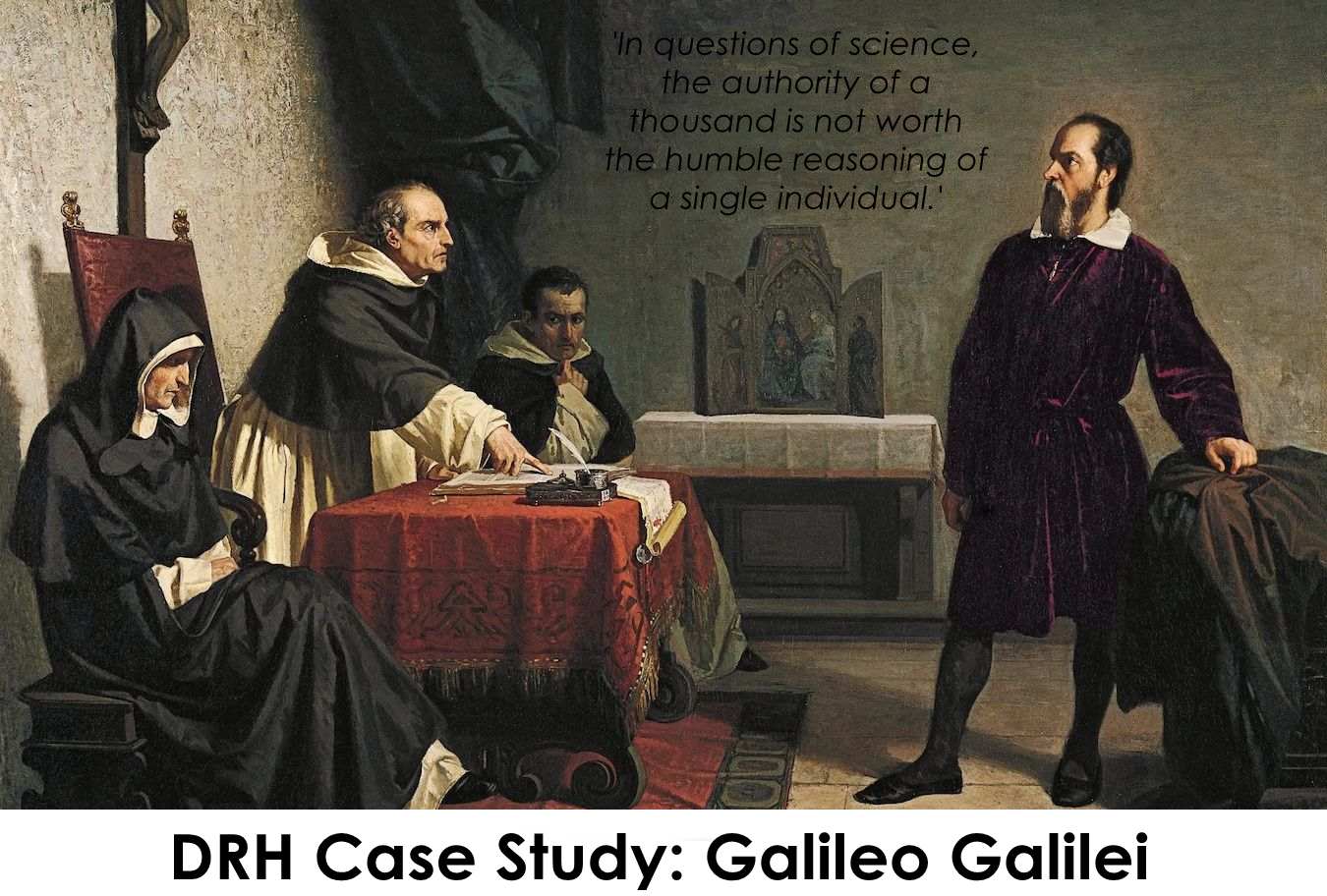
Galileo Galilei: A Deindividuation Resister and Champion of Individual Thought
Introduction
Galileo Galilei (1564–1642) stands as a towering figure in science not only for his revolutionary discoveries in astronomy and physics, but also for his remarkable intellectual independence and courage. He lived in an age when conformity to Aristotelian science and Church doctrine was expected of scholars, yet Galileo consistently put evidence and reason above social approval. In psychological terms, he can be seen through the Deindividuation Resister Hypothesis (DRH) as one of the rare individuals who resisted social conditioning and held onto his individual judgment despite tremendous pressure to conform. Likewise, the Neurological Spectrum Model (NSM), which envisions a spectrum from the extremely Individual thinker to the extremely Social Person, would place Galileo near the Individual end. Such an Individual 'acts based on their individual judgment alone' and does not bend to outside influences - an apt description of Galileo's character. This analysis will chronologically explore Galileo's life - his personal background, scientific achievements, intellectual struggles, and clashes with authority - interwoven with commentary on how he exemplified the traits of a deindividuation resister and an extreme individual on the neurological spectrum. The aim is to show, with historical evidence, that Galileo's steadfast refusal to 'just follow the crowd' and his willingness to speak truths that defied collective belief made him a prime example of how human progress is driven by independent minds.
Early Life and Education: An Independent Mind Develops
Galileo was born in Pisa, Italy, in 1564 to a family of modest nobility. His father, Vincenzo Galilei, was a respected music theorist who had hoped his son would pursue a stable and lucrative profession in medicine. Dutifully, teenage Galileo enrolled at the University of Pisa in 1580 to study medicine as his father wished. However, Galileo's own intellectual passions soon took a different course. He became fascinated by mathematics and natural philosophy, areas not socially esteemed as medicine was, and he began attending geometry lectures in secret. In a decisive act of youthful autonomy, Galileo convinced his 'reluctant father' to allow him to abandon medical studies and officially switch to mathematics and natural philosophy. This early turning point illustrates Galileo's emerging profile as a deindividuation resister: instead of yielding to parental and societal expectations of a medical career (the 'safe' path for social acceptance), he upheld his individual interests and judgment. Such resistance to social conditioning - choosing authenticity over conformity - is rare, as 'the vast majority of people' are conditioned to prioritise fitting in, whereas only a few 'hold on to their individual identities despite the repercussions'. Galileo clearly belonged to that uncommon few from the very start of his life.
Galileo left the University of Pisa without a degree in 1585, opting to continue learning on his own and through tutoring students in mathematics. This period of self-directed study further exemplifies his individualistic approach. Rather than following a prescribed academic path, Galileo followed his own curiosity - a trait often found in deindividuation resisters, who 'tend to teach themselves in areas that interest them' and retain the inborn intellectual curiosity that social conditioning often dampens. In later writings, Galileo would famously argue that the 'book of nature is written in the language of mathematics,' insisting on learning directly from observation and logical analysis rather than deferring to established authority. That mindset was already visible in his youth. It is telling that even as a student, Galileo's first scientific observations - such as his study of a swinging chandelier in Pisa's cathedral leading to the discovery of the pendulum's isochronism - came from his own experimental curiosity rather than any assignment or expectation from his teachers.
Thus, by the end of his adolescence, Galileo had demonstrated a strong Individual orientation in NSM terms: he trusted his own perceptions and reasoning over the conventional wisdom handed down to him. He was drawn to the unique, original, and creative thinking that characterises individuals, rather than the rote acceptance of received knowledge that group-minded thinking often entails. In a time when young scholars were generally expected to 'fulfil the expectations of those in positions of authority', Galileo was already pushing back, carving out an identity as a thinker in his own right. This independent streak set the stage for the transformative - and tumultuous - career that would follow.
Academic Career and Scientific Discoveries: Originality vs Conformity
In 1589, Galileo, at age 25, secured a position as the chair of mathematics at the University of Pisa, giving him a platform to teach and further his research. From the outset of his academic career, Galileo's methods and findings challenged the orthodox doctrines embraced by his colleagues. According to his early biographers, during this Pisa period Galileo performed a bold experiment: he allegedly dropped balls of different weights from the Leaning Tower of Pisa to demonstrate that, contrary to Aristotle's teaching, objects fall at the same acceleration regardless of mass. Whether apocryphal or not (the story comes from Galileo's pupil Vincenzo Viviani), it symbolises Galileo's willingness to literally defy gravity and authority at once. By experimentally disproving a long-held Aristotelian belief in public, Galileo was in effect rebuking the intellectual conformity of his peers. Such behaviour did not endear him to the conservative faculty at Pisa. In fact, 'his attacks on Aristotle made him unpopular with his colleagues, and in 1592 his contract was not renewed'. The loss of his position at Pisa - effectively a punishment for his nonconformity - is a concrete instance of the backlash from collective-identity structures that the DRH predicts for resisters. The university establishment in late 16th-century Italy was heavily invested in Aristotelian scholasticism (an intellectual ingroup with its own dogmas), and Galileo's refusal to stay within accepted parameters of thought was met with institutional pushback.
One telling anecdote from this period underscores Galileo's exceptional integrity as an independent thinker. It is recorded that on one occasion a member of one of Italy's most powerful aristocratic families approached Professor Galileo with a design for a machine, expecting lavish praise for his ingenuity. Galileo, however, would not compromise the truth for flattery or favour. Even at the risk of offending a influential patron, he honestly informed the nobleman that the machine would not work as proposed. The wealthy man, humiliated by Galileo's frank critique, used his influence to have Galileo removed from his post at Pisa - prompting Galileo to resign rather than kowtow to political pressure. In light of the NSM, this story highlights Galileo's place on the far Individual end of the spectrum: 'The Individual says what they mean and what they know to be true,' whereas 'The Social Person says what is expected of them ... regardless of the facts'. Galileo's truth-telling to the powerful, in defiance of expected deference, was an act of personal accountability and principle. It illustrates how he would not absorb the expectations of a social superior at the expense of reality - a classic trait of a deindividuation resister who holds fast to personal judgment.
Fortunately for Galileo, his talent had not gone unnoticed. In 1592 he was offered the chair of mathematics at the University of Padua in the more liberal Venetian Republic, at a much higher salary. He taught in Padua for 18 years, calling them 'the best years of his life,' during which he conducted groundbreaking research. Freed from some of the constraints of the more traditionalist Tuscan environment, Galileo flourished. He studied mechanics, undertook experiments in motion, and worked on inventions (such as an early thermometer and a powerful water pump). Most famously, in 1609 he learned of a new invention from Holland - the telescope - and rapidly built improved telescopes of his own. Turning his telescope to the night sky, Galileo made astonishing discoveries: mountains and craters on the Moon, four moons orbiting Jupiter, the phases of Venus, sunspots, and countless new stars in the Milky Way. Each of these findings challenged the prevailing collective belief that the heavens were perfectly unchanging and that all celestial bodies revolved around the Earth.
Galileo's empirical discoveries were initially met with scepticism and even denial by many scholars who were deeply wedded to the Aristotelian-Ptolemaic cosmology. Notably, when he announced the existence of Jupiter's moons in 1610 (something no human had seen before), many astronomers 'initially refused to believe that Galileo could have discovered such a thing' since a planet with satellites contradicted the axiom that all heavenly bodies must orbit Earth. Some scholars attacked the credibility of the telescope itself rather than accept a result that defied their worldview. This reaction is a textbook example of what DRH describes: group members replacing the reality they see with the reality their group perceives as true. The scholarly community's collective identity - grounded in centuries of Aristotelian authority - made them resist even direct sensory evidence. Galileo, by contrast, insisted on seeing the world as it is, rather than as his group perceived it, just as an Individual on the neurological spectrum would. He welcomed the progress that new evidence heralded, whereas the Social Persons around him feared the change and clung to the status quo. Galileo's ability to 'connect the dots' from his observations to broader truths, unencumbered by doctrinal blinders, was partly a function of his refusal to have his perception pruned by conformity - a trait identified in DRH as common among those who resist deindividuation.
Importantly, Galileo did not work entirely in isolation - he sought and obtained support from forward-thinking members of society, including powerful patrons. He dedicated his discovery of Jupiter's moons to Cosimo II de' Medici (naming them the 'Medicean stars'), winning the Medici family's patronage as 'Mathematician and Philosopher' to the Grand Duke of Tuscany. This move shows Galileo's practical acumen in navigating social structures to protect and advance his work. Yet it was a strategic alliance, not an act of conformity: Galileo never diluted his scientific claims to please his patrons. In fact, the Medici patronage later provided only partial shield when Galileo's work ran afoul of the Inquisition. We see here a nuanced aspect of Galileo's individualism - he understood the need to engage with society (he was not a sullen recluse), but he engaged on his own terms. He practiced what DRH might call principled non-conformity: outwardly he could exercise diplomacy, but he never surrendered his core commitment to truth. As a result, even while he enjoyed fame and support as Europe's most celebrated astronomer of the time, he was laying the groundwork for an ultimate confrontation with the ultimate authority of his era: the Roman Catholic Church.
Confrontation with Authority: The Heliocentrism Affair
By the early 1610s, Galileo's observations had convinced him that Nicolaus Copernicus's heliocentric model (which posited the Sun at the centre of the cosmos) was physically true. This put Galileo on a direct collision course with the Catholic Church, which regarded geocentrism (Earth at the centre) as not only the scientific consensus of the day but also as aligned with Scripture and Church tradition. Here, the collective identity structure whose norms Galileo defied was enormous in scale: virtually all of educated European society, guided by the Church, subscribed to the Aristotelian geocentric view of the universe. Questioning this cosmology was seen as an attack on the very framework that underpinned religious and social order. In 1615, Galileo's advocacy of Copernican theory was formally investigated by the Inquisition, which declared his views 'contrary to Scripture'. The following year, he was admonished by Cardinal Bellarmine (on the Pope's orders) to abandon the heliocentric idea entirely. Galileo temporarily complied outwardly - a pragmatic pause, perhaps, in line with what DRH observes about even resisters needing to 'subscribe to a religion, at least outwardly, if they wanted to survive' in those times. But he did not change his mind or cease his private investigations.
After a new pope (Urban VIII) who was initially sympathetic came to power, Galileo felt it might be safe to publish his ideas. In 1632 he released his masterwork Dialogue Concerning the Two Chief World Systems, a book which presented arguments for and against heliocentrism. Although Galileo maintained a veneer of neutrality in the dialogue, the work was widely perceived as a compelling endorsement of the Copernican system - and worse, it seemed to lampoon the Pope's own views by putting the defence of geocentrism into the mouth of a buffoonish character named Simplicio. This perceived affront to authority proved too much. The previously supportive Pope Urban VIII reacted as an injured leader of an identity group (the Church) who felt one of his own had betrayed him. Galileo was summoned to Rome to face trial for heresy in 1633. In DRH terms, we witness the full force of collective conformity enforcing itself: the Church demanded Galileo's compliance and submission to its cosmology, and when he resisted, they moved to punish and silence him. The trial verdict was severe. Galileo was found 'vehemently suspect of heresy' for holding and teaching that the Earth moves, forced to recant his views under threat of torture, and sentenced to lifelong imprisonment - a sentence later commuted to house arrest. For the remaining nine years of his life, the 70-year-old Galileo lived confined to his home and forbidden to publish on the Copernican topic.
This dramatic confrontation vividly demonstrates how Galileo's personal traits as a deindividuation resister brought him into conflict with a monolithic group authority. The Catholic hierarchy exhibited what NSM would classify as extreme Social Person behaviour: they insisted on unquestioning loyalty to group doctrine, placed hierarchy and obedience above empirical reality, and refused to 'question the orders of their superiors' or the interpretations of Scripture handed down through tradition. Galileo, by contrast, fulfilled the role of the Individual to the utmost: 'someone who acts based on their individual judgment alone'. Even when standing before the Inquisition - arguably the most intimidating social pressure imaginable - Galileo never truly surrendered his inner conviction that the Earth moves around the Sun. (Legend has it that after recanting, he muttered 'Eppur si muove' - 'And yet it moves' - under his breath, an anecdote that, while apocryphal, perfectly encapsulates Galileo's unbroken spirit of independent thought.) In the dialectic between individual judgment and external pressure, Galileo's case was an extreme test. As the DRH notes, for most people the struggle between following one's conscience and obeying authority is 'an easy victory for the latter'. Galileo, however, represents the minority in whom conscience and reason prevail, regardless of consequences. His willingness to face isolation, condemnation, and the loss of reputation for the sake of what he knew to be true is a hallmark of the neurological Individual who 'stands up for what they believe is right and just, regardless of their affiliation'. In modern parlance, many of Galileo's qualities - obsessiveness about the truth, intolerance for logical contradiction, indifference to others' disapproval - might be considered atypical or even pathologised. Indeed, the DRH argues that the very trait of refusing to conform has often been labelled as a defect (for example, in the context of autism) by a society that cannot understand nonconformity. Galileo's fate exemplifies this: his steadfast individualism was treated as a crime and a heresy. Yet, paradoxically, it is exactly this kind of steadfast individualism that drives humanity forward.
Under house arrest, Galileo remained intellectually active. In 1638, he managed (with help from friends smuggling out manuscripts) to publish Two New Sciences, a work summarising his decades of research on motion and materials. This final achievement, accomplished in defiance of a ban on his writings, reinforces how integral Galileo's independent thinking was to his identity. Even blindness and confinement could not entirely quench his investigative spirit. In Two New Sciences, one hears Galileo's authentic voice discussing experiments and results without regard to the prior authority - the same voice that had been silenced in public. It is a poignant coda: the Individual continuing to 'promote the moral and intellectual values he lives by' - honesty, experimentation, reason - whereas the social order had only temporarily suppressed them. Galileo's life, especially the climactic heliocentrism affair, thus encapsulates the central DRH narrative: an individual who 'didn't just follow orders' or the crowd and who faced the wrath of the collective for it.
Legacy: Progress Through Individuality
Galileo's story has a resounding epilogue. Though he died in 1642 still under house arrest and nominal disgrace, history has vindicated his individual-driven approach to knowledge. The scientific revolution that he helped spark only gained momentum after him. His work on motion laid crucial groundwork for Sir Isaac Newton, and his insistence on experiment and mathematical laws paved the way for modern physics. Perhaps even more importantly, Galileo became an icon of intellectual freedom. In the centuries after, he was increasingly celebrated as a man who 'had the willingness to stand up to authority … to defend his findings.'
This willingness is exactly what the DRH identifies as the engine of human progress: 'All the people who drove human progress have been deindividuation resisters ... who refused to uncritically conform to their groups and unquestioningly obey authorities.' Galileo's name stands alongside those of other great 'heretics' and pioneers - thinkers like Darwin or Einstein - who also bucked the norms of their communities in order to advance understanding. Each of these figures faced hostility in their time, yet their individualistic contributions proved invaluable. In Galileo's case, the truth of Earth's motion and the nature of the cosmos could not be repressed forever. By 1758 the Church dropped its general ban on pro-Copernican works, and by 1835 even Galileo's Dialogue was removed from the Index of prohibited books. In 1992 - over 350 years after Galileo's trial - Pope John Paul II formally acknowledged the errors made by the Church in condemning Galileo. The long arc of history thus bends toward the side of the one who saw reality correctly through his own eyes, rather than those who 'replaced the reality they saw with what the group perceived as reality'.
From the perspective of the Neurological Spectrum Model, Galileo's life illustrates the immense potential - and cost - of residing at the far Individual end of the spectrum. Individuals like him, who operate from internal principle and curiosity, are the innovators, explorers, and truth-tellers who push boundaries (Galileo's contributions indeed earned him titles like 'father of modern observational astronomy' and 'father of modern science'). The NSM notes that at the individual end one finds 'innovators, artists, pioneers, human rights activists and whistleblowers' - Galileo was clearly a scientific pioneer and in some sense a whistleblower against the false consensus of geocentrism. His antithesis, the extreme Social Person, might be exemplified by those churchmen and philosophers of his day who refused to look through his telescope or who condemned him to protect the prevailing doctrine. They were 'people pleasers' and 'crowd followers' of their era, defending an inherited worldview out of loyalty and fear of change. Galileo, in contrast, showed how an Individual can 'welcome progress as they appreciate everything that improves their life and that of others,' whereas a Social Person 'believes the status quo or even a past state is ideal and any change is detrimental.' In 1633, Galileo stood alone, condemned; but by being right and brave, he helped shift the 'status quo' for all who came after. The collective mindset that punished him eventually had to adapt to the new reality he revealed.
Galileo's life also invites a deeper reflection on the psychology of resisting deindividuation. It was not an easy road - he paid with personal hardship, including isolation and the tarnishing of his reputation among contemporaries. The DRH posits that such individuals often endure being 'ostracised and pathologised' by the majority. Galileo indeed was treated as a dangerous misfit in his final years. Yet, he also experienced the profound fulfilment of intellectual autonomy. Throughout his life, Galileo appears to have derived satisfaction from thinking for himself and discovering truths first-hand. This intrinsic reward echoes the DRH view that while most people seek acceptance by conforming, a few find a more meaningful path in authenticity despite rejection. Galileo's 'neurological identity,' to use the NSM's language, was tilted toward logic, evidence, and principle - so much so that he could not force himself to see the world through the distortions of collective dogma. In one of his letters, Galileo wrote that he could not ignore sensory evidence because 'I do not feel obliged to believe that the same God who has endowed us with senses, reason and intellect has intended us to forgo their use'. This statement (to the Grand Duchess Christina in 1615) encapsulates his refusal to subordinate individual reason to authority. It also hints at how Galileo reconciled his personal faith with his science: by quietly 'amending the teachings' of his religion to fit what his own mind knew to be true. Many deindividuation resisters historically had to walk this fine line, outwardly honouring the group's rituals while inwardly maintaining their independence. Galileo's balancing act - remaining a devout Catholic in belief, yet fundamentally revising how scripture should be interpreted in light of science - fits this pattern.
In conclusion, Galileo Galilei's biography, seen through the lens of the DRH and the NSM, exemplifies the power and predicament of the individual thinker in society. He steadfastly resisted social conditioning, be it the pressure to pursue an approved career, to accept the academic consensus, or to obey an institutional decree against his scientific convictions. He valued his own judgment over group conformity, demonstrating the courage to say 'the machine will not work' or 'Jupiter has moons' when everyone else expected or demanded a different answer. And he faced backlash from collective-identity structures at its harshest - expelled from positions, denounced by peers, condemned by the Church - yet never lost his integrity or his pursuit of truth. Galileo's life validates the notion that progress is propelled by those who dare to be individuals. In him, we see the archetype of the scientist as rebel: someone who, due to perhaps an innate neurological wiring or an extraordinary strength of character (likely both), could not simply 'follow the orders' or beliefs of others. Instead, he lit his own path. The world eventually followed. Galileo's legacy is thus twofold - the substantive scientific knowledge he uncovered, and the model he provided of how to pursue knowledge: with fearless autonomy, critical thinking, and resistance to the lullaby of consensus. It is a legacy that speaks across the ages, reminding us that every time we 'stand on the shoulders of giants' in science, it is often on the shoulders of those who stood apart from the crowd. In the final measure, Galileo Galilei exemplifies the Deindividuation Resister Hypothesis' ideal of the individual hero, and he vindicates the Neurological Spectrum Model's insight that society's real visionaries are those who remain closest to the Individual extreme, where seeing reality clearly matters more than being called normal.
References:
Galileo's life events and quotations are documented in numerous historical sources, including his own letters and well-regarded biographies. The interpretive framework applied here is drawn from the Deindividuation Resister Hypothesis and the Neurological Spectrum Model, which offer a modern psychological lens to understand Galileo's individuality. His scientific clashes with academia and the Church are recounted in the works of scholars and in records of his trials, illustrating how his experience aligns with these theories. Ultimately, Galileo's story teaches that while collective identities may punish the nonconformist in the short term, it is the courage to 'see the world as it is' and not as the group says that drives humanity forward.