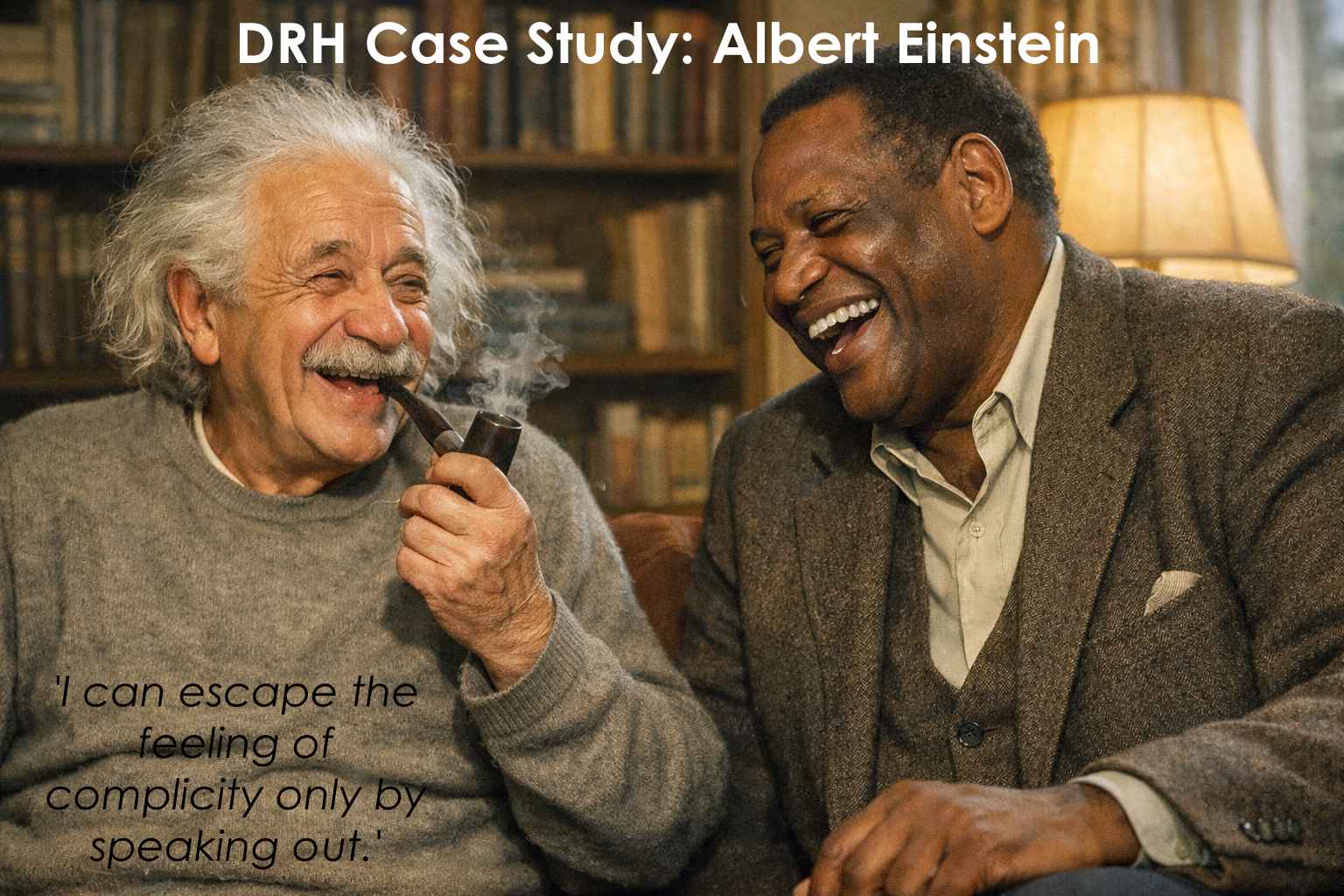
Albert Einstein: A Life of Individuality and Resistance to Group Conformity
Introduction: Einstein Through the DRH and NSM Lens
Albert Einstein's legacy is often defined by his groundbreaking contributions to physics, but equally remarkable is how he lived as an independent thinker and moral voice in society. We can interpret his life through the Deindividuation Resister Hypothesis (DRH) - which posits that human progress is driven by those rare individuals who resist social conditioning and maintain their personal identity despite pressures to conform - and the Neurological Spectrum Model (NSM), which describes a continuum between the Individual and the Social Person poles of human identity. At the 'Individual' extreme is someone who acts on personal judgment and stays immune to outside influence, whereas the 'Social Person' absorbs group expectations with no sense of self. Throughout his life, Albert Einstein exemplified the traits of a 'deindividuation resister', consistently aligning with the Individual end of this spectrum. He resisted collective norms in education, defied militaristic and nationalistic fervour, and spoke out against social injustices - all while retaining a strong sense of individual identity and ethical autonomy. This biography explores Einstein's personal development, professional milestones, social views, and historical legacy through the framework of DRH and NSM, highlighting how each phase of his life was marked by an unusual refusal to 'join the crowd' and a steadfast commitment to his own conscience and reason.
Early Life and Education: An Independent Mind Emerges
Albert Einstein was born on March 14, 1879, to a secular Jewish family in Germany - an upbringing he later described as 'intellectually privileged' due to its lack of rigid religious or ideological conditioning. From a young age, Einstein displayed a strong will and independent thought, often at odds with the social conditioning attempts of his environment. As a child, he experienced a brief self-motivated religious phase, devoutly observing Jewish traditions for a time, but this ended abruptly around age 12 when he began questioning organised religion's dogmas against scientific evidence. This early scepticism toward inherited beliefs hinted at a mind inclined to personal reasoning over collective doctrine - a hallmark of a deindividuation resister.
In school, Einstein's independent streak quickly became evident. He was educated at a strict Gymnasium in Munich, where rote learning and military-style discipline were the norm. The young Einstein 'loathed the dull, mechanical method of teaching' and chafed under authoritarian teachers. Classmasters found him 'precocious and insolent', as he refused to simply memorise and recite, instead asking probing questions and challenging orthodox answers. One frustrated instructor even taunted him that he'd never amount to anything - an accusation often faced by children who won't conform to the narrow definition of 'normal' behaviour. This tension culminated when, at age 15, Einstein decided to leave school early. He obtained a doctor's note to excuse him from classes and dropped out rather than endure an education that stifled his curiosity. This act of youthful rebellion - effectively resisting the deindividuation process that . This act of youthful rebellion – effectively resisting the deindividuation process that demanded obedience - came at a cost (his parents were alarmed that he was now a dropout) but demonstrated Einstein's willingness to uphold his authentic self over others' expectations.
Another formative incident underscored Einstein's innate aversion to group conformity. As a boy, watching a military parade, Einstein famously burst into tears because he could not fathom why people would march in lockstep to someone else's commands. The spectacle of uniformed soldiers moving 'mindlessly on the orders of someone else' horrified him. This emotional reaction reveals the young Einstein's intuitive revulsion against the loss of individuality in group settings. He simply could not imagine surrendering his will to a collective force - an early sign of what NSM calls an Individual-oriented perspective, one that 'doesn't ‘just follow orders' … but stands up for what they believe is right'. In later years, Einstein would recall that moment as pivotal to his hatred of militarism in all forms.
By his late teens, Einstein's resistance to authoritarian structures took a very concrete turn. At 16, facing the prospect of compulsory military service in the German army, he chose a path that set him apart from virtually all his peers: he renounced his German citizenship in 1896 to avoid conscription. Einstein essentially became stateless rather than don a uniform - a bold act of conscientious objection that foreshadowed his lifelong pacifism. His family was initially upset that he was now seen as a draft-dodger, but Einstein's conscience left him no alternative. As a pacifist even in youth, he later remarked that 'the pioneers of a warless world are the youth who refuse military service'. This early decision to reject an expected collective duty (serving in the army) was a profound assertion of individual identity. In terms of NSM, it was a move firmly on the 'Individual' side - prioritising personal moral judgment over the 'binding... nationalist allegiances' that society tried to impose. In fact, Einstein hoped for a future world with no fanatic nationalism at all, and he himself would hold multiple citizenships (Swiss, later American) without ever embracing fervent patriotism. Already in his youth, Einstein was demonstrating that belonging to himself mattered more than belonging to any regimented group.
Intellectual Autonomy and Scientific Breakthroughs
In 1896, after leaving Germany, Einstein moved to Switzerland – a country he favoured for its more liberal environment - and enrolled at the renowned Swiss Federal Polytechnic in Zürich. Even in this university setting, where he finally could study physics, Einstein preserved an unusually autonomous learning style. He often skipped formal lectures to study on his own, following his curiosity rather than the curriculum. Classmates noted that he would read the professors' notes at home and then work independently on problems that interested him. This habit reflected the trait of a deindividuation resister to self-direct their education. As one biographer put it, Einstein 'frequently cut classes to study on his own,' remarking wryly that 'it is a miracle that curiosity survives formal education'. That quip encapsulated his view that genuine learning comes from individual inquiry, not passive conformity to classroom drills. It also echoes the DRH observation that progress 'happens outside the norm', driven by those willing to break free of standard schooling and think for themselves. Indeed, many iconic innovators were largely autodidacts - Charles Darwin and Gregor Mendel, for example, taught themselves in pursuit of their interests - and Einstein was very much of that mould. He learned deeply beyond the prescribed syllabus, collaborating in student study groups and devouring advanced texts on physics that fed his imagination.
After graduating in 1900, Einstein hit a short-lived wall with the academic establishment: his unorthodox approach and lacklustre attitude in some courses meant no professor was eager to hire him as a teaching assistant. Instead, he took a job as a technical examiner at the Swiss Patent Office in Bern, a mundane position that became an unlikely incubator for revolutionary science. Working full-time as a patent clerk, Einstein would steal time for physics by pondering thought experiments at his desk and scribbling equations after hours. Free from the pressures of academic conformity or the need to please a superior, he later recalled these years as idyllic: 'the years of my curiosity-driven discoveries were the happiest of my life – no one expected me to lay golden eggs on schedule'. In 1905, this 26-year-old outsider stunned the scientific world by publishing a quartet of papers that fundamentally changed physics - explaining Brownian motion, devising the special theory of relativity, introducing the revolutionary idea of mass–energy equivalence (E = mc²), and confirming the existence of atoms and light quanta. Historians call it Einstein's 'annus mirabilis,' or miracle year. It is hard to imagine a more striking example of creative individual thinking triumphing over collective expectation: while conventional science at the time was largely mired in classical Newtonian paradigms, Einstein - working in isolation from the mainstream - connected insights from disparate sources (Maxwell's electrodynamics, philosophical questions about time, statistical mechanics) to overturn long-held assumptions. According to the DRH framework, deindividuation resisters often retain an ability to 'logically connect facts, information and observations that appear unrelated to others' precisely because they are not limited by the same habitual schemas that mainstream minds adopt. Einstein's intellectual independence enabled him to see patterns where others saw paradoxes, leading to innovations that socially conditioned thinkers had missed.
It took time for the collective scientific community to catch up and accept Einstein's ideas. At first, some academics reacted with scepticism or even hostility - a famous book published in 1931, Hundred Authors Against Einstein, compiled essays from numerous scientists attempting to refute relativity (some motivated by nationalist and anti-Semitic bias). But Einstein's work was robust, and gradually the evidence vindicated him. By 1919, measurements during a solar eclipse confirmed his theory of gravity (general relativity), making front-page news worldwide. Einstein, the once-neglected patent clerk, had become the world's first scientific celebrity. Notably, he did not bask in fame in the manner of a traditional hero or nationalist icon. True to his individualist nature, Einstein remained personally modest and even uncomfortable with fame's demands. He often dodged the press and declined invitations to be lauded, joking to fans who recognised him on the street, 'Oh yes, people say I look like Einstein'. 'The only way to escape the corruptible effect of praise is to go on working,' he said, and he did just that. Even as he accepted prestigious positions (a professorship in Berlin, membership in academies) and eventually the 1921 Nobel Prize in Physics, Einstein refused to become an establishment figure in the usual sense. He maintained his informal, non-conformist style - famously neglecting socks even when invited to the White House, to the horror of etiquette-minded peers - and continued to think and speak with the frankness of a free agent, not a servant to any institution. This was fully in line with the NSM's Individual archetype: Einstein saw the world 'as it is' and said what he meant to say, rather than tailoring his words to please any authority. Whereas a Social Person in his position might have become a complacent insider proud of belonging to the elite, Einstein stayed an outsider-at-heart, proud only of truthful achievements, not of titles or group status.
Einstein's relationship with conventional institutions remained one of creative tension. He valued collaboration and exchange of ideas, but only insofar as they did not infringe on intellectual honesty. For example, in the 1920s he joined the League of Nations' Committee on Intellectual Cooperation, hoping to foster international scientific collaboration for peace. Yet when he felt the League's political entanglements rendered it ineffective - it failed to prevent escalations like France's occupation of Germany's Ruhr Valley - Einstein resigned in protest, stating he doubted the League's sincerity and strength. He was not one to lend his name to causes he did not fully believe in, no matter how respectable the group. Throughout his scientific career, Einstein also bucked certain 'groupthink' trends among physicists. In the 1930s, when the rise of quantum mechanics introduced indeterminacy in physics, Einstein famously dissented with the popular Copenhagen interpretation, quipping 'God does not play dice.' It was not fashion or peer pressure that guided him, but his own reasoned sense of what truth ought to look like. In this way, Einstein exemplified the Individual who 'promotes the moral (or in this case, intellectual) values they truly live by,' rather than a Social Person who might espouse ideas just because they are the prevailing consensus. His scientific creativity was the flipside of his social nonconformity - both rooted in an intrinsic refusal to let prevailing opinion override personal judgment.
Rejecting Nationalism and Militarism
Einstein's instinctive resistance to group conformity was perhaps most strikingly displayed in his response to war and nationalism. Living through the era of World War I and the rise of fascism, Einstein distinguished himself by the boldness with which he defied patriotic mass hysteria. At a time when many intellectuals in Europe eagerly marched in lockstep with their nations' war efforts, Einstein was a voice in the wilderness for peace. In 1914, soon after he had moved to Berlin, the First World War broke out. The German government circulated a manifesto signed by 93 prominent German scholars and artists, stridently justifying Germany's militarism. Einstein refused to sign this pro-war manifesto. Instead, he aligned with a tiny counter-movement: he was one of only four courageous individuals in Germany to sign the Manifesto to Europeans, a document that condemned militarism and 'this barbarous war' while urging a united, peaceful Europe. This was an extraordinary stance for a German professor in 1914, amounting to open dissent against the fervent nationalism of his colleagues. Most of Einstein's peers at the Prussian Academy considered such pacifism nearly treasonous - he was isolated and even viewed with suspicion for it. Yet, consistent with the DRH idea that 'progress is the result of individuals who don't "just follow orders"', Einstein would not bow to the crowd's war fever. He later remarked how dismayed he was that 'even men of high culture [in Germany] cannot rid themselves of narrow nationalism', observing that otherwise intelligent people had essentially succumbed to herd thinking.
Throughout World War I, Einstein quietly but resolutely supported anti-war and pro-democracy efforts. He helped form a pacifist student society, spoke in private against Germany's authoritarian government, and lent his name to calls for a more democratic politics at home. When the war ended in 1918 and Germany underwent a revolution, Einstein was outspoken in favour of the new democratic republic. This outspokenness did not endear him to reactionaries. By the early 1920s, right-wing nationalists and anti-Semites in Germany regularly vilified Einstein - not only for his ethnicity and his 'unpatriotic' politics, but even by attacking his scientific theories as 'un-German.' He became a favourite target of extremist groups. At one lecture, nationalist students shouted and threatened to lynch him. Undeterred, Einstein continued to denounce what he called 'the madness of militarism'. In 1922, after the assassination of a top Jewish statesman (Walther Rathenau) by ultra-nationalists, friends warned Einstein that his life could be at risk; nevertheless, he appeared publicly at a Berlin peace rally, declaring 'war is a terrible thing and must be abolished at all costs'. This willingness to stand up in public against violence and bigotry, even under threat, shows how far Einstein was from the Social Person who lives in fear of disobeying the group. Instead, he exemplified the Individual who 'doesn't accept authority over them when it is based on hierarchy or social constructs,' and who will not stay silent in the face of injustice. He felt a personal responsibility for his actions and words, in contrast to those who excused their complicity by saying they were 'just following orders' - an attitude he abhorred.
Einstein's rejection of aggressive nationalism was also evident in how he handled his citizenship and national affiliations. As noted, he renounced his birth citizenship to avoid military service as a youth. He became a Swiss citizen and lived for years in neutral Switzerland. After World War I, he did re-accept German citizenship when he joined the Prussian Academy, but only in a technical sense - his loyalty was never to 'Germany right or wrong.' In fact, Einstein was the epitome of a cosmopolitan thinker who considered himself a citizen of the world. He often quipped that if he had to identify with a group, it would be the 'human race' above any nationality. By 1933, when Adolf Hitler rose to power in Germany with a virulently collective (and genocidal) ideology, Einstein made a final break: he fled Germany, and soon after renounced his German citizenship again. The Nazi regime had already begun smearing Einstein - they published his name on a list of enemies and even put a bounty on his head, labelling his theory 'Jewish physics.' Einstein needed little prompting to abandon a nation that demanded racial conformity and blind allegiance. He resigned from all German institutions and eventually settled in the United States as his new home. It is telling that Einstein was cast out by the extreme 'Social Persons' of his time - the Nazis, who embodied the furthest collective end of the neurological spectrum with their insistence on total conformity, hierarchy, and elimination of those who were 'different.' In contrast, Einstein's values lay with the opposite end: he championed universal human rights, international cooperation, and the sanctity of the individual conscience over any ethnic or national division. In NSM terms, he consistently viewed society 'as a horizontal entity in which each individual is of equal value,' rejecting the fascist vision of a vertical hierarchy of superior and inferior groups. This principle also underpinned his later advocacy for a world federal government to prevent war - he believed only by transcending nationalistic loyalties could humanity avoid self-destruction.
Einstein's principled stands often invited comparison to other dissenters in history. For example, his insistence on not serving in the military and encouraging youth to resist conscription foreshadowed later movements of conscientious objection. In the mid-20th century, figures like Nelson Mandela in South Africa and Martin Luther King Jr. in the United States would likewise defy the laws or customs of their societies in pursuit of justice - and, like Einstein, would be deemed troublemakers by the mainstream for doing so. Einstein's life shows that such deindividuation resisters often face intense pushback from the majority, yet their courage to say no when everyone else says yes is precisely what drives social progress. As the DRH author writes, 'all these people, and many more, changed this world because, when they deemed it necessary, they refused to conform and comply in the face of ostracisation, discrimination, persecution, physical violence and even murder… they did what they did because they knew it was the right thing'. Albert Einstein belongs in this pantheon of individuals who, in moments of crisis, privileged their personal ethics over the comfort of group approval.
Activism and Advocacy for Human Rights
After emigrating to the United States in 1933, Einstein could have chosen a quiet life of scientific research far from the political turmoil of Europe. Instead, he quickly became an active voice in American public affairs, leveraging his fame to shine a light on social injustices. In particular, Einstein was appalled by the systemic racism he witnessed in his new country. As a Jew who had experienced discrimination and seen the worst that ethnic hatred could produce, Einstein empathised deeply with the plight of African Americans. He did not hesitate to speak out: as early as 1931, while still splitting time between Europe and the U.S., Einstein joined a committee to protest the notorious Scottsboro Boys case - a racially charged miscarriage of justice in Alabama. This was a controversial stance for a prominent scientist, especially one who was a guest in America, but Einstein's moral compass demanded it. He firmly believed scientists and intellectuals had a duty to use their voices for justice, not just hide in ivory towers. In one interview he stated plainly that he 'was never one to just stick to the science', and he proved it through his deeds.
Throughout the 1930s and 1940s, Einstein consistently aligned himself with the civil rights movement and other progressive causes. In 1937, he welcomed the famed opera singer Marian Anderson (an African American woman barred from staying at segregated hotels) into his own home - a quiet act of defiance against racist norms. In 1946, he gave a commencement speech at Lincoln University (a historically black college), in which he condemned American racial segregation as a malignant societal ill. 'There is separation of colored people from white people in the United States,' Einstein observed, 'That separation is not a disease of colored people. It is a disease of white people. I do not intend to be quiet about it.'. Calling racism America's 'worst disease,' Einstein made it clear he saw prejudice as incompatible with the ideals of freedom. His stance was that of a true Individual in NSM terms: someone who 'cares about the wellbeing of others, regardless of how different these people may be', and who refuses to stay silent about violations of fundamental rights. Meanwhile, the Social Person mentality in mid-century America - which accepted or turned a blind eye to Jim Crow segregation out of a desire to fit in or not make waves - was anathema to Einstein. He criticised such complacency as a betrayal of the country's own constitution. In a 1946 address to the National Urban League, he pointed out the hypocrisy of excluding black Americans from equal rights, calling it 'a slap in the face of the Constitution'. These were strong words at a time when it was unusual for a white public figure of his stature to so openly champion racial equality.
Einstein didn't stop at words. He also took action and lent his prestige to organisations fighting racism. He became a member of the NAACP and worked closely with noted civil rights leaders. For example, he struck up a 20-year friendship with Paul Robeson - the African American singer, actor, and activist - finding common cause with him on many initiatives. In 1946, Robeson invited Einstein to serve as co-chair of the American Crusade Against Lynching (A.C.A.L.), a campaign to pass federal anti-lynching legislation. Einstein accepted, despite knowing it could make him a target for reactionary politicians. He personally lobbied President Harry Truman as part of this role. He also supported famed black scholar W.E.B. Du Bois during Du Bois' trial for alleged subversion, even offering to testify as a character witness - a gesture that led the judge to drop the case, not wanting the embarrassment of pitting the U.S. government against the world's most famous scientist. These examples show Einstein deliberately using his Individual status to challenge unjust group dynamics. Unlike many who would shy away to protect their reputation, Einstein put principle before popularity. Some of his own scientific colleagues cautioned him against such activism; even friends like Max Born gently warned him that he was naïve about politics and should avoid stirring controversy. But Einstein's integrity and empathy overruled any desire to placate his peers. He replied that his celebrity meant little if he couldn't use it to speak for those without a voice.
Einstein's outspoken activism did not go unnoticed by the authorities. In the climate of McCarthy-era America, any association with leftist or civil rights causes drew suspicion. J. Edgar Hoover's FBI opened a file on Einstein soon after he arrived in the U.S., and by the time of Einstein's death in 1955 that file had swollen to a remarkable 1,427 pages of surveillance records. His phone was tapped and his mail monitored, as the government tried to find evidence that this troublesome genius was a subversive. Of course, Einstein had no illicit activity - his 'crimes' were his letters and speeches of conscience. Despite being aware of the scrutiny (the FBI even interviewed him at home at one point), Einstein refused to be intimidated into silence. He once quipped that if being socially conscious made him a radical, then 'I am by choice a radical.' In a way, the FBI's intense focus on Einstein was ironic: here was a model citizen of the world, advocating peace and equality, being treated with more alarm than actual hate groups. (Hoover's FBI infamously ignored the Ku Klux Klan while tracking Einstein's every move.) But Einstein's international prestige also shielded him - Hoover knew better than to publicly attack such a beloved figure. In true resister fashion, Einstein used this relative immunity to keep pushing for what was right. Well into his 70s, he continued to endorse civil rights initiatives and speak against nuclear weapons and militarism. In one of his last public messages, he reminded an audience that we must take care to preserve and hand down to our children 'that which gives life its meaning' - a call to uphold our highest moral values over the pressures of fear and conformity.
Einstein's social views also extended to questions of economic justice and political freedom. He was a self-declared democratic socialist, writing an article 'Why Socialism?' in 1949 that argued for a compassionate, planned economy to serve human needs (while explicitly warning against the stifling of individuality in any system). This again shows his balanced Individual-centric mindset: he cared about the collective good, but through an approach that empowered individuals rather than subsuming them. He rejected both unfettered capitalism (for fostering exploitation) and Soviet-style authoritarianism (for crushing personal freedoms) - staking out a humanistic position that valued each person. In the realm of international politics, Einstein became a leading advocate for world government as the only way to eliminate the threat of nuclear war. After witnessing the atomic bomb's creation (a project he had indirectly helped initiate by warning the U.S. of Nazi research), Einstein spent his final decade urging the formation of a supranational authority to control nuclear arms and resolve conflicts. This idea was far outside mainstream thinking at the time, and he was criticised for being idealistic or even labelled a one-world-government extremist in some quarters. Yet Einstein held firm that humanity's survival depended on transcending the old paradigm of rival nation-states. Here too, he was vindicated by later generations who have recognised the wisdom of international cooperation.
In sum, whether the issue was race, war, or political freedom, Einstein consistently approached it from the perspective of an Individual who resisted social pressure. He did not check whether his stance was popular or aligned with any in-group; he followed his own reason and conscience. This placed him near one pole of the neurological spectrum, while much of society occupied the other. As the NSM describes, 'the Individual lives in hope of a better future for everybody, while the Social Person lives in fear - fear of what will happen if they don't conform'. Einstein was decidedly hopeful - he genuinely believed in human betterment and was willing to stick his neck out to achieve it - whereas those who attacked him (whether Nazi or McCarthyite) were acting out of fear and prejudice, hallmarks of the collective mindset.
Legacy and Conclusion: Einstein as a Model 'Individual' Resister
Albert Einstein's life story, viewed through the lens of the Deindividuation Resister Hypothesis and the Neurological Spectrum Model, illustrates how a strong individual identity can yield extraordinary contributions to human progress. At each stage - childhood, education, scientific work, public activism - we see Einstein choosing the path of personal integrity over social compliance. In childhood he resisted indoctrination and questioned authority; as a young adult he pursued knowledge as an autodidact and dared to challenge scientific orthodoxy; in middle age he stood nearly alone against the tide of militant nationalism; and in his later years he championed universal human rights despite social hostility. In all these phases, Einstein fulfilled the role of a deindividuation resister: someone who 'refused to uncritically conform to their groups and unquestioningly obey authorities,' and thereby was able to develop and express his full intellectual and moral potential. Crucially, it was this very nonconformity that enabled his genius to flourish. As the DRH analysis argues, such individuals drive progress precisely because they operate outside the normal bounds, where they can imagine new possibilities and speak uncomfortable truths. Einstein's breakthroughs in physics required seeing reality with fresh eyes, unclouded by the conventional 'group consensus' of his era. Likewise, his voice for peace and justice cut through the chorus of conformity that sustained war and racism.
In terms of the Neurological Spectrum Model, Einstein can be seen as remarkably close to the idealised Individual pole. He embodied so many of the characteristics listed for the Individual: he approached every person as an equal human being, not through a lens of tribe or nationality; he 'didn't patronise anybody, but also didn't accept unwarranted authority over himself,' insisting on thinking and deciding for himself; he utterly rejected violence except in the most regrettable necessity of self-defence, and he never justified harm for the sake of some group 'glory'; he took responsibility for his actions (for example, expressing regret for the unintended consequences of the atomic bomb he had helped warn about), rather than hiding behind others; he valued diversity and individual expression - whether in scientific creativity or cultural variety - and feared rigid uniformity. Conversely, the traits of the Social Person were antithetical to Einstein's character. He had little patience for 'us versus them' tribalism or claims of group superiority; he did not blindly follow orders or popular opinion; and he certainly never abdicated moral responsibility by saying he was just doing what was expected.
Einstein's legacy as a deindividuation resister is inspirational when compared to other great figures in history who stood at the Individual end of the spectrum. He shares that legacy with pioneers like Galileo Galilei, who defied religious dogma in science, or Charles Darwin, who pursued truth over societal comfort - and with social revolutionaries like Mahatma Gandhi, Nelson Mandela, or Martin Luther King Jr., who each in their context refused to 'fit in' with an unjust status quo and instead helped bend the arc of history toward progress. Each of these individuals, Einstein included, paid a personal price for their resistance - be it ridicule, imprisonment, exile, or in some cases assassination - yet they are remembered as heroes of conscience precisely because they did not lose themselves in the collective. As the DRH points out, human progress is driven by 'individuals who successfully resisted attempts at being mainstreamed'. In Einstein's case, the world benefited immensely from a mind that remained free. Science was advanced by his originality, and society was elevated by his ethical example.
Of course, Einstein was not perfect, nor would he claim to be. He had personal flaws and made mistakes. But even his flaws often reflected that fierce individuality (for instance, a certain aloofness or impatience with social niceties). In a poignant self-aware quote, Einstein once quipped, 'To punish me for my contempt of authority, fate made me an authority.' He recognised the irony that a man as sceptical of authority as he was had himself become a sort of icon. Yet Einstein never abused that status; he remained immune to the cult of personality that surrounded him, often deflecting praise and reminding admirers to focus on the ideas, not the person. In doing so, he modelled the principle that true individuality is not egoism - it's a commitment to truth and justice even when it means standing alone. In NSM terms, he also showed that being an Individual is not about being against society, but about being against unjust society. Einstein cared deeply for humanity; his very reason for resisting the pull of conformity was to uphold a better vision of what humanity could be.
In conclusion, Albert Einstein's biography as interpreted through DRH and NSM demonstrates how one man's resistance to deindividuation left an indelible mark on history. He retained his self when many others surrendered to the slogans of nation, race, or dogma. By holding on to his individual identity, Einstein was able to unleash his intellectual brilliance and moral courage - qualities that the world desperately needed in the turbulent twentieth century. His life invites us to consider, as Nietzsche did, the value of the Übermensch-like individual 'who acts based on their individual judgment alone and remains immune to outside influences… retaining their individuality and with it their intellectual potential'. Such persons are society's safety valves and catalysts. Einstein's story is a compelling case of how an Individual at heart can benefit the collective far more than those who slavishly conform. It validates the Deindividuation Resister Hypothesis by showing that while the majority may power the engines of tradition, it is the creative minority of resisters that steer humanity in new, better directions. In a world still rife with pressures to comply and belong, the example of Albert Einstein stands as a resounding testament to the power - and progress - that can come from staying true to oneself against the odds.
Sources:
• Albert Einstein, Autobiographical Notes. (Einstein's reflections on his youth, religious phase, and education)
• Elizabeth Fee, 'Einstein: The Shy Genius,' Circulating Now, U.S. National Library of Medicine (2014)
• 'Albert Einstein.' Men Who Said No – Pacifism Biography Project
• Matthew Francis, 'How Albert Einstein Used His Fame to Denounce American Racism,' Smithsonian Magazine (Mar 3, 2017)
• .
• The Deindividuation Resister Hypothesis
• The Neurological Spectrum: Between Individual and Collective Identity
• Einstein's Letters and Speeches, ed. by Alice Calaprice (compilation of Einstein's political and social writings)
.
• Walter Isaacson, Einstein: His Life and Universe. (Definitive biography detailing Einstein's scientific work and personal life, including his activism and philosophy).