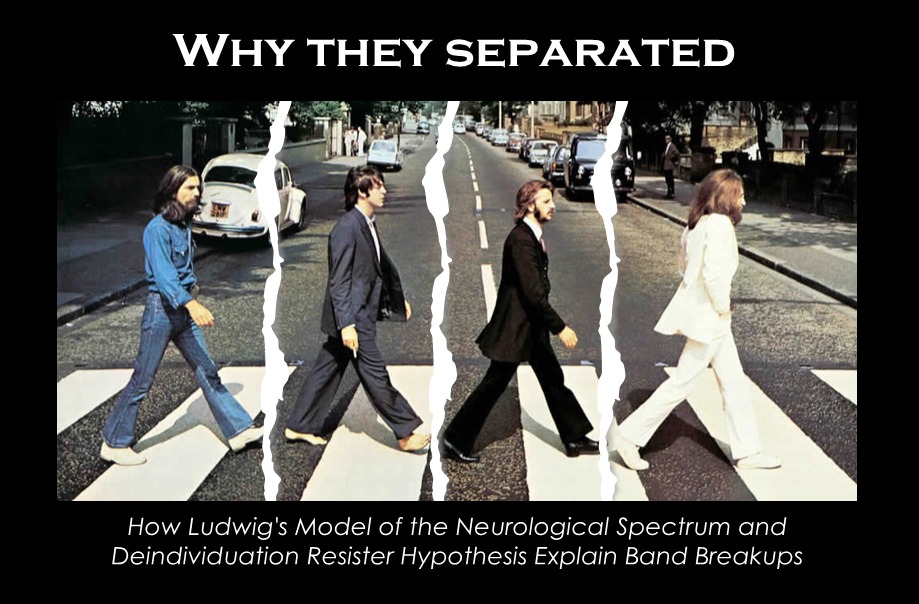
These are not wrong, but they are incomplete. They describe what happened, not why it became psychologically unbearable for particular individuals to remain.
Seen through the the model of the Neurological Spectrum (Between Individual and Collective Identity) and the Deindividuation Resister Hypothesis (How Humans Progress) (DRH), band breakups start to look much less random. They become case studies in how different people tolerate - or refuse to tolerate - the psychological cost of belonging to a powerful collective.
Bands as Micro-Societies: Why the DRH Fits So Well
The Neurological Spectrum and Deindividuation Resisters
The neurological spectrum model does not simply classify people by "neurotypical" and "neurodivergent". It posits a continuum of social orientation:
- At one end are people who are comfortable merging into groups, absorbing norms, rituals, and expectations with relatively low psychological cost.
- At the other end are deindividuation resisters: people for whom identity autonomy is non-negotiable, who experience enforced conformity as deeply stressful or even intolerable.
The DRH adds a social-psychological layer:
Most social systems (from classrooms to armies to corporations) generate deindividuation pressure: they reward conformity and discourage deviation.
For many people this is manageable.
For deindividuation resisters, it creates chronic strain. Over time they:
- mask and comply,
- suffer burnout, resentment or depression,
- and eventually withdraw, rebel, or are expelled when the cost of belonging exceeds the psychological benefit.
A band is a perfect DRH laboratory
A successful band is a compressed society with:
- A collective identity (sound, image, mythology, "brand").
- Internal hierarchies (principal songwriter, front person, musical director).
- External expectations (record companies, audiences, press, nostalgia).
- Intense proximity (touring, studio work, shared finances, joint decisions).
The more successful a band becomes, the more it crystallises into a symbolic entity that must remain recognisable. The band name on the album cover means its members are no longer just people; they are carriers of a shared persona.
This is pure DRH territory:
- The collective identity demands stability.
- The individuals evolve, grow, and change.
- Those nearer the individual end of the spectrum increasingly feel that the band is stifling their authentic self.
- Breakups occur when those individuals decide that protecting their own identity is more important than maintaining the collective.
The following case studies show how clearly this pattern recurs.
The Beatles – When the Myth Outgrew the Men
Few groups illustrate the DRH so vividly as the Beatles. What broke them was not merely business disputes or personal disagreements, but the growing incompatibility between "The Beatles" as a global myth and four diverging inner lives.
John Lennon - The reluctant saint of a religion he did not choose
- Increasingly uncomfortable being "John Lennon of the Beatles".
- Felt trapped in a role that no longer matched his evolving identity (political, avant-garde).
- Experienced the group as identity confinement: the "Beatle" persona was a mask he was desperate to discard.
- Ultimately saw leaving as a form of psychological liberation: reclaiming authorship of his own life.
From a DRH perspective, Lennon is the archetypal resister: the more the Beatles became an institution, the more he needed to escape.
Paul McCartney - The architect of the collective
- Highly driven, prolific, and organisationally minded.
- More comfortable than the others with the idea of "being a Beatle" as a stable identity.
- Derived creative energy from the group structure and tried to keep it together when others were drifting away.
- His perceived "bossiness" can be reframed as a high tolerance for deindividuation: he could commit to the band identity more fully and expected others to do likewise.
McCartney sits more toward the collective-oriented middle of the spectrum: he certainly has a strong personal identity, but he is relatively at ease binding it into a group.
George Harrison - The quietly emerging resister
- Developed rapidly as a songwriter, but was limited to a small quota of songs per album.
- Felt overshadowed and under-acknowledged; his artistic identity was repeatedly subordinated to the Lennon-McCartney axis.
- Spiritual and musical interests (Indian music, mysticism) differed increasingly from the band’s core trajectory.
For Harrison, the band became a bottleneck for creative and spiritual growth. His later solo explosion (e.g. All Things Must Pass) looks exactly like what the DRH predicts when a resister is finally released from a constraining collective.
Ringo Starr - The cooperative stabiliser
- Least conflicted with the band identity.
- Valued the sense of belonging and continuity.
- Left briefly when internal conflicts made the group feel hostile, not because he needed to assert a separate artistic identity.
Ringo exemplifies a collective-friendly profile: he was not the driver of the breakup, but the one most likely to stay if the others had been willing.
Why they separated
By the late 1960s:
- Lennon and Harrison's autonomy needs diverged sharply from the Beatles' collective identity.
- McCartney’s efforts to preserve that identity became, for them, part of the problem.
- The symbolic weight of "being the Beatles" turned into an intolerable deindividuation burden for at least half the band.
The end result matches the DRH prediction: once the psychological cost of identity suppression exceeds the reward of belonging, resisters disengage - even from the most successful group in the world.
(The DRH model actually explains their divergence more clearly than most pop-psych or biographical accounts.)
Pink Floyd - When Visionaries Collide
Pink Floyd’s history isn’t one breakup but a sequence of DRH events.
Syd Barrett - An extreme resister overwhelmed
- Highly idiosyncratic writer and performer; the early band was essentially his vision.
- As the band gained structure and external expectations, he struggled to function within it.
His withdrawal is often explained solely in psychiatric or pharmacological terms, but DRH highlights an additional factor: he represents an extreme autonomy-driven creator unable to sustain the role of predictable band member.
Roger Waters - From team player to self-declared sovereign
- Gradually assumed conceptual and lyrical control.
- Came to see Pink Floyd as a vehicle for his large-scale ideas (The Wall, The Final Cut).
- When other members asserted their own identities, he perceived it as interference.
- Eventually concluded that the band without his leadership was not "really" Pink Floyd.
Waters exemplifies a dominant resister: not opposed to collectives in principle, but only when they fully reflect his own vision.
David Gilmour - Cooperative but unwilling to disappear
- Joined after Barrett, balancing musicality and pragmatism.
- Initially more conciliatory but increasingly unwilling to submit to Waters' unilateral control.
- His resistance triggered open conflict, leading to the split into "Waters' vs. Gilmour's Pink Floyd".
Richard Wright & Nick Mason - Moderately collective-oriented
- More comfortable with their roles but caught in the crossfire between high-autonomy personalities.
- Wright in particular experienced marginalisation and temporary expulsion when he could not navigate Waters' dominance.
Why they separated
Pink Floyd’s story is a DRH lesson in what happens when a collective is populated by multiple strong identity-driven individuals:
- Barrett could not live inside the emerging structure.
- Waters could not tolerate a structure he did not control.
- Gilmour could not tolerate being absorbed into Waters’ vision.
The band name continued, but the "breakups" are best seen as reconfigurations of collective identity around the autonomy thresholds of its most powerful members.
The Beach Boys – The Genius in a Straightjacket
The Beach Boys' public image froze early: Californian youth, surf, cars, innocence. That collective identity became deeply constraining for Brian Wilson.
Brian Wilson - A resister crushed by expectation
- A sensitive, intensely creative composer and producer.
- Pushed the band into new artistic territory (Pet Sounds, the aborted Smile).
- Faced internal resistance from bandmates who feared alienating the existing audience.
- Carried heavy responsibility for both artistic innovation and commercial success.
From a DRH angle, Brian's story is one of chronic deindividuation stress:
the band's required identity clashed with his evolving inner world. His subsequent withdrawal, mental health crises, and episodic returns show what happens when a powerful resister remains symbolically tied to a group he can no longer psychologically inhabit.
Mike Love, Carl Wilson, and the others - Guardians of the collective
- More aligned with the original surf-pop identity.
- Prioritised continuity, recognisability, and commercial viability.
- Often functioned as agents of the collective, resisting Brian’s attempts to redefine it.
The internal conflict was therefore not between "progressive" and "conservative" in a narrow musical sense, but between:
- a resister's need for authentic personal expression and
- the group’s need to preserve a profitable, familiar identity.
Oasis - Mutual Resisters in a Confined Space
Oasis are almost a cartoon version of DRH dynamics.
Noel Gallagher - Authoritative resister
- Primary songwriter, saw himself as the band's creative engine.
- Needed control over musical direction.
- Low tolerance for being challenged on artistic matters.
Liam Gallagher - Embodied resister
- Charismatic frontman with a strong sense of self and very little inclination to bow to authority.
- Interpreted Noel's control as personal and artistic disrespect.
- Expressed resistance in confrontational, often explosive ways.
The supporting members were more collective-oriented, but the band’s emotional climate was set by two high-autonomy brothers locked in perpetual struggle.
The breakup becomes almost inevitable in DRH terms: two resisters with overlapping territories (music, identity, family) sharing a single brand name. There is simply no stable configuration in which both can feel fully respected and unconfined.
The Police – Virtuosos with Different Tolerance Levels
The Police combined three powerful personalities in a very tight musical format.
Sting - High-functioning resister seeking control
- Principal songwriter and de facto leader.
- Pushed towards more sophisticated, jazz-influenced material.
- Increasingly saw the band as a vehicle for his personal artistic development.
Stewart Copeland - Strong-willed counter-resister
- Energetic, inventive drummer with his own compositional ambitions.
- Resented Sting's dominance and fought back, sometimes literally, in the studio.
- Experienced the band as a struggle for recognition and autonomy, not simply as a job.
Andy Summers - Comparatively conciliatory, but not self-less
- Brought a distinctive guitar voice and experimental texture.
- Less confrontational, though not without his own artistic needs.
The Police are an example of a band where no one sits comfortably at the collective end of the spectrum. The music required tight cohesion, but the personalities were all too individualistic for a long-term stable collective. Once the external pressure eased, the resisters’ need for autonomy triumphed.
Genesis - When One Member Outgrows the Collective
Genesis's first major fracture came with Peter Gabriel's departure.
Peter Gabriel - Transforming identity, shrinking patience
- Became increasingly theatrical, symbolic, and concept-driven.
- Found the band structure restrictive for his evolving ideas and stage personas.
- Left to explore his own artistic and personal trajectory without negotiation.
Tony Banks, Mike Rutherford, Phil Collins, Steve Hackett
- More comfortable upholding the band's identity, though Hackett too eventually left when he felt boxed in.
- Banks and Rutherford particularly exemplify collective-oriented stability: willing to compromise to keep the band functional.
Genesis demonstrates a recurring DRH theme: when one member's identity accelerates away from the group, departure can be healthier than mutual stagnation. Gabriel's later solo career and Hackett's eventual exit both show resisters choosing autonomy over indefinite compromise.
Fleetwood Mac - Many Identities, One Brand
Fleetwood Mac's classic Rumours lineup (Mick Fleetwood, John and Christine McVie, Stevie Nicks, Lindsey Buckingham) was a volatile compound of strong identities.
Stevie Nicks: intensely self-defined writer-performer with a mythic, poetic persona.
Lindsey Buckingham: controlling, perfectionistic producer and arranger with his own artistic agenda.
Christine McVie: strong songwriter with a more understated public persona but a distinct musical identity.
Mick Fleetwood & John McVie: stabilising rhythm section, more collective-oriented but inevitably drawn into the emotional storms.
Here, the DRH pattern manifests less as a single clear "breakup moment" and more as repeated cycles of fracture and reunion:
- Members tried to protect their own identities (and, often, emotional survival amid tangled personal relationships).
- The band’s immense commercial success acted as a counter-force, pulling them back into the collective even when it was psychologically costly.
Fleetwood Mac illustrates the DRH at its most complex: a collective that repeatedly re-forms despite - and because of - the very identity conflicts that tear it apart.
The Smiths - Two Poles, One Short Lifespan
The Smiths were dominated by the creative dyad of Morrissey and Johnny Marr.
Morrissey - Radical individualist
- Built a literary, ironic, intensely personal persona.
- Experienced the band as an extension of his aesthetic and moral identity.
- Had little interest in compromise once he felt the group no longer perfectly reflected his vision.
Johnny Marr - Restless collaborator
- Multi-faceted musician eager to explore different styles, partnerships, and contexts.
- Found the Smiths' framework increasingly limiting for his broader musical ambitions.
Bassist Andy Rourke and drummer Mike Joyce were more collective-oriented and not primary drivers of the breakup.
From a DRH viewpoint, the Smiths were too small and too intense for two such strong identities to cohabitate indefinitely. Once Marr's sense of confinement crossed his threshold, the band ceased to exist - leaving Morrissey to continue as a solo figure whose identity no longer had to share space with a collective.
Guns N' Roses - One Brand, Diverging Lives
Guns N' Roses combine a potent brand with conflicting identity needs.
Axl Rose - Centralising, high-control resister
- Sees himself as guardian of what "Guns N' Roses" really means.
- Increasingly merged the band's identity with his own.
- Requires others to align with his pace, expectations, and vision.
Slash, Duff McKagan, Izzy Stradlin and others
- Strong personalities, but less interested in subsuming their lives into a single slowly-moving project.
- Eventually experienced Axl's control and the band's inertia as psychological suffocation.
Here, the DRH pattern appears in a familiar variant: one member transforms the band into an extension of his own identity, while others, unwilling to surrender their autonomy, depart and form or join more flexible collectives.
Led Zeppelin - When the Collective Soul Vanishes
Led Zeppelin did not disintegrate through gradual conflict but ended abruptly after John Bonham's death. The DRH perspective is subtler here but still informative.
- Bonham was not just "the drummer"; he was central to the identity and feel of the band.
- His death shattered the psychological sense of "we" that made continuing viable.
- Rather than attempting to re-engineer the collective around a replacement, the remaining members chose to stop.
This can be read as a case where the collective identity could no longer be reconstructed without unacceptable falsification, and so the remaining members chose, in a sense, to protect their individual integrity - and the truth of what the band had been - by letting it end.
Simon & Garfunkel - A Duo Too Tight for Two Identities
As a duo, Simon & Garfunkel are an intense micro-DRH case.
Paul Simon
- Principal songwriter, musically restless, keen on exploring different genres and collaborators.
- Felt constrained by being permanently tied to equal billing with another person.
- Needed the freedom to reinvent himself without dragging a duo identity along.
Art Garfunkel
- Distinct vocal identity but heavily dependent on Simon's writing.
- Simultaneously benefited from the partnership and felt overshadowed.
- Experienced the duo label as both a lifeline and a limit.
In such a tight formation, any shift in individual identity is magnified. Once Simon’s desire to move beyond the duo crossed his threshold, the partnership could not be sustained without one or both feeling deeply compromised.
Other Patterns and Quiet Endings
Some bands manage the same underlying forces more gracefully.
Talking Heads
- David Byrne's artistic identity increasingly diverged from that of the band.
- Other members resented being sidelined and used primarily to realise Byrne's ideas.
- The band never exploded publicly so much as quietly ceased, once the psychological and practical costs outweighed the benefits.
R.E.M.
- Here, the DRH dynamic ends in a relatively healthy separation.
- As members aged and their identities and priorities changed, they concluded, collectively, that continuing as "R.E.M." no longer matched who they were.
- Rather than forcing a misaligned collective, they chose conscious dissolution - a rare case of pre-emptive alignment of group decision with evolving individual selves.
What the DRH Adds to the Story
Looking at these breakups through the DRH and the neurological spectrum highlights several common threads:
1. Fame magnifies deindividuation pressure.
Success hardens the band’s identity into something that must not change too much without risking backlash. This makes it harder for individuals to grow publicly.
2. Artistic maturation is often autonomy maturation.
As musicians develop, they become clearer about who they are and what they want to do. This often pushes them toward the individual end of the spectrum.
3. Different autonomy thresholds drive conflict.
- Some members are relatively comfortable in a long-term shared identity.
- Others find it increasingly suffocating.
The band can only stretch so far before these positions become incompatible.
4. Departures are often acts of self-preservation.
Rather than being purely destructive or selfish, leaving a band can be a psychologically necessary choice to preserve or reclaim one's identity.
5. Post-breakup explosions of creativity are predictable.
Many artists (Harrison, Gabriel, Brian Wilson in his best moments, Marr, various ex-members of famous bands) display an immediate surge of output once freed from constraining collectives - exactly what the DRH would expect when a resister is no longer spending energy on masking and compromise.
Conclusion - Band Breakups as Case Studies in Identity
"Why did they split up?" is usually answered with gossip and surface explanations.
The DRH invites a deeper question:
How much identity suppression was required to keep this collective functioning - and which members were no longer willing or able to pay that price?
Seen this way, band breakups are not simply failures of cooperation but revealing experiments in human psychology:
- They show how far different people can bend toward a group before they break.
- They illustrate how powerful the need for autonomy can be, even when enormous rewards (money, fame, adoration) are on offer for those who stay.
- And they demonstrate, again and again, that for certain individuals - the deindividuation resisters - no external reward is worth the loss of self.
In that sense, the story of why bands separate is also a story about why individuals sometimes walk away from empires: because remaining would mean becoming someone they are not, and some people would rather start again from nothing than live the rest of their lives behind a mask.