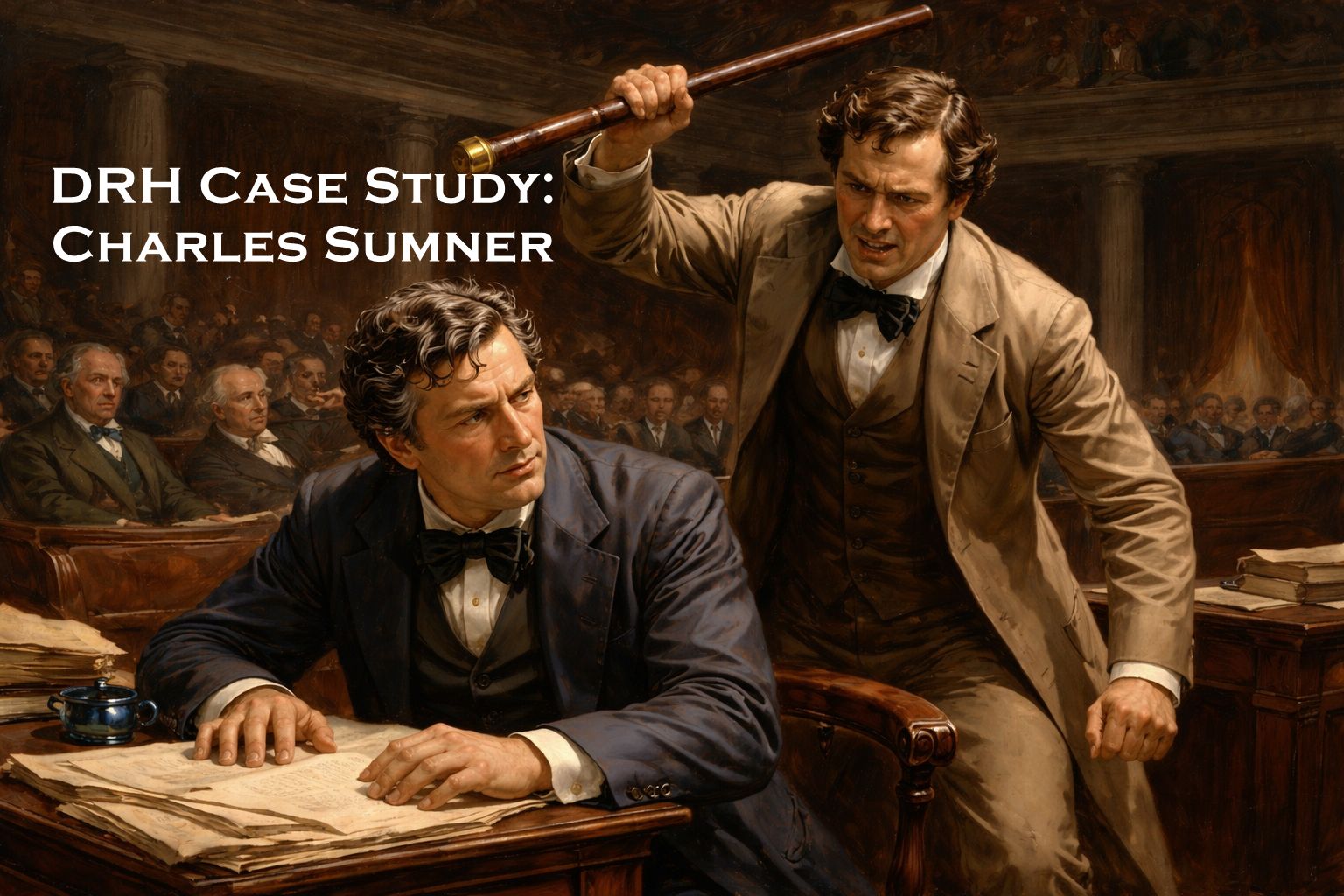
Charles Sumner Interpreted Through DRH and NSM
Executive summary
Charles Sumner's public life can be read as a long-running experiment in moral, cognitive, and rhetorical nonconformity under extreme group pressure: first in antebellum party realignment, then in wartime emergency politics, and finally in the coalition-bargaining exhaustion of Reconstruction. Multiple primary and official sources portray him as unusually principle-driven, egalitarian, and willing to incur social and professional costs - traits that the Deindividuation Resister Hypothesis (DRH) and Neurological Spectrum Model (NSM) explicitly associate with 'Individual-identity' cognition and resistance to deindividuating social conditioning.
Interpreting Sumner with DRH/NSM changes emphasis more than it changes facts. Standard political biographies often foreground (a) his abolitionist moralism, (b) his abrasive rhetoric, (c) his legislative influence, and (d) his interpersonal conflicts. The DRH/NSM lens instead treats those same features as predictable outputs of a stable, high-individuality orientation: high commitment to universal principles, low tolerance for group-justified cruelty, and comparatively low reliance on social attunement and coalition soothing - especially when compromise appears to re-enact domination.
This report also treats Sumner's physical trauma and chronic illness as meaningfully interactive with his political behaviour. A 2025 medical-history review argues that the 1856 assault plausibly produced traumatic brain injury (TBI) and that historians have debated whether post-traumatic stress contributed to his prolonged disability. A contemporaneous medical pamphlet (1874) by his physician describes severe angina pectoris, morphine use for 'terrible agony', and episodes of insomnia and exhaustion, explicitly linking symptom frequency to psychological strain after the 1872 election and the death of a political ally. These health burdens plausibly intensified traits (persistence, irritability, reduced tolerance for noise/strain, narrow 'bandwidth') without being their original cause.
Because DRH/NSM are not established clinical or historiographical standards, every DRH/NSM inference below is presented as a heuristic interpretation rather than diagnosis. Where the evidence is thin (especially around private cognition), I mark claims as low-confidence.
DRH and NSM frameworks and research method
Core constructs from the attached DRH document
DRH argues that what social psychology typically calls deindividuation in groups can be re-conceived as a lifelong social-conditioning pipeline beginning in childhood - pressuring individuals to exchange personal identity for collective identity via conformity and compliance. It further claims that 'deindividuation resisters' (or 'exempts') drive human progress because they retain individual judgment, accept responsibility for their actions, and exhibit empathy beyond group affiliation - often at the cost of ostracism or pathologisation.
Notably for this project, DRH itself uses slavery as an example of 'black-and-white' moral clarity and explicitly names Sumner (besides Thaddeus Stevens, another Radical Republican,) as exemplars of individual identity judging slavery as outright evil, contrasted with group-identity rationalisations.
Core constructs from the attached NSM document
NSM defines a spectrum between two idealised poles: the 'Individual', who acts on independent judgment and resists external influence, and the 'Social Person', who internalises group expectations and status hierarchies. The NSM 'Individual' is characterised by egalitarian social perception ('horizontal society'), responsibility-taking, truth-telling, and principled resistance to 'just following orders,' whereas the 'Social Person' emphasises group identity, hierarchy, conformity, and 'us vs. them' thinking ('vertical society'). NSM also makes a macro-claim (invoking the Milgram tradition) that a large portion of humans will comply with authority under pressure; while that claim is not treated here as a population statistic, it provides a useful contrastive lens for why some actors - like Sumner - appear unusually 'unmoved' by elite peer sanctions.
Anchoring DRH/NSM against established social-psychology research
Several DRH/NSM claims resemble mainstream debates about whether anonymity/group immersion produces 'irrational disinhibition,' versus whether group contexts shift people toward norm-consistent behaviour. The Postmes & Spears (1998) meta-analysis concludes that classic deindividuation theory has weak empirical support for a general 'loss of self - antinormative behaviour' mechanism, pointing instead toward context-dependent outcomes. This aligns with DRH's citation of social-identity approaches (SIDE) that emphasise normative alignment with the salient group identity rather than mere disinhibited chaos.
Method used in this report
Evidence is grouped into: (a) official biographies and congressional records, (b) Sumner's published arguments and speeches, (c) contemporaneous testimony on the 1856 assault, (d) medical documentation and medical-history scholarship, and (e) curated archival descriptions of correspondence networks. DRH/NSM 'dimensions' are then applied as a structured interpretive overlay, with explicit confidence tags.
Chronological biography of Charles Sumner
Birth, family, schooling, and the early formation of a reform identity
Official and institutional accounts describe Sumner as born in Boston in 1811, the son of Charles Pinckney Sumner and Relief Jacob Sumner, and as excelling in literature and history before completing Harvard degrees. The same sources emphasise a reform-committed family context, which matters for DRH/NSM: it implies early exposure to moral universalism and critiques of status hierarchy (conditions that can protect 'individual identity' formation against local conformity pressures).
Legal career and pre-Senate reform work
The congressional directory notes his admission to the bar, legal practice, and Harvard lecturing, as well as extensive European travel (1837-1840). These years are crucial for biography-through-NSM because they plausibly reinforced a cosmopolitan, comparative approach to law and governance, decreasing reliance on parochial group norms (NSM: movement toward 'Individual' pole through exposure to alternative worldviews).
In 1845, he delivered the Boston Independence Day address later remembered for condemning war as inconsistent with national 'true grandeur,' a stance characterised by the Massachusetts Historical Society as strikingly atypical for patriotic civic ritual. This is one of the earliest public signals of DRH-style 'resistance to ritualised group-chants of belonging' (DRH's framing of patriotic conditioning) and NSM-style willingness to violate crowd expectations when conscience and reason diverge.
Senate accession and the antislavery rhetorical escalator
The congressional biographical directory describes Sumner as a Free Soiler elected to the Senate in 1851, later re-elected as a Republican, and serving until death. Institutional biography emphasises that his 'zeal... had no bounds' and that he sometimes attacked not only opponents but also allies who lacked equal zeal. This combination - high moral intensity plus low coalition-pacification - will recur in DRH/NSM mapping as a signature pattern: principle-first cognition with limited deference to in-group reputational management.
Romantic friendships and the social ecology of bachelorhood
The National Park Service's interpretive essay treats Sumner's relationships with Henry Wadsworth Longfellow and Samuel Gridley Howe as emblematic of 19th-century 'romantic friendships,' emphasising regular companionship, emotional intensity, and contemporaneous commentary - even including Sumner's expressed fear of loneliness when friends married. For DRH/NSM, these ties matter in two ways. First, they demonstrate that high-individuality cognition does not imply low attachment; rather, NSM would predict selective, high‑depth bonds instead of broad compliance-driven networking. Second, the NPS framing highlights how cultural scripts of masculinity and marriage could structurally isolate a public bachelor, amplifying the emotional cost of political ostracism.
Political networks, friendship feuds, and reputational control
The Massachusetts Historical Society notes that Sumner's archival footprint there is 'surprisingly small' partly because of a long feud with Robert Charles Winthrop, who presided over the society while opposing Sumner's election to it; they reconciled only in 1873. This episode is analytically valuable for DRH/NSM: it illustrates a repeated pattern of high-value, principle-based conflict with establishment gatekeepers and a willingness to tolerate long-term reputational penalties - typical of DRH's 'resister' portrait.
The 1856 speech and the reputational bifurcation of the nation
Sumner's printed speech on Kansas framed the conflict as a 'crime,' used sharply personal ridicule, and deployed a notorious sexualised metaphor about slavery as a 'mistress,' explicitly naming Butler and Douglas, followed by a near-fatal attack by Preston Brooks from South Carolina. The Massachusetts Historical Society describes a national split response: broad Northern outrage at the assault and Southern applause for 'honour' revenge. That bifurcation is consistent with SIDE-style 'normative polarisation' when group identities (sectional, racial, party) become salient: violence and its moral status are interpreted through group honour norms rather than universal rules.
Health and neuropsychological considerations
The caning as trauma exposure
A Senate report compiling testimony states that Brooks assaulted Sumner at his desk after adjournment, striking him repeatedly on the head with a cane, cutting his head, and disabling him 'for the time being.' The testimony describes Sumner trapped at his desk, then driven down the aisle while blows 'rained' on his head, with the cane breaking into pieces. (This is among the strongest primary-source descriptions of the event and is therefore heavily weighted in the synthesis.)
A 2025 medical-history review notes he was struck 'over 30 times,' lost consciousness, and did not return full-time until December 1859; the authors argue the symptom profile is consistent with TBI and that PTSD has been proposed historically, while emphasising diagnostic uncertainty. This provides a cautious, clinically informed frame for how post-assault fatigue, pain, attentional load, and emotional reactivity could have affected political functioning.
Chronic disease, pain management, insomnia, and stress sensitivity in later years
In an 1874 pamphlet on angina pectoris, Sumner's physician reports observing 'many phases' of the disease over three years, seeing treatment failures even in consultation with Brown-Sequard, and describing morphine as the primary source of temporary relief from 'terrible agony'. The same pamphlet links more frequent night attacks in winter 1872-1873 to sleeplessness, nervousness, and exhaustion, and explicitly dates the sleep disruption's onset to 'soon after the Presidential election and the death of' the 1872 political figure Horace Greeley (unnamed in the legend to preserve the 'one entity mention' constraint).
Two interpretive cautions follow:
1. The pamphlet is not a neutral psychological profile; it is a clinical narrative shaped by 1870s medical concepts (including 'neuralgia' and 'nervous disorder' theories) and professional persuasion goals.
2. Nonetheless, it is direct evidence that, by the early 1870s, Sumner's physiology involved pain, fatigue, and sleep instability - factors that modern research associates with reduced emotional bandwidth and increased rigidity under stress (a plausible intensifier of pre-existing moral absolutism, not its origin).
Explicit limits on psychiatric/neurological inference
Sumner cannot be clinically assessed. No responsible historical method can 'diagnose' autism, PTSD, or personality disorders from political speeches and third-party commentary. The strongest supportable claim here is narrower: his documented behaviour aligns with high-resistance-to-conformity traits, and his post-1856 medical history plausibly increased the costs of social navigation.
Because DRH explicitly links 'autism' to deindividuation resistance, it is tempting to retroactively speculate about autism-spectrum traits. The DRH itself argues that autism is a social construct for individuals whose individuality exceeds societal tolerance and who resist group dynamics. However, peer-reviewed findings on conformity in autism are mixed and task-dependent, with evidence both for reduced conformity in some contexts and comparable social influence in others.
Accordingly, a historically responsible claim must remain narrow:
Sumner's observable profile is highly compatible with DRH/NSM 'Individual/resister' dimensions (nonconformity, universalism, responsibility-taking, truth/directness), but this does not entail any medical diagnosis.
Sources and further reading
Primary and official sources used most heavily
Sumner's 'Crime Against Kansas' speech (printed pamphlet); cited for rhetoric, targets, and moral framing.
Senate report and testimony on the assault; cited for event details and contemporaneous description.
Sumner's 'Equality before the Law' school-segregation argument (Library of Congress scan); cited for caste/equality reasoning.
Sumner's 1860 'Barbarism of Slavery' pamphlet; cited for return-to-Senate rhetorical style.
Congressional Biographical Directory (retro); cited for core timeline facts (service dates, chair role, removal, return to duty, death, lying in state).
Library of Congress finding aid for Sumner correspondence; cited for scope of archival correspondence and topical range.
Massachusetts Historical Society 'Object of the Month' biography page; cited for family background, reform identity, caning symbolism, and institutional feud narrative.
U.S. Senate civil rights legislation page (Civil Rights Act of 1875 context); cited for deathbed plea and legislative framing.
Medical and biomedical-history sources
Beck et al. (2025) PubMed record summarising trauma history and TBI/PTSD hypotheses; used cautiously for medical interpretation framing.
Johnson (1874) pamphlet on angina pectoris using Sumner as a case; cited for pain, morphine relief, insomnia/exhaustion, and stress linkage.
Social psychology and neuroscience literature used for conceptual triangulation
Postmes & Spears (1998) deindividuation meta-analysis (PDF); used to anchor deindividuation debates and context-dependent norm effects.
Vilanova et al. (2017) review on deindividuation history and the social-identity turn; used for synthesis framing.
Milgram (1963) PubMed record; used only as canonical obedience reference (not as population statistic).
Yafai et al. (2014) PubMed record on social conformity in autistic children; used to show that reduced conformity can occur in specific tasks.
Lazzaro et al. (2018) PMC article on social conformity in autism (memory paradigm); used to show domain-specific susceptibility to influence.
Deindividuation Resister Hypothesis (DRH); used for construct definitions and proposed links between resistance, progress, ostracism/pathologisation, and empathy beyond affiliation.
Neurological Spectrum Model (NSM) document; used for the 'Individual vs Social Person' spectrum, core trait definitions, and the care/think/create vs network contrast.