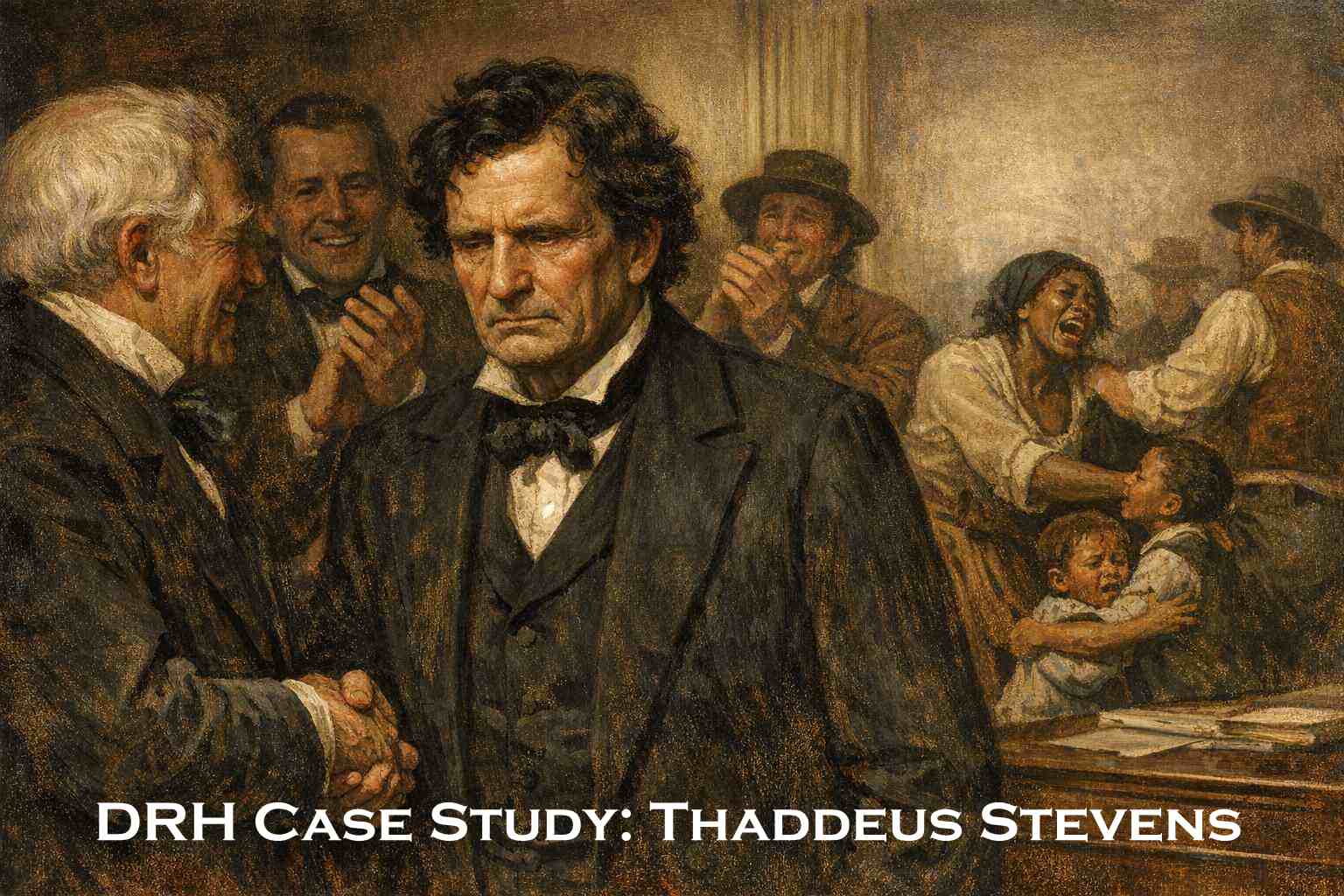
Thaddeus Stevens: The Relentless Egalitarian
Executive summary
Thaddeus Stevens (1792-1868) rose from rural poverty and physical disability to become one of the most consequential legislators of the Civil War and Reconstruction era, shaping federal war finance, emancipation policy, and the postwar constitutional settlement. He was born in a northern Vermont village, educated at Dartmouth, built a formidable legal practice in Pennsylvania, and became a state and then national politician whose defining throughline was a moral-legal egalitarianism expressed with unusual rhetorical bluntness and a sustained willingness to incur social and political backlash.
This report reconstructs his life using two interpretive lenses: the Deindividuation Resister Hypothesis (DRH) and the Neurological Spectrum Model (NSM) that positions people along a continuum between Individual (self-directed judgment, resistance to crowd/authority, universalism) and Social Person (identity absorbed into group expectations, conformity, and compliance). Both models are treated as heuristic frameworks rather than diagnostic instruments; the analysis emphasises visible behaviour in documented settings (courtrooms, legislatures, political crises) and explicitly flags the limits of retrospective inference.
Key findings (evidence-weighted, with caveats):
Stevens repeatedly exhibited high deindividuation resistance (DRH) and strong Individual-end NSM features, operationalised as: (a) resistance to majority and party pressures; (b) refusal to legitimise hierarchy-based authority claims; (c) personal accountability rather than 'we only followed orders'; and (d) moral universalism applied across race and status. These traits appear across major episodes: his lone stand against Black disenfranchisement amendments in Pennsylvania politics; his leadership in emancipation and Black military participation; his insistence on federal supremacy in Reconstruction; and even his choice of burial site and epitaph to publicly dramatise racial equality.
At the same time, his record includes strategic hard-edged politics and at least one early legal success in a slavery-related case (the Butler v. Delaplaine litigation) in which he represented interests aligned with slaveholding property claims. That episode complicates one-dimensional narratives of moral purity and underscores why this report separates behavioural patterns (resistance to social conditioning) from normative judgments (whether a given act advanced justice).
Finally, the Underground Railroad dimension is treated with evidentiary stratification: high-confidence items derive from contemporaneous or near-contemporaneous documentation (and from National Park Service Network to Freedom evaluation materials), while claims rooted chiefly in tradition or later memoir are presented as plausible but lower-certainty. The strongest primary narrative link is an 1883 regional history describing Stevens' direct assistance to a group of twenty-six freedom seekers in 1842, including feeding them and sending them onward to known stationmasters.
Frameworks, variables, and evidentiary method
Model definitions used in this report
The Deindividuation Resister Hypothesis (DRH) frames deindividuation not as a rare crowd phenomenon but as a life-course social-conditioning process wherein most people trade individual identity for collective identity built on conformity and compliance. The DRH posits that human progress is disproportionately driven by 'deindividuation resisters' who retain individual identity despite social sanctions, and that such resisters are often ostracised or pathologised.
The Neurological Spectrum Model (NSM) describes a continuum between the 'Individual' (self-directed judgment, resistance to crowd/authority, universalist equality, responsibility-taking) and the 'Social Person' (group-absorbed identity, hierarchy acceptance, crowd-following, responsibility diffusion). The NSM explicitly treats these as idealised endpoints with most people in between and with some situational flexibility.
Because the DRH references deindividuation but diverges from classic social-psychology formulations, this report also anchors claims about deindividuation in mainstream scholarship: meta-analytic evidence suggests deindividuation effects are not uniformly anti-normative and are strongly moderated by local norms and social identity context (the broad claim in Postmes & Spears's meta-analysis).
Justifying applicability to a nineteenth-century political actor
Stevens' life is unusually well-suited to DRH/NSM analysis because his documented behaviour sits at the intersection of (a) intense group identity politics (race, party, region, nation), (b) high-pressure institutional settings where conformity incentives are strong (legislatures, party coalitions, wartime governance), and (c) repeated personal-cost decisions in which he chose principle-anchored positions that were not the modal preferences of the electorates or elites around him.
Critically, the aim is not to 'diagnose' Stevens with any modern clinical condition. Instead, the DRH/NSM approach here is a behavioural-historical mapping: what does the record suggest about (1) his responsiveness to social pressure, (2) his identity orientation (universalist individualism vs. ingroup hierarchy), and (3) his patterns of authority acceptance or refusal?
Linking the DRH to modern conformity and neural-plasticity research (with strict caveats)
The DRH's author explicitly connects deindividuation resistance with traits often associated with autism and cites reduced conformity to 'majority' cues as a key behavioural signature. Modern research does report that autistic children, in an Asch-like 'line judgment' paradigm with misleading majority cues, can show less conformity than typically developing peers.
The DRH also references reduced synaptic pruning as a hypothesised mechanism for certain cognitive and sensory profiles. While such biological claims must not be projected onto Stevens, contemporary neuroscience literature has discussed atypical pruning in autism using postmortem evidence and developmental theory; public summaries note large developmental reductions in synapse density in neurotypical adolescents compared to smaller reductions in autism samples.
This report uses these findings only to illustrate: (a) the DRH model is interpretable as a theory of resistance to social influence with some empirical analogues, and (b) DRH/NSM can be applied to historical behaviour without making clinical claims.
Life course and career development
Early life, family background, and education
Stevens was born in rural Danville in 1792; he was physically disabled with a clubfoot, and his childhood was shaped by poverty and family instability. A widely cited narrative account describes him as the second of four children and states that his father abandoned the family when Thaddeus was about twelve, leaving his mother to sustain the household and insist on her sons' education.
His formal education included attendance at the University of Vermont and graduation from Dartmouth College in 1814, after which he moved to Pennsylvania, studied law, and entered practice.
Building a legal identity and an early political style
Stevens began legal practice in Gettysburg and developed a reputation for aggressive, creative advocacy. In the legal domain, his early record includes participation in slavery-adjacent litigation, sometimes in ways that complicate retrospective moral narratives (addressed in detail in the Butler section).
Politically, Stevens' first major cause was hostility to secret societies - especially Freemasonry - during a period when Anti-Masonic politics surged in the United States. Contemporary synthesis accounts emphasise that this 'minor cause' in modern hindsight was a major mobilising engine in his early career and helped form his characteristic style: moralised language, contempt for elite conspiratorial authority, and readiness for confrontation.
Pennsylvania state politics and the public-school fight
As a Pennsylvania state legislator (service at multiple intervals in the 1830s-1840s), Stevens played a decisive role in defending and institutionalising free public education. A prominent interpretive narrative describes his April 11, 1835 speech as pivotal in preserving statewide legislative support for a public school system.
Even in this 'domestic policy' arena, Stevens' behaviour fits DRH/NSM operational markers: he treated education as a civic equaliser extending to 'the poorest child,' framed opposition as class arrogance, and accepted antagonism from entrenched interests.
Lancaster relocation and prewar congressional career
After political conflict and violent instability in Pennsylvania politics (the 'Buckshot War' context), Stevens relocated in 1842 to Lancaster and established a combined home and office. He was later elected as a Whig to Congress (1849-1853) and then returned as a Republican (1859-1868), serving until his death.
This Lancaster phase is particularly important not only for congressional mobilisation but also for evidence linking him to Underground Railroad activity and to a long-term household partnership with Lydia Hamilton Smith.
Civil War, Reconstruction leadership, and legislative actions
War leadership and fiscal architecture
In Congress, Stevens became chairman of the House Committee on Ways and Means during the Civil War and later chaired the Appropriations Committee, positions that gave him agenda control over taxation, borrowing, and wartime finance. Official House biography summaries identify these chairmanships, placing him at the fiscal centre of Union war-making.
Institutional histories of the committee note the Civil War expansion of federal fiscal capacity (including national paper currency and new revenue instruments), which aligns with the well-established view of Stevens as a driver of these measures as chair.
Emancipation policy and constitutional transformation
Stevens' legislative activity consistently tied military victory to slavery destruction: he pushed for emancipation measures, for Black enlistment, and for constitutional abolition of slavery. The National Archives' summary of the National Archives and Records Administration milestone document confirms the Thirteenth Amendment's passage and ratification timeline, within which Stevens is repeatedly documented as a leading House advocate.
He also played a central role in shaping and selling the Fourteenth Amendment settlement. An archived primary-source excerpt of his May 8, 1866 House speech introducing the amendment documents his framing of constitutional equality and the Joint Committee's process.
From DRH/NSM perspective, Stevens' approach to constitutional change is revealing: rather than accept 'group peace' by quick reconciliation, he repeatedly argued that a legal order built on racial hierarchy produced the war and would reproduce future conflict unless structurally dismantled.
Reconstruction Acts, civil offices, and impeachment logic
Stevens' Reconstruction program insisted on federal control over ex-Confederate governance and the protection of freedpeople's civil and political status. The statutory text of the First Reconstruction Act (March 2, 1867) codified military districts and federal oversight because 'no legal State governments' and inadequate protection were said to exist in the rebel states.
The same day, Congress enacted (over presidential veto) the Tenure of Office Act restricting the president's removal power over Senate-confirmed officials; this act became central to the clash with Andrew Johnson and the impeachment crisis that followed.
House institutional history materials underscore that Stevens' participation in the impeachment process occurred amid severe physical decline - he was often too infirm to speak and sometimes had remarks read aloud - yet he remained strategically engaged and cognitively focused.
The Butler case and Stevens' legal contact with slavery regimes
Legal context: Pennsylvania's gradual abolition law and the 'sojourner' problem
Pennsylvania's 1780 gradual abolition act is a core legal substrate for the Butler litigation. The statute distinguished between permanent residence and 'sojourning' nonresidents, exempting certain 'domestic slaves attending' visitors while limiting retention in Pennsylvania to no more than six months in specified circumstances.
This framework created a frequent nineteenth-century legal battleground: enslaved people (or advocates) argued that presence beyond statutory windows triggered freedom, while slaveholders tried to preserve property claims through jurisdictional and intent-based arguments.
Case identification and timeline
The 'Butler case' most directly connected to Stevens as counsel is Butler v. Delaplaine (Pennsylvania, 1821), involving plaintiffs including Charity Butler and her children in litigation over whether Pennsylvania law rendered them legally free. Modern case-summaries identify the parties and the freedom-status dispute; the authoritative legal excerpting of the case is preserved in the University of Chicago Press 'Founders' Constitution' compilation under the federal fugitive slave clause context.
Stevens' role is documented in secondary synthesis as representing the slaveholding/property side of the dispute early in his career; the episode is often treated by biographers as one he immediately regretted, leading to his later abolitionist identity.
Core legal arguments and outcome structure (as reflected in preserved legal text)
The central argument preserved in the case excerpt turns on whether 'every slave brought into this State' and remaining six months became 'ipso facto' free - an interpretation tied to the statutory 'six months' concept - plus whether authority/intent and the nature of the person's presence (sojourner vs resident) should control.
The reported opinion's reasoning (as excerpted) emphasises that a property claim in human beings was being asserted in a legal environment increasingly hostile to slavery and that the law's exceptions and assumptions about intent and probability were pivotal to adjudication. Because the most accessible text here is excerpted rather than the full report, this report treats detailed claims about counsel strategy (beyond what is explicit in the excerpt) as lower certainty unless corroborated by additional court-record evidence.
DRH/NSM interpretation of the Butler episode
On DRH/NSM criteria, the Butler litigation is not best read as evidence that Stevens lacked deindividuation resistance. Instead, it is evidence that (1) his early professional identity could still align with prevailing property/legal norms, and (2) his later 'Individual-end' consistency was, at minimum, historically contingent and possibly developmental - shaped by experience, exposure, and the rising sectional conflict. The DRH document itself uses slavery as an example domain where 'individually identifying' actors tended to see the institution as outright evil; Butler illustrates how Stevens may have moved into that stance rather than having fully embodied it at career start.
Underground Railroad involvement and abolitionist network
High-confidence documented actions, dates, and locations
The most concrete narrative of Stevens directly aiding a large group of freedom seekers appears in Dr. R. C. Smedley's 1883 regional Underground Railroad history. In Smedley's account, a party of twenty-six fugitives from Anne Arundel County reached the Susquehanna corridor around 1842, mistakenly thinking they were already in Canada. Smedley records that they were armed (clubs, pistols, guns), were warned of danger, and were guided into Lancaster to Stevens' office, where he fed them and directed them to the next stop associated with Daniel Gibbons.
This episode is important for two reasons: it provides (a) a specific date window, (b) a specific chain of locations (Columbia - Lancaster - onward), and (c) named collaborators or nodes in the network. Smedley's narrative also explicitly describes Stevens as having rendered 'valuable assistance' as a young lawyer in Gettysburg and later giving money and assistance to those coming through the Columbia route after his removal to Lancaster.
Network to Freedom evidentiary compilation and the 'spy' episode
A National Underground Railroad Network to Freedom application for Stevens' grave and memorial (prepared in 2006 and described by the preparer as accepted by the National Park Service) compiles three categories of evidence: (1) direct harbouring incidents (including the 1842 group), (2) financial/tactical support to thwart slave catchers, and (3) archaeological evidence from Lancaster properties.
Within that compilation, a key documentary thread is a letter dated January 9, 1847 (reported as published in Lancaster papers in 1883 and then reprinted in the New York Times) in which Stevens allegedly warns a local judge to move two harbouring victims and references a 'spy' informing him about slave-catcher activity. The same narrative chain identifies the spy as Edward H. Rauch and lists additional individuals said to have known of the activity (including A.H. Hood, George Ford, and Dr. Joseph Gibbons). Because the underlying 1847 letter is not provided as an original manuscript in the application excerpt, this report treats it as credible but secondary-mediated unless independently verified in manuscript collections.
Archaeological evidence and interpretive limits
Archaeological investigations at the Stevens and Smith site in Lancaster have been published as professional scholarship: the 2004 article by Delle and Levine reports excavations at the Thaddeus Stevens-Lydia Hamilton Smith location and evaluates whether modified cistern features could have functioned as concealment spaces consistent with Underground Railroad use. This is crucial because it moves the discussion beyond oral tradition by testing physical-site hypotheses and demonstrating how hard it is to identify Underground Railroad activity archaeologically.
The archaeological work does not 'prove' a specific hiding event on a specific date; rather, it provides a plausibility structure: modified features compatible with concealment and movement, embedded in a historically plausible social network of abolitionist activity. This distinction matters for evidence-based reporting: 'possible use' is a different claim from 'documented use.'
DRH/NSM mapping: Underground Railroad behaviour as deindividuation resistance
Assisting freedom seekers in a slave-catching environment required sustained resistance to dominant legal-social pressures, especially after the Fugitive Slave Act era intensified enforcement. Under the NSM definition, such conduct aligns with 'Individual' orientation: treating outsiders as equals, refusing the authority of hierarchical group norms, and accepting personal risk. Under DRH, it aligns with resisting social conditioning toward conformity/compliance even when peers or institutions reward silence.
Personal life, health, death, burial, and legacy formation
Household, relationships, and privacy constraints in the record
Stevens never married, and the most significant long-term personal relationship in the record is with Lydia Hamilton Smith, who managed his Lancaster household and served as a confidante. Modern interpretive writing notes that direct documentary confirmation of a sexual relationship is absent, while circumstantial indicators (her role as hostess, her centrality in household operations, and later public speculation) have fuelled debate. An evidence-based approach must treat intimacy claims as indeterminate unless supported by direct correspondence or legal documentation that clearly establishes such a relationship.
Health, physical disability, and late-life decline
Stevens' clubfoot was present from birth and remained a visible aspect of his identity. In later years he experienced severe illness and was sometimes physically carried into the House chamber; institutional history material describing the impeachment period emphasises his stomach pain, liver problems, and edema and notes that he sometimes required others to read his remarks.
This health trajectory is relevant to DRH/NSM analysis because it heightens the interpretive impact of his persistence: his willingness to engage in highly antagonistic political conflict despite infirmity is a strong behavioural indicator of 'cost tolerance' and nonconformity persistence. It does not, however, uniquely identify any neurological trait; many personalities persist through illness for reasons ranging from ideology to vendetta to legacy management.
Death and burial as staged moral communication
Stevens died in Washington, D.C. on August 11, 1868; official House biography notes he lay in state in the Capitol Rotunda (August 13-14) and was interred in Lancaster.
The Network to Freedom application for his gravesite preserves the essential claim about his burial choice: he selected a cemetery that accepted people of all races because other cemeteries limited burial by race, making his burial a final moral demonstration of racial equality. The frequently quoted core phrase is 'Equality of man before his Creator,' which the application identifies as part of the epitaph inscription.
Public reputation, institutional commemoration, and modern legacy infrastructure
Stevens' reputation has long been contested. Modern public-history narratives highlight that he was vilified during and after Reconstruction and has been periodically rehabilitated as scholarship re-evaluated Reconstruction's goals and outcomes. Recent mainstream public history and museum developments reflect this renewed attention: Lancaster has developed a dedicated interpretive centre focussed on Stevens and Smith, described as scheduled to open May 1, 2026.
From a DRH/NSM perspective, contested reputation is expected: resisters to dominant collective identities often become symbolic enemies for groups invested in hierarchy maintenance. But historiography can also reinterpret, romanticise, or flatten such actors; thus, 'rehabilitation' should be evaluated against primary records and institutional outcomes rather than modern admiration alone.
Methodological limitations and alternative interpretations
Limits of retrospective psychological inference
The DRH and NSM models are not part of the nineteenth-century evidentiary world; they are interpretive overlays. Even when Stevens' behaviour fits 'Individual-end' markers (nonconformity, universalism, blunt truth-claiming), multiple causal stories remain plausible: ideological conviction, constituency incentives, class interest, strategic positioning, or personal animosities can produce similar outward behaviour.
Source-structure constraints and secrecy bias
Underground Railroad participation was intentionally clandestine; the historical record is therefore systematically incomplete. As a result, later narratives (like Smedley's 1883 account) are invaluable but must be treated as near-primary rather than direct contemporaneous documentation. Official Network to Freedom materials strengthen confidence by aggregating and vetting evidence, but do not eliminate all uncertainty about specific events, dates, and attribution chains.
Archaeology: plausibility without event-certainty
Archaeological findings at the Lancaster site can support the plausibility of concealment infrastructure but rarely establish who used a space, when, and for what exact purpose without converging documentary evidence. Overstating archaeology as proof risks replicating a common public-history error: conflating 'consistent with' and 'demonstrative of.'
Alternative interpretation of Stevens' 'resistance'
A DRH/NSM reading highlights Stevens as a deindividuation resister and 'Individual-end' actor. But a coalition-politics reading emphasises that he was also a master of institutional leverage: chairmanships, agenda control, and procedural force. Under that view, his apparent resistance could be reconstructed as strategic dominance within a shifting Republican coalition rather than primarily psychological nonconformity. The record supports both: he held powerful committee roles, and he used them for doctrinal goals that ran ahead of popular opinion.
Key references used
DRH and NSM definitions.
Core biographical scaffolding (official/public history): U.S. House biography; NEH feature narrative; House impeachment exhibit materials.
Primary/official legal and legislative texts: Reconstruction Act (1867); Tenure of Office Act (1867); Freedmen's Bureau Act (1865); Fourteenth Amendment introduction speech excerpt.
Butler case and Pennsylvania antislavery law context: Butler v. Delaplaine excerpt; Pennsylvania gradual abolition statute excerpt.
Underground Railroad documentation: Smedley's 1883 narrative; Network to Freedom application text; archaeological publication on the Lancaster site.
Social-psychology anchoring for conformity/deindividuation comparisons: Asch social pressure paper; Postmes & Spears meta-analysis; autism conformity study.