Following the November Revolution in 1918 which forced the Kaiser to abdicate and saw the republic proclaimed two days before the end of World War I, and amidst the flu pandemic, Germany’s traumatised population was facing an unimaginable level of poverty, unemployment and homelessness as well as a succession of unstable governments. But the revolution had also paved the way for an entirely new experience: an unprecedented and unrepeated level of freedom of expression.
This was the world’s first film openly addressing the topic of homosexuality, which was still a crime in Germany.
Paul Körner, a successful violinist, is admired by the young Kurt Sivers who approaches him and asks for violin lessons. They soon get romantically involved, and while Kurt’s father disapproves of his son’s musical ambitions, Paul’s parents try to organise a wife for him.
Written by Richard Oswald and Magnus Hirschfeld (a homosexual sexologist who also starred as the sexologist), the film was an urgent plea to decriminalise and destigmatise homosexuality. It also is a powerful demonstration of the way the reinforcement of the ‘norm’ (i.e. the very narrow spectrum of behaviours and opinions tolerated by mainstream society) destroys the lives of people deemed ‘not normal’.
Hirschfeld was on a global lecture tour when the Nazis seized power and decided not to return. Oswald fled first to Paris and then to the US where he worked in Hollywood before returning to Germany after WWII.
(Traditionally the title is translated as ‘Different from the Others’ which doesn’t reflect its application of ‘otherness’ to both sides.)
(On a park bench in the outdoor area of an insane asylum an old man concludes telling Franzis his story of how he got there. Jane walks past them in a state of trance without looking at them, and Franzis claims that she is his bride, and that their story is even stranger than his...)
The expressionistic film, generally recognised as the ‘first true horror film’, was written by Carl Mayer and Hans Janowitz, two pacifists who aimed to warn against abusive authority and blind obedience. It is often credited with having foreseen the rise of fascism, even though they probably drew from their previous experience of authoritarianism under the monarchy. Having said that, the country’s return to authoritarianism was already tangible, explained by the mechanism I described in the DRH.
Wiene and Mayer left Germany shortly after the Nazis seized power, and Janowitz followed in 1939.
Subtitled ‘A Symphony of Horror’ (‘Eine Symphonie des Grauens’), this is another expressionistic film warning of the dangers of unquestioning obedience and mass hysteria.
Knock, an eccentric and peculiar estate agent shunned by the townsfolk in Wisbourg, tells his clerk Thomas Hutter that the Transylvanian Count Orlok is looking for a nice deserted house and suggests the building opposite the one in which Thomas lives with his wife Ellen. Thomas is sent to visit the count and have him sign the papers while leaving Ellen in the care of his friend Harding and his sister.
Horror fans will have recognised Bram Stoker’s Dracula. The production company had asked Henrik Galeen to write a script based on it; it isn’t clear whether they had sought permission from Stoker’s widow and were refused or if they didn’t bother in the first place. Yet Galeen added his own touch to the plot: he introduced the trope of sunlight destroying vampires (rather than just weakening them), drew from folklore that associates them with plagues and has them defeated by an act of self-sacrifice instead of being hunted down.
The film portrays Orlok as a force of death and disease and a personification of war (his name probably derived from the Dutch word oorlog, meaning ‘war’), Knock as a person who has surrendered his individual agency unconditionally to that force, left with no will or judgment of his own, and the townspeople as a frightened mob who had stereotyped Knock long before his association with Orlok. He was scapegoated, but even if they had succeeded in killing him, this would not have stopped the plague.
Nosferatu set the standard for the horror genre. Director Friedrich Murnau’s use of shadows doing the acting before revealing the character and his variable cranking technique are just two examples of the influence he had on future films.
Once the film was released, Florence Stoker sued for copyright violation, and in 1925 a German court ruled that all copies had to be destroyed. However, since the film had already been distributed internationally, several copies survived, and over the years it became a cult classic.
Based on a Norbert Jacques novel, the film was directed by Fritz Lang and written by him and Thea von Harbou.
The Great Player: A Picture of the Time (‘Der große Spieler: Ein Bild der Zeit’)
Dr Mabuse is publicly known as a reputable psychoanalyst, but secretly he runs a vast criminal network of gambling dens, counterfeiting operations, stock market manipulation etc. His spies and henchmen cover the entire city. He is a master of disguise taking on dozens of different personas, and he is able to hypnotise his victims and cause them to behave recklessly. He enjoys, as he puts it, ‘playing with humans and their fates’.
Inferno: A Game for the People of our Age (‘Inferno: Ein Spiel von Menschen unserer Zeit’)
The count tells Wenk about the party, assuming that his disgusted wife left him and went to her mother’s. When asked whether any attendees were recent acquaintances, he remembers the psychoanalyst Dr Mabuse. Later the count visits Mabuse and asks him to treat his depression. Mabuse agrees under the condition that he have no contact with any other person for the duration of the treatment, and the count instructs his servant to tell everybody he and his wife are on vacation.
Dr Mabuse is a textbook narcissist who neither cares about other individuals nor about his ingroups. In his mind people only exist to serve his purposes, and if they no longer do, they are expendable.
The film not only demonstrates how authoritarian people manipulate and intimidate others but also how easily most people are manipulated and intimidated.
Being the first film about a supervillain and depicting the corruption, hysteria and fear defining Germany at that time, it became an instant success.
(The title was translated as ‘Dr Mabuse the Gambler’ which doesn’t capture the versatility of the word ‘Spieler’)
The sequel The Testament of Dr Mabuse (‘Das Testament des Dr Mabuse’) was filmed in 1932. In it Mabuse, having spent ten years in an asylum without talking, keeps writing about perfect crimes that actually happen in real time. Dr Kramm who works in the asylum notices the parallels and, after informing the head of the asylum, Professor Baum, decides to notify the police. On his way he gets killed by a hitman.
Once again, people obey out of fear, and even though nobody ever sees ‘the boss’ who appears to control them telepathically, the enforcement mechanism amongst the gang members is absolute, and even hesitation to obey an order can lead to being eliminated.
While not actually quoting them, Lang used the type of language employed by the Nazis to make Mabuse/Baum appear as mad as possible.
The film was released in 1933 but banned in Germany where Hitler was already in power. Its first public screening in Germany took place in 1961.
It was the last collaboration between Lang and his then-wife Thea von Harbou. Harbou, other than her husband, remained in Germany and joined the NSDAP in 1940.
In 1960 Lang completed the trilogy with his last film, The Thousand Eyes of Dr Mabuse (‘Die 1000 Augen des Dr Mabuse’), in which a hotel in West Berlin, initially built by the Nazis to spy on politicians and diplomats, is used by a man who considers himself the continuation of Dr Mabuse. Most of the seemingly regular people act on his orders, paid, blackmailed or hypnotised and under constant surveillance through the still active cameras in every room. His actors are forced to watch their every step in a plot to have a woman marry an American billionaire owning nuclear plants and subsequently bewidow him to give him access to nuclear weapons and enable him to hold the world to ransom and unleash chaos: ‘The famous push of the button - I would have done it!’
Dr Mabuse is not a man. Dr Mabuse is an ideology. Lang’s trilogy reflects this: in 1922 it appeared on the horizon, in 1933 it had a face, and in 1960 it was viewed through the rear window and appeared on the horizon.
This film, written by Carl Mayer and directed by Friedrich Murnau, is unique (amongst other aspects) in being the first feature-length one of the silent era using only two intertitles. It claims to be a story about changing fortunes and how nobody knows what to expect from the future, but it goes deeper than that. It is also a reflection on the obsession of mainstream society (and therefore of its socially conditioned members) with status.
The ageing doorman of the Atlantic, wearing a stately uniform and an impressive moustache, struggles with a heavy trunk which is witnessed by the hotel manager.
Mayer’s script perfectly portrays that timeless society valuing etiquette over authenticity, rank over character, status symbols over substance and wealth over merit.
On a side note, Alfred Hitchcock, who worked in the same studio, spent a lot of time on Murnau’s set and learned some of his techniques, such as the unchained camera.
Murnau left Berlin for Hollywood in 1926 and died in a car accident in 1931.
(The title was translated as ‘The Last Laugh’ to avoid confusion with the American film ‘The Last Man on Earth’.)
Directed by Fritz Lang and written by Thea von Harbou, Metropolis was a groundbreaking science fiction film with revolutionary visual effects.
Metropolis is a large city filled with skyscrapers and ruled by the authoritarian Joh Fredersen. An estate called Club of the Sons provides the children of the elite with plenty of opportunities to pass their time, such as sporting events, libraries and the Eternal Gardens.
Far beneath the city lie the machine rooms in which the workers work 10-hour shifts; unlike above, here the days have only 20 hours.
Prelude
While frolicking in the Eternal Gardens with a young woman assigned to entertain him, amidst several other such pairs, Fredersen’s son Freder sees another young woman, Maria, entering the garden with a few dozen workers’ children. She tells the children, ‘These are your brothers’ before turning to the people in the garden and telling them, ‘These are your brothers.’ After being approached by staff, she ushers the children out.
Intermezzo
When Freder enters the cathedral, he hears the Thin Man dressed as a monk preaching about the Apocalypse and the Whore of Babylon. On the quest for Maria he spots a sculpture group of Death and the Seven Deadly Sins.
Furioso
Josaphat enters Freder’s room, dressed as a worker to escape the Thin Man’s attention, and tells him how (machine-)Maria causes her admirers in the Yoshiwara to fight, duel and kill each other or themselves while the Eternal Gardens lie deserted. Freder states that the mediator is needed, and they leave.
Freder, having caught a glimpse of those Maria called his brothers, gets curious about the people on the other side of the divide whom he also refers to as brothers rather than them. He is not afraid of experiencing their working conditions and realises how inhumane they are, subsequently offering to become the much-needed mediator. Despite having grown up in a wealthy entitled family, he acknowledges their shared humanity and takes their side when he deems it justified.
Even though her people are exploited and despised by the ruling class, Maria doesn’t see them as enemies but as brothers and sisters who, as she naively believes, merely happen to be uninformed about rather than indifferent to the workers’ suffering and struggles. Her aim is to reach the ears of the elite; she eventually achieves this, but that doesn’t mean those ears will listen.
The mob’s behaviour in destroying their city’s source of power and endangering their children’s lives demonstrates how in groups, especially in a state of hysteria, people tend to lose their ability to reason.
The script was largely written by von Harbou, Lang’s conservative wife, while he considered himself apolitical at that time and was more interested in the visual spectacle of large machines. This explains the film’s message of maintaining the status quo, albeit with improved communication between the classes, the equation of the elite with ‘brain’ and the workers with ‘hands’ to justify their separation, the intense use of Judeo-Christian mythology and the messianic role of Freder.
Based on a novel by Frank Wedekind, the film was directed by G W Pabst and written by him and Ladislaus Vajda.
Lulu (Louise Brooks), a dancer in Berlin, is a free spirit who is unconcerned about the social expectations of mainstream people and therefore attracts the attention of several men, most importantly that of her boyfriend, jealous newspaper owner Dr Ludwig Schön, who keeps their relationship secret to safeguard his reputation. One day he breaks the news to her that he is going to marry a minister’s daughter and that their relationship is over.
In the Neurological Spectrum Model (NSM) I described how people who identify collectively tend to publicly promote their groups’ norms but only abide by them in the presence of other group members. Schön is a perfect example of this hypocrisy, dating the woman he loves in secret while planning to marry a high-profile woman to advance his standing in mainstream society.
As the first film with a lesbian subplot (besides her prostitution, murder and other grievances), it was severely censored in Germany, but countries like France, the UK and the US went a lot further than that, practically making the film incoherent.
Initially it flopped, largely due to the lead role being played by an American actress (and real-life flapper girl) while anti-American sentiment was still prevalent in Germany following WWI and for being a silent film at a time when ‘talkies’ had already taken over. It was only rediscovered in the 1950s by an American film curator who was fascinated by Brook’s modern acting style.
The film was written by Carl Zuckmayer, Karl Vollmöller, and Robert Liebmann, based loosely on a Heinrich Mann novel.
The ageing Professor Rath (Emil Jannings), who has carried the Wilhelmine need for absolute authority into the Weimar era, is made fun of by his students for his attempts to keep them under control. When he finds out that several of them frequent a cabaret called The Blue Angel (which is none of his business) he decides to confront them.
Rath represents an authoritarian character in a liberal environment which doesn’t take his attempts at projecting dominance seriously. He gets involved with a woman whom his social group disapproves of, knowing that it would eject him, but can’t help being drawn to a woman who is herself rather than conforming to social norms. He is subsequently thrown into the world of cabaret to which he has nothing to offer, and as he even fails at selling postcards, the role of the pathetic clown is his only option.
The film was shot simultaneously in German and English (with a lot of German thrown in), included several musical cabaret performances and became an international success.
Emil Jannings, who had been popular in Hollywood and received the first Oscar for ‘Best Actor’ in 1929, had to return to Germany after the arrival of talkies due to his thick German accent. He remained in Germany and produced and acted in Nazi propaganda films, leading to his blacklisting by the Allies after the war.
Marlene Dietrich, who rose to international fame following the film’s release, moved to the US in 1930 and began starring in Hollywood films. She rejected offers from the Nazi government to return, helped fund the escape of Jews and regime critics from Germany, renounced her German citizenship and supported the Allies during WWII, leading to the German government officially labelling her a traitor. When she returned to Germany for a concert tour in 1960, she faced a hostile reception and bomb threats, demonstrating how people who identify collectively (in this case as Germans) tend to revile dissidents for doing the right thing.
Carl Zuckmayer fled to Austria where he was expatriated following its annexation. He then fled to Switzerland, and after an unsuccessful stint in Hollywood moved to Vermont before settling in Switzerland in 1957.
Being a Jew, Kurt Gerron (famous for his rendition of Mack the Knife in Bertolt Brecht’s play Threepenny Opera) first fled to Paris and then to Vienna, but the rise of anti-Semitism in Austria caused him to leave for the Netherlands. (He repeatedly declined invitations to Hollywood since he didn’t want to leave Europe.) Following its German occupation he was arrested in 1943 and ended up in Theresienstadt where he was pressured into directing a propaganda film (‘documentary’) about the supposedly humane conditions in the ghetto. Once the film was finished, he was deported to Auschwitz and gassed on arrival in 1944.
Directed by Fritz Lang and written by him and Thea von Harbou, M was one of the first films about a serial killer.
A serial child murderer terrorises Berlin. Men point fingers at each other, and an elderly man whom a child asks for the time is accused and dragged to the police station by a hysterical mob.
The murders happen off-camera, and their manner is never discussed (the only possible hint being Beckert’s pocket knife); the horror is atmospheric rather than graphic.
In the film Lang dared to humanise the killer by portraying him as a frightened pathetic man who is unable to control his urges; he isn’t likeable and doesn’t evoke sympathy, but he is human after all.
M also exposes the mob mentality people who identify collectively are prone to.
The film made Peter Lorre an international star. When the Nazis came to power, he fled to Paris and later to London where he starred in Hitchcock’s The Man Who Knew Too Much.
The film was written by Karl Otten and directed by G W Pabst.
In the Lorraine (France) and Saar (Germany) area people frequently cross the border, but interactions tend to be tense due to language-based misunderstandings and mutual resentment of each other’s nationality, especially following WWI.
Some people are baffled by the fact that most people love and hate based on social constructs such as nationality. Pabst was one of them, and he chose one of history’s most extreme examples to demonstrate that we all are human and have more in common with each other than with the rich and powerful who turn us against each other for their interests. In this film, at least for a time, the French-German community realises this; being mostly mainstream people, they still need to identify collectively, but rather than identifying by nationality, they now choose the less toxic and more inclusive collective identity of being workers.
When the Nazis seized power, Pabst stayed in France where he worked at that time before unsuccessfully trying his luck in Hollywood. He went back to France in 1934, and in August 1939 he visited his family in Nazi-occupied Austria; from here he had planned to emigrate to the US (via France) again but got trapped when WWII broke out on September 1. Goebbels, having been made aware of his return, offered him to make ‘apolitical films’ (rather than ending up in a concentration camp for his political views; after all, he was widely known as the ‘Red Pabst’), and while his films of the Nazi era are not propaganda as such, they helped legitimise the regime (as did his return to German cinema). After the war he made several films condemning fascism and anti-Semitism but failed to reflect on the role of collaborators like himself.
Conceived and directed by Slatan Dudow, the film was written by Bertolt Brecht and Ernst Ottwalt, with a musical score by Hanns Eisler.
One unemployed person less
The best life of a young person
Two scenes were struck by censors: one was the call for collective resistance against evictions, the other depicted fellow workers at the sports event collecting money for Anni to abort their child, which was illegal at that time.
When the Nazis seized power, Bertolt Brecht fled to several European destinations before emigrating to the US where he was blacklisted due to his communist affiliations. He fled the US in 1947 and eventually settled in East Berlin.
Ernst Ottwalt who in 1932 had published the essay Germany Awake! The History of National Socialism (‘Deutschland erwache! Geschichte des Nationalsozialismus’) fled first to Denmark and eventually settled in the USSR where he died in a gulag in 1943. At the opening remarks of the Nuremberg Trials in 1946 the chief Soviet prosecutor quoted his essay to prove that the Nazis’ genocidal intentions were known before 1933.
Hertha Thiele was blacklisted after she refused Goebbels’ offer to make propaganda films for the regime. She moved to Switzerland in 1937 and to East Germany in 1966.
Ernst Busch fled first to the Netherlands and later settled in the USSR. In 1937 he joined the International Brigades to fight the fascists in the Spanish Civil War. After that war he moved to Belgium where, following its German occupation, he was interned in a concentration camp until he was freed by the Red Army and moved to East Germany.
A young German couple arriving at an inn in Santa Maria, a village in the Dolomites, are immediately surrounded by children presenting them with crystals and a medallion of a young woman. When settling in, they notice photographs of that woman all over the place, including one with the inscription ‘Junta’.
Junta tries to get along with people, but since she has retained her individuality, all interactions with the socially conditioned villagers meet hostile reactions. They see themselves as a group to which she does not belong and therefore treat her as an enemy.
When the film was shot in 1931, Leni Riefenstahl still identified individually; she directed and played the leading role in a work she had conceived and which valued individuality, empathised with outsiders and condemned collective hysteria, greed and the exploitation of nature while still defying social norms and expectations. However, when the Nazi Party rose to prominence and the return of authoritarianism seemed inevitable, she became involved and, once Hitler came to power, directed propaganda films for the regime. (She even removed the name of Jewish co-author Béla Balázs from the film’s credits in its 1938 re-release.) This demonstrates that even people who initially retain their individual identities may shift to the collective, either from breaking under pressure or, as in her case, for opportunistic reasons.
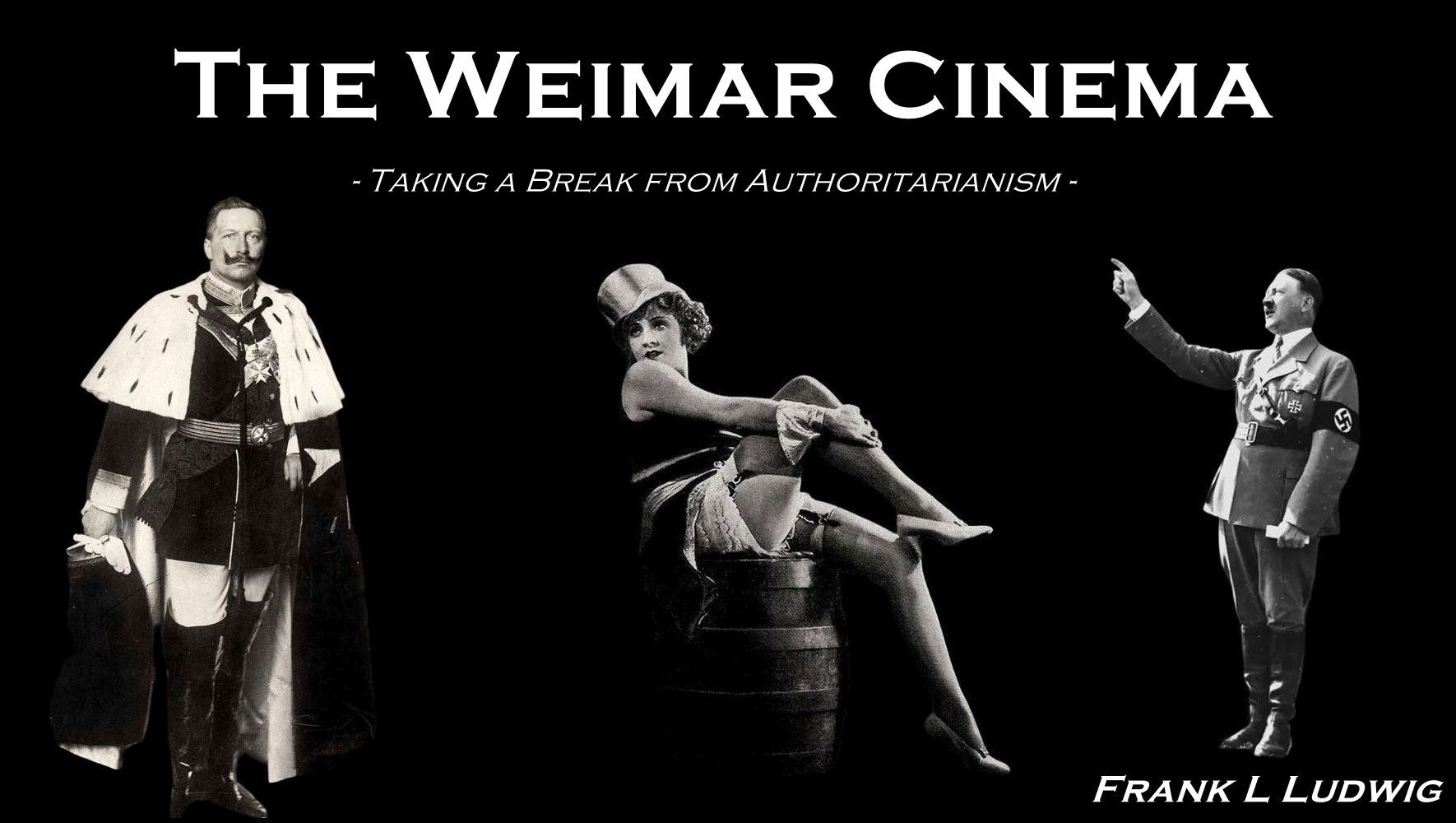
As I demonstrated in my Deindividuation Resister Hypothesis (DRH), human progress is driven by the few people who retain the individual identity every child is born with while those who identify collectively (i.e. by religion, nationality, culture etc) provide the network to spread it. Authoritarian and conservative governments suppress individuality and thus stifle progress; consequently Germany’s 14-year window between authoritarian regimes produced astonishing advances in science, the arts and other fields.
The Weimar Republic is also a textbook example of the mechanism (explained in the DRH) that causes societies that break free from permanent authoritarian rule, such as monarchies, to subsequently oscillate between liberalism and authoritarianism.
Film production was still in its infancy, and many directors jumped at the opportunity to use the new medium to express themselves largely uncensored and create works that couldn’t have been created at any other time, remembered as the Golden Age of German cinema. (This was arguably the most consequential era in cinematic history, and when the Nazis seized power, the mass exodus of directors, writers and actors to the US helped ring in Hollywood’s Golden Age.)
Other than the Others (‘Anders als die Andern’) - 1919
Paul sends his parents to a doctor who explains to them that Paul is homosexual, that he is not to blame for his orientation and that homosexuality is a natural variation rather than an illness.
One day Paul is visited by Franz Bollek who had blackmailed him before and, having seen the two in the park, returns to blackmail him again.
After Kurt’s parents forbid him to see Paul, he sends his sister Else to ask him to talk to his parents. He obliges, and they eventually agree to let Kurt pursue a musical career.
Bollek continues blackmailing Paul who eventually tells him he will receive no more money. Subsequently he breaks into Paul’s house to rob him but is surprised by Kurt and Paul as they return from a successful performance, leading to a fistfight.
Following that night, Kurt leaves a note for his sister, stating that he is determined to make his way alone. When Else tells Paul the news, he breaks down. She makes romantic advances which are spurned by him and leaves in a huff.
Paul reflects on his life: being bullied and harassed in his youth, unsuccessfully consulting a hypnotist to ‘cure’ him and visiting a sexologist who advises him to embrace his sexual orientation.
He invites Else to a lecture on sexology, and when she learns of his homosexuality, she decides to become his ally.
Bollek brings Paul to court, accusing him of homosexuality, where the latter is defended by the sexologist. The judge sentences Bollek to three years for blackmail and Paul, while pointing out that he is an honourable individual who has hurt no one, to one week since, according to the law, he cannot acquit him.
Before commencing his sentence, Paul realises that he is now shunned by everybody, and his agency cancels his concert tour and their contract. His own father comments, ‘If he’s a man of honour, he’ll know what he has to do now.’
Paul takes poison and is visited by Kurt on his deathbed. Paul’s parents are upset by his presence while Else accuses them and the rest of society of being responsible.
Kurt has suicidal thoughts as well, but the sexologist who is also present reminds him that the best way to honour Paul’s memory is to change society’s prejudices: ‘Through knowledge to justice!’
It met mostly with outrage, protests, anti-Semitic backlash and death threats against its Jewish writers and led to the reinstatement of censorship in 1920 under which it was banned, only to be available to medical and scientific communities. Under the Nazi regime all known copies were destroyed, and today only fragments of the film exist.
The Cabinet of Dr Caligari (‘Das Cabinet des Dr Caligari’) – 1920
His friend Alan bursts into Franzis’ room with the news that the fun fair is coming to town, and they decide to go.
An old man calling himself Dr Caligari approaches the grumpy town clerk for a permit to perform with his somnambulist at the fair and is kept waiting before the clerk refers him to his staff. At the fair he announces Cesare, his somnambulist; that night the town clerk is killed with a sharp instrument.
The following day, with Franzis and Alan in the audience, Caligari announces Cesare again, a man he claims has been sleeping since birth, and opens an upright coffinesque box revealing Cesare. He orders him to wake up and obey the voice of his master. Cesare emerges with trance-like movements, and Caligari encourages questions for him from the audience.
Alan asks, ‘How long do I have to live?’ to which Cesare replies, ‘Until dawn.’
On their way home they learn about the clerk’s murder from a poster before meeting Jane whom both are romantically interested in. After bringing her home, they agree to respect her choice and to remain friends all the same.
Alan is murdered with a pointed instrument at dawn. After hearing the news, Franzis informs the devastated Jane whose father decides to have police investigate the somnambulist.
That night another murder attempt is foiled and the perpetrator arrested. Franzis and Jane’s father hear of it while investigating Caligari and Cesare with police authorisation and subsequently leave.
Worried about her father not returning home, Jane gets restless and visits Caligari to enquire about his whereabouts while the arrested subject confesses to the murder attempt but swears he had nothing to do with the previous murders which he intended to use as a cover.
Later, while Franzis keeps a close eye on Caligari’s wagon, Cesare breaks into Jane’s home, tries to stab her but can’t bring himself to do it and instead kidnaps her. He lets go of her when the townspeople start chasing him.
Back home she tells Franzis and her father that it was Cesare, but Franzis claims that he had watched him the entire time.
At the police station Franzis checks that the suspect is still in custody and brings the officers to Caligari’s wagon where they discover that what he had been watching all night was a dummy.
Caligari flees and is chased by Franzis who sees him disappearing into an insane asylum. Personnel assure him that there’s no inmate called Caligari and refer him to the director who turns out to be the man calling himself Caligari. Franzis runs out and manages to convince staff who keep the director under observation. Amongst his effects they find a book on somnambulism containing the story of a Dr Caligari who, in 1703, used a somnambulist called Cesare whose mind he controlled to carry out murders while keeping a dummy in his box to divert any suspicion. They also find the director’s diary in which he vows to test whether a somnambulist can really be forced to do things that would appal him in a waking state. ‘I must become Caligari!’
The unresponsive Cesare is found by Franzis and staff in the wilderness and brought back to the asylum where he accuses the director, ‘You are Caligari!’
The director, realising that his instrument of terror is dead, attacks his staff who put him in a straitjacket.
(Back at the bench, Franzis brings the old man back inside and introduces him to Cesare and Jane. As the director enters, he shouts out, ‘You all believe I’m mad. It’s not true - the director is mad! He is Caligari!’
Franzis is put in a straitjacket, and after some thinking the director concludes, ‘Now I know how to cure him.’)
The bracketed scenes were added by director Robert Wiene to reverse the film’s anti-authoritarian message, much to the chagrin of the film’s writers.
Nosferatu - 1922
Arriving in Transylvania and having a meal at an inn, he mentions that he is on the way to Count Orlok and dismisses the warnings of the locals. In his room he finds a treatise on the vampire Nosferatu who lives on human blood and lives in coffins filled with the soil from the fields of the Black Death. Although he doesn’t take it seriously, he takes it with him when he travels on the following day. As the sun sets, the coachman tells him that he will not go any further and turns around. Thomas walks on for a while and is then collected by a coach which brings him to the castle. The grotesque-looking Orlok receives him and asks him to keep him company for the night since he has to sleep during the day.
When he awakes, Thomas finds two marks on his neck which he attributes to mosquitoes and writes a letter to Ellen.
The following evening Orlok signs the papers and spots Thomas’ medallion with Ellen’s portrait, remarking on her ‘beautiful neck’. That night Orlok threateningly approaches Thomas who tries to escape but corners him as Ellen rises from her bed and sleepwalks. Harding calls a doctor, and when Ellen shouts out her husband’s name, Orlok lets go of him.
In the morning Thomas explores the castle and finds Orlok motionlessly lying in a coffin. He passes out, and when he comes to, he watches him putting three coffins on a cart and lying down in the top one. The cart is then drawn away by horses. Realising he is locked in, Thomas manages to let himself out of a window with a makeshift rope but still has a significant fall and passes out again. Meanwhile the coffins are brought downriver on a raft.
Thomas is found by villagers and brought to the hospital while the coffins are carried onto a Wisbourg-bound schooner where rats are discovered in them.
Knock, who is now in an insane asylum since he started eating insects, nicks a warden’s newspaper and is delighted to read that a plague has broken out in Transylvania and on the Black Sea, with all victims having scars on the neck.
On the schooner the sailors die one by one of the plague, and when no one else is left, the captain ties himself to the wheel while the mate takes an axe and commences opening the coffins. Suddenly Orlok appears, and the horrified mate jumps overboard.
Knock watches the schooner entering Wisbourg Harbour from his cell, claiming, ‘The master is close’ and subsequently manages to escape.
Orlok carries his coffins to his new home while Thomas, who has ridden across Europe, returns to his wife.
Officials inspect the schooner whose captain is now dead as well and, after finding the logbook, declare a plague, and many fall victim to it, causing a panic in which people are distrustful of each other and blame Knock whom they try to lynch but who manages to escape.
Ellen discovers the vampire treaty and reads that the creature can be destroyed if a ‘sinless maiden’ willing to sacrifice her blood manages to make him forget the cockcrow. After Orlok has stared at her all night, she gives him an inviting look at dawn and opens her window. As he is about to come over, she feigns illness and tells Thomas to fetch the doctor. Orlok enters and feeds on her when he hears the cock crow. He gets up and struggles, but when he is hit by the first rays of the sun, he is reduced to a pile of ashes.
And while the recaptured Knock bemoans the loss of his master, Thomas embraces his dying wife one more time.
The plague ends with the destruction of Orlok.
Ellen, on the other hand, is a highly individual person, far removed from the hysterical crowd, but nonetheless saving that crowd by using her individual judgment and deciding to offer herself for the common good.
Dr Mabuse the Player (‘Dr Mabuse, der Spieler’) – 1922
One of his victims is Edgar Hull, son of an industrialist who is a member of an exclusive club and attends a performance of Mabuse’s girlfriend Cara Carozza. Mabuse hypnotises him and gets him to bring him along to the club where he causes him to lose massively and write him an IOU which he, for the time being, doesn’t claim. Mabuse orders Carozza to run into Hull and get him to invite her to his place. She asks, ‘Am I just a tool for you?’ but obeys nonetheless.
Hull is approached by public prosecutor Norbert von Wenk who has dealt with several similar cases. He realises that the culprit he calls the ‘Great Unknown’ must use different personas to remain unnoticed and disguises himself to go undercover. He meets Mabuse in a club, and when he notices who he is dealing with, Mabuse leaves. Wenk runs after him; his henchmen try to stop him, but he barricades the door behind him and manages to follow Mabuse to his hotel where a liftboy tells him his room number. A trap is set, but Mabuse gets past them disguised as the office manager.
Wenk calls a taxi in which he is gassed and, after losing consciousness, he is set adrift in a dinghy from which he is rescued by a group of fishermen.
Mabuse scolds his men for having failed and orders the killings of Wenk and Hull.
Carozza lures Hull, who is accompanied by Wenk, to a new casino. When Wenk disappears, she correctly assumes that he is about to raid the place and runs off, leading Hull into a side street where he is killed by one of Mabuse’s men.
Carozza is imprisoned, and when Wenk interrogates her, she refuses to cooperate.
Wenk enlists the help of a mutual acquaintance, Countess Dusy Told, who agrees to share her cell trying to find out on whose orders she acted. Carozza refuses and glorifies him as ‘the only man’ and ‘towering over the city’, giving the impression she protects him out of love.
Mabuse gives his men a deadline of one week to kill Wenk. Asked whether they should do something to help Carozza, he states that he doesn’t care about her.
As Dr Mabuse, this time acting as himself, holds a séance, he meets Told, falls in love with her and wills her to invite him to her and her husband’s home.
A few days later he attends a party at their place, and while the others play cards, he finds an excuse to bring her to another room while he wills her husband to cheat and get caught. The outraged guests leave, and as Told faints, Mabuse uses the distraction to bring her to his waiting car unnoticed.
Carozza is transferred to the women’s prison with a security guard stationed at her door to ensure her safety. Wenk interviews her again and claims he is on the Great Unknown’s track already, to which she replies, ‘He’s stronger than all of you!’ and that he destroys whoever gets in his way, revealing that she doesn’t protect him out of love but out of fear.
After Wenk leaves, the guard enters and gives her poison, saying, ‘From him.’ She replies, ‘I haven’t done anything’ but takes it, anyway.
Pesch, another of Mabuse’s men, bombs Wenk’s office but fails to kill him and is arrested. Mabuse, in yet another disguise, enters a pub, stands on a table, waves his hat and excitedly tells the crowd that their good friend Johannes Gutter has been arrested and calls for action. The angry mob spills into the street, blocks the police car and demands Gutter’s release, giving a sniper sufficient time to kill Pesch. Gutter doesn’t exist.
Mabuse decides to leave the city and asks Told whether she’ll accompany him willingly or as a prisoner. When she replies she wants to go back to her husband, he claims that this is the count’s death sentence.
The count, who has taken to drink and keeps reliving the humiliating moment of his guests leaving, is visited by Mabuse who tells him that his wife left him and that he ‘can’t go on living’, repeating the phrase several times. After he leaves, the count kills himself with a razor blade.
Wenk, investigating his death, interviews his psychoanalyst Mabuse who tells him he suspects that the count was acting under the spell of a powerful mind and invites him to a performance of the magician Sandor Weltmann that evening, exploring mass suggestion, trance and other phenomena.
Weltmann is none other than Mabuse and delivers several examples of the power of suggestion before hypnotising Wenk. By mentioning a Chinese place name he had repeatedly used when trying to hypnotise him at their first meeting, he lets Wenk know who he’s dealing with before sending him to drive a prepared car into a quarry.
Wenk does as he is willed, but his men outside drive after him, catch up and manage to drag him from his driving car into theirs.
The following morning Mabuse and his men prepare to leave the country but find that they are surrounded by police. A gunfight ensues, and Wenk phones Mabuse, asking him to surrender. Mabuse claims to be ‘the state within the state I am at war with’ and challenges Wenk to get him, telling him that he has Told.
Wenk calls in the army, and Mabuse’s men are eventually defeated and arrested. Mabuse escapes through a tunnel to the counterfeiting workshop operated by blind men, forgetting that he had installed a mechanism that only allows it to be opened from the outside. Realising he is trapped, he hallucinates about his victims and rapidly descends into madness before being found and arrested.
Wenk is one of the few in the city who retain their individual judgment (unless hypnotised) over the expectations of others.
A clue pointing to Mabuse brings Inspector Lohmann to the asylum where Baum tells him that Mabuse has just died. While Lohmann calls him a criminal, Baum considers him a genius who would have destroyed a world without charity and justice that only knows egoism, cruelty and hatred, a humanity that itself only knows destruction and that can only be cleansed by terror.
After Lohmann leaves, Baum reads Mabuse’s manifesto in which he calls for the rule of crime. ‘People have to be made afraid through unfathomable and seemingly senseless crimes, crimes not even understood by those committing them, crimes that don’t benefit anyone and whose only purpose is the spread of fear and terror.’
He is joined by Mabuse’s ghost who tells him, ‘The ultimate point of crime is to erect an unlimited rule of crime, a state of total uncertainty and anarchy, built on the destroyed ideals of a world doomed to perish. When people, ruled by the terror of crime, become numbed from horror, when chaos becomes the superior law, the hour of the rule of crime has come.’
Mabuse’s ghost gets up, walks over to the professor and merges with him.
After Baum acts suspiciously, Lohmann goes back to the asylum and finds a plan to attack a chemical plant. He visits the scene where he spots Baum watching from afar and chases him in his car. Back at the asylum the ghost of Mabuse leads Baum into the cell of another inmate (a former policeman who had gone insane after finding the lead to Mabuse) where he introduces himself as Dr Mabuse and tries to kill him but is held back by the guards.
The film ends with Lohmann finding Baum, having descended into madness, sitting in his cell and tearing Mabuse’s manifesto to shreds.
Being chased by police and Interpol, he loses control of his car which crashes and falls into the river.
The Last Man (‘Der letzte Mann’) – 1924
In the evening the doorman, not looking unlike Wilhelm II, majestically marches into the working-class area he calls home where he is revered as an authority and father figure who gives advice and reprimands children playing in the yard.
The following day he finds himself demoted to washroom attendant (a position which, in those days, generally provided more income than that of a doorman through tips) and has to part with his beloved uniform, turning him from a proud to a broken man within minutes. In the evening he steals the uniform to continue the triumphant entries into his neighbourhood where he attends his niece’s wedding, gets drunk and hallucinates about balancing a heavy trunk on one hand that six other men aren’t able to lift off the ground.
In the morning he leaves the uniform at the luggage deposit at the train station before going to work. At noon his sister wants to surprise him by bringing him lunch and is confused when she sees a different doorman. Asking about him, she discovers him in the washroom and flees in horror to alarm the neighbourhood, probably assuming that he had lied about being the doorman all along.
When he returns home in his uniform, he finds the yard deserted, and as he enters, his neighbours open their doors and windows to laugh at him. His family reprimands him, and he goes back to the hotel and surrenders his precious uniform to the night porter before breaking down in the washroom where the latter comforts him.
One day, while on duty, a millionaire dies in his arms whose testament stipulates that his fortune go to the person in whose arms he dies. Thus he regains the respect of the others and throws a big feast in the hotel to which he invites the night porter. Before they leave in a stagecoach, he generously tips the hotel staff, and when a beggar approaches the coach, the new doorman tries to drag him away, but instead he is invited to join the two for their ride.
Metropolis - 1927
Yet beneath the machine rooms lies the workers’ city.
Fascinated by Maria, he, for the first time in his life, enters the machine rooms to search for her. Here he witnesses a deadly accident with several casualties and has a vision of a massive statue of Moloch into whose fiery mouth people are fed, some by force while others go voluntarily, reminding him that many religions, such as capitalism, require human sacrifices. He immediately goes back to his car and tells his driver to bring him to the New Tower of Babel. Here he reports the incident to his father who tells him that accidents are unavoidable and turns against his secretary Josaphat for not having alerted him himself. When asked what he was doing in the machine rooms, Freder tells his father that he wanted to see the faces of his brothers and sisters. He points out the beauty of Metropolis and asks where the people are who built it, to which Fredersen replies, ‘Where they belong.’
Josaphat announces Grot, guardian of the heart machine, who tells Fredersen that two more of ‘these plans’ have been found in the pockets of the dead workers and hands them to him.
Fredersen fires Josaphat for not having brought him the plans himself. Freder points out that being dismissed by him means having to go into the depths before following Josaphat, preventing him from shooting himself, inviting him to his place and writing down his address. He tells him to wait for him since he first has to go to his brothers into the depths.
Fredersen orders the Thin Man, his personal spy, to keep Freder under surveillance at all times.
Freder enters the machine room again and sees worker 11811 collapse. When he tries to bring him to safety, the worker (named Georgy) tells him that the machine has to be manned at all times. Freder changes places and clothes with him, gives him his address where he should wait for him and sends him to his car whose driver doesn’t notice that he’s driving someone else.
On the way Georgy gets distracted by flyers for the nightclub Yoshiwara and asks the driver to bring him there instead, closely followed by the Thin Man.
Fredersen visits the inventor Rotwang who lives in a small old house, starkly contrasting with the surrounding skyscrapers. In the entrance hall he notices a monumental bust of a woman called Hel inscribed, ‘Born for my happiness and all humans’ blessing, lost to Joh Fredersen, died giving birth to his son Freder.’
After a heated exchange about Hel, Rotwang shows him a robot he constructed and tells him that within 24 hours he will be able to make a machine that is indistinguishable from a human.
Asked about the reason for his visit, Fredersen shows him the plans found on the workers and enquires about their nature. Rotwang tells him that these are maps of the catacombs which lie even beneath the workers’ city and to which he has access through his basement.
In the meantime Freder struggles with the machine and wonders whether ten hours will ever end. A plan falls out of his pocket, and another worker tells him that ‘she’ has called again. After the shift, he follows the others into the catacombs.
Here Maria tells her version of the Tower of Babel: despite speaking the same language, those who envisioned it couldn’t build it, and those who were meant to build it couldn’t envision it. Therefore, she claims, a mediator is needed: The Heart needs to be the mediator between Brain and Hands.
Observed by Fredersen and Rotwang, Freder steps forward and volunteers for the role of mediator. Fredersen orders Rotwang to make the machine-human in her image to sow division between her and the workers. After he leaves, Rotwang mutters, ‘You fool! You’ll lose the last you’ve had of Hel... your son.’
Freder and Maria agree to meet in the cathedral the following day. After Freder leaves, Rotwang kidnaps Maria.
When Georgy goes back to the car, he is surprised by the Thin Man who orders him to go back to work and forget what happened.
Returning home, Freder tells Josaphat to wake Georgy to bring him to the workers’ city, only to learn that he hasn’t arrived. Right after Freder leaves, the Thin Man arrives and tries to bribe Josaphat into leaving with ever-increasing sums of money, but to no avail. A fight ensues, and the Thin Man tells him he’ll collect him in three hours.
Passing Rotwang’s house, Freder hears Maria’s screams and breaks in only to become trapped by a mechanism of closing doors.
Rotwang connects the unconscious Maria to his machine-human to give it her appearance. After releasing Freder and being asked about Maria, he tells him that she is with his father.
He goes to his father, finds him embracing machine-Maria and becomes delirious.
At Rotwang’s reception machine-Maria, emerging from a shell-like vessel supported by seven sculptures of dark-skinned people, dazzles all men with a wild suggestive dance, causing them to risk the Seven Deadly Sins for her.
Freder on his sickbed hallucinates about the event, seeing (machine-)Maria as the Whore of Babylon, remembering the Thin Man’s sermon and having a vision of the sculptures of the Seven Deadly Sins and eventually that of Death himself coming to life, shouting, ‘Death is above the city!’
Fredersen tells the Thin Man that, whatever happens, he has to let the workers have their way.
Rotwang explains to Maria how Fredersen is trying to get the workers to commit violence to justify violent retaliation against them and how machine-Maria will preach upheaval by destroying belief in the mediator, but that she is controlled by him, not by Fredersen. He also admits not having told him that Freder wants to be the mediator and loves her.
In the meantime machine-Maria addresses the workers, telling them that the mediator hasn’t come. She asks them, ‘Who is the living fodder for the machines? Who greases the machines with their own marrow? Who feeds the machines with their own flesh? Let the machines starve, let them die!’
As the gathering turns into an angry mob, Freder and Josaphat arrive, and Freder shouts out, ‘You’re not Maria!’ He is recognised as Fredersen’s son and about to be lynched by the mob; one attacker tries to stab him but instead kills Georgy who has come to his aid. One calls for them to get their wives and sons from the workers’ city to join them.
Fredersen who secretly listened to Rotwang’s confession enters and starts a fight with him, giving Maria the opportunity to escape.
The workers go to their city and gather all adults to attack the machines with them. Machine-Maria directs the mob to the vital heart machine. Grot manages to prevent the attack by closing the gates, but Fredersen who monitors the situation phones him and orders him to open the gates, upon which he is attacked by the mob whom he tells that destroying the heart machine would flood their own city. The machine is destroyed nonetheless, leading to the predicted flooding of the workers’ city in which Maria has just arrived. Panicked children flee from their homes, and Maria sounds the alarm as the first buildings collapse.
On the monitor Fredersen watches the mob perform a victory dance when the Thin Man bursts in to tell him that his son is amongst the workers. Fredersen gets distraught and asks him, ‘Where is my son?’ to which the Thin Man replies, ‘This is what thousands will ask you tomorrow.’
Having heard the alarm, Fredersen and Josaphat rush to the workers’ city and, together with Maria, evacuate the children and bring them to the Club of Sons.
Grot interrupts the mob’s celebration by asking, ‘Where are your children? The city is flooded.’ After a sobering moment, realising they may have killed their children, they turn against their leader and hunt Maria whom they now call ‘the witch’ (rather than checking on their children).
Machine-Maria returns to the Yoshiwara celebrating the apocalypse with her admirers who proceed to parade through the streets with her when the mob, now led by Grot, spots her and calls for her to be burnt at the stake. She edges them on, is tied to a wrecked car and set on fire. Freder and Josaphat spot her but can’t reach her. Eventually her metal core becomes visible.
In the meantime Rotwang finds Maria and considers her to be Hel. He chases her as she runs into the cathedral where she manages to ring the bell for attention. Freder spots them at the balustrade and hurries to help her. Josaphat, the Thin Man and Fredersen watch their fight on the roof in anguish which ends with Rotwang falling to his death.
Grot attacks Josaphat but lets go when he is told that the children are safe.
Later, under Maria’s supervision, Grot and Fredersen attempt to shake hands but are not able to overcome their mutual resentment. She then calls for Freder as the mediator who takes both their hands and brings them together.
The final intertitle again claims that the Heart has to be mediator between Brain and Hands.
His role in supporting the workers is enabled by privilege: other members of the elite would probably have been politely escorted back if they had entered the machine rooms, but of course they couldn’t do this to the son of Dear Leader.
Pandora’s Box (‘Die Büchse der Pandora’) – 1929
The next day she visits her best friend Alwa who happens to be Schön’s son. His father is annoyed to see her but suggests that she join Alwa’s variety show. On the opening night Schön brings his fiancée along, and Lulu refuses to perform in front of her rival. Trying to get her to change her mind, he takes her to a storage room where she seduces him and where his fiancée discovers them.
Since the wedding has been called off and his reputation is shattered, Schön marries Lulu after all. On the wedding night he catches her flirting with other men and gets his revolver to shoot them. She tries to stop him, and the men manage to escape.
Shortly afterwards Alwa professes his love for her, but his father, still carrying the revolver, sends him out to be alone with Lulu. He forces the revolver into her hands and orders her to shoot herself. She refuses, and amidst the struggle a shot kills him.
At her trial the prosecutor demands the death penalty, comparing her to the Pandora of Greek mythology, but the judge sentences her to five years for manslaughter. Two of her admirers raise the fire alarm, and she manages to escape with them.
She shows up at Alwa’s place who reprimands her, but when she tries to call the authorities to turn herself in, he agrees to arrange for her to flee the country with the help of Countess Augusta Geschwitz, another of her many admirers who lets her use her passport. The three and two other of her male admirers board a train, but she is recognised and blackmailed by another passenger who lures the fellowship onto his gambling ship where they stay in hiding.
Here one of her fellow travellers demands money from her to finance his wedding, and in order to get it, Alwa cheats at a card game with money provided by the countess but is discovered while the ship’s owner sells her to an Egyptian. Simultaneously the countess, urged by Lulu whom she is infatuated with, seduces the second blackmailer to get him to change his mind. When police arrive to raid the ship, Lulu, Alwa and the remaining admirer manage to flee in a boat and try to get to London.
Here they arrive during the Christmas season at the time of the Whitechapel Murders and live in poor conditions. Lulu has to prostitute herself, and one evening she brings a man home who claims to have no money, saying that she likes him and that he can come anyway. The man drops a knife he held behind his back and follows her upstairs. However, when she snuggles up to him, he spots a kitchen knife on the table and can’t resist the temptation.
Lulu, on the other hand, has retained her individual identity and doesn’t care about the norms (i.e. the very narrow spectrum of behaviours and opinions tolerated by mainstream society) of her environment and does her own thing, a choice stereotyped as the ‘flapper lifestyle’ at the time. For this she is severely punished by said society which eventually ejects her and forces her to fend for herself in anonymity.
Brooks had been Pabst’s first choice, but her studio (which she later left over a salary dispute) didn’t tell her about the offer. While Marlene Dietrich sat in his office, waiting to sign the contract, he was informed about Brooks’ availability.
The Blue Angel - (‘Der blaue Engel’) – 1930
That night he visits the cabaret and starts chasing them when he stumbles across Lola Lola (Marlene Dietrich), the main attraction of the show, and becomes infatuated with her.
He finds a reason to return the following night, starts a bar fight to protect her from an insistent customer and threatens his students with consequences.
The next morning he wakes up in Lola’s bed, and when he enters the classroom, his students rebel against him, their racket alerting the director who dismisses the class before confronting Rath about his visit to Lola. Rath replies he intends to marry her, aware that this would mean the end of his career.
Just as the troupe are leaving The Blue Angel to travel on, Rath enters and proposes to Lola; they marry and he joins the troupe but gets increasingly frustrated with having to sell postcards of his wife to the audience.
Five years later, when he has become a popular pathetic clown, the troupe returns to The Blue Angel against his will. He refuses to perform and has to be dragged on stage by the others to be laughed at by his former students and humiliated by the troupe’s director, the magician Kiepert (Kurt Gerron). Eventually he cracks an egg on Rath’s head and forces him to crow like a cock while Rath watches the strongman kiss Lola. After the performance he bursts into her changing room, still crowing, and attacks the strongman who overwhelms him and puts him in a straitjacket.
After he is released, he returns to his old classroom, sits down and clenches a desk where the janitor finds him dead.
Starting out as an authoritarian without authority who was merely disrespected, he inadvertently chose a downward spiral of condescension, ridicule, derision and utter humiliation.
M - 1931
After police and the press receive letters from the killer, assuring them he isn’t finished, they use state-of-the-art techniques like fingerprinting and handwriting analysis to find the murderer.
The frantic efforts of the police disrupt organised crime and prostitution. In the end the crime syndicates come together and plan to catch the killer themselves. In order to have a group of people surveilling the entire city without arousing suspicion, they recruit the association of beggars.
In the meantime police gathered a list of all recently released patients from mental institutions and check on them. One of them is Hans Beckert who isn’t home but whose landlady lets police enter his room where they discover the imprint of the letter, caused by pressing the pencil, on the windowsill and await his return to arrest him.
Beckert, whistling the tune In the Hall of the Mountain King (the first use of a leitmotif in a film), approaches a girl and treats her to a bag of sweets while peeling an apple for himself. A blind beggar remembers the tune from a previous crime scene and alerts the others. One of them slaps Beckert on the shoulder and reprimands him for dropping his knife, leaving the letter M for murderer in chalk on his coat. Subsequently Beckert and the girl are followed closely until she spots the chalk and points it out to him. Realising that he is being watched, he panics and runs away. He is chased through the streets and disappears into an office building just as the offices are closing and the workers go home.
The criminals move in, overwhelm the watchmen, tie them up and search the building. One of the watchmen manages to trigger the alarm, and just before the police move in, Beckert is located in the attic and taken to a disused factory. However, one of the criminals is left behind and later tricked by police into disclosing the location.
In the factory Beckert is subjected to a kangaroo court in front of hundreds of criminals and prostitutes, most of whom demand that he be beaten to death while he demands to be handed over to police.
When the ‘prosecutor’ tells him that he’ll even get a defence lawyer, Beckert, kneeling on the floor, becomes hysterical and points out the hypocrisy of criminals prosecuting him.
The ‘prosecutor’ argues in favour of killing him since he may break out of an asylum or may be released as cured and continue killing.
Regaining his composure, Beckert claims that he can’t be held responsible, compared to his accusers whom he accuses of being criminals by choice who are too lazy to seek regular employment.
He describes how he is constantly chased by someone turning out to be himself, running through endless streets trying to escape himself and his ghosts who are always present, except when he ‘does it’, and how the following day he would read a poster and think, ‘This was me?’
The ‘prosecutor’ claims that Beckert passed the death penalty on himself by admitting that he has to kill.
The ‘defence lawyer’, after mentioning that the ‘prosecutor’ is wanted for three homicides, insists that Beckert is not responsible for his actions and therefore a case for the doctor and not the executioner, and ‘that this human being’ (someone shouting, ‘He isn’t one!’) has the same right to a fair trial as any other criminal and should be handed over to the police. The others laugh at him and demand Beckert’s death. Just as the mob is about to lynch him, the police arrive.
The film ends with the proper court going into session, leaving the judgment to the audience.
By detailing forensic techniques and developing a psychological profile, M laid the groundwork for future thrillers and crime films.
Most mainstream people accept or even support the killing of people when it is institutionalised, such as war and the death penalty. Germany, like most Western countries, still practised capital punishment (which progressive people opposed as barbaric), and so the suggestion of sparing the life of someone guilty of the most heinous crimes came as a shock to many. By contrast, nowadays the general reaction in the Western world, apart from some of the United States, would be the demand to lock them up for life.
Propaganda Minister Joseph Goebbels (who had banned his latest film, The Testament of Dr Mabuse) called Lang to his office in 1933 and offered him to head the film studio UFA. Instead, Lang emigrated to France.
Both Lorre and Lang eventually arrived in the US to commence their Hollywood careers.
Comradeship (‘Kameradschaft’) – 1931
In the mornings German miners travel across to find work, but the French have a surplus of unemployed miners themselves.
Frequent fires break out in the French part of the mine which are noticed on the German side as well.
One day the fires get out of control and cause the roof to collapse. Hundreds of miners are trapped, and the smoke can be seen from the German side as well. German miners finishing their shift discuss the tragedy, most of them being indifferent (‘That’s not my problem’). Wittkopp (Ernst Busch), head of the German rescue team, appeals to his men to help but is met with comments like ‘They wouldn’t come to our aid, either’ or ‘We know the French from the Ruhr occupation’. Wittkopp urges them to forget about the generals and reminds them that they are kumpels (‘Kumpel’ being a German term for a fellow miner) with wives and children, and in the end he convinces most of them to join him, and a few others follow after he appeals to their manliness (‘Who’s afraid doesn’t have to come along’).
After he gets approval from his boss, the men leave in two lorries. Assuming that French border patrols would hold them up with passport controls, they crash through the tollgate and are shot at by border police until their captain tells them to stop.
Family members gather at the entrance of the mine and are refused entry as the black flag of mourning is raised. They insist the men are not dead and try to force the gate open despite being threatened with the military when, to everybody’s surprise, the German rescue team arrives.
In the meantime three German miners break through the wall that separates the German and French parts of the mine and find a gate marked ‘Border 1919’ which they smash in to join the rescue efforts.
German rescue workers wearing gas masks try to save one of the trapped miners who relives the trauma of hand-to-hand combat with German soldiers wearing gas masks during the war and tries to strangle the worker who has to knock him out in order to rescue him.
An outdoor party is organised in the wake of the events. People ask, ‘Where is the archenemy?’ and hug each other. A French miner tells the audience that they are all miners, and that they only have two enemies: gas and war. Afterwards Wittkopp stresses that they are all kumpels and workers and warns them not to let politicians get them to hate and kill each other again.
The film ends with French and German border police overseeing the reinstallation of the ‘Border 1919’ gate.
Kuhle Wampe or Who Owns the World? (‘Kuhle Wampe oder Wem gehört die Welt?’) – 1932
An unnamed young man, like thousands of others, cycles through Berlin in search of employment but returns¬ home empty-handed, like most of the others. His mother reprimands him by spouting out a number of conservative platitudes like ‘Hard-working people are always successful.’ The father, unemployed himself without even trying, scolds him for not greeting the landlord to whom they owe six months’ rent. The only one sticking up for him is his sister Anni (Hertha Thiele), the only person in the household who still has work.
After lunch he goes to his room, takes off his watch, puts it on the nightstand and jumps out of the window. Mourners claim that he had ‘the best life ahead of him’.
The family gets evicted for not paying their rent. Anni’s boyfriend Fritz (Ernst Busch) brings them to Kuhle Wampe (‘Empty Stomach’), a campsite at a lake. Anni finds out that she’s pregnant; her father, probably suspecting she might be, threatens to kill her if ‘something happens’.
Fritz tells his colleague that he doesn’t want to marry because he wants his independence.
On a stroll together Anni and Fritz run into a group of children. As she looks at them, she suddenly perceives them as dangerous and nightmarish, a scene accompanied by a shrill apocalyptic cacophony.
After Fritz talking to her father, the two get engaged. However, at the celebration he admits to her that he feels he was trapped, causing Anni to leave and move in with her friend Gerda.
At a socialist sporting event Anni and Fritz (who are now both unemployed) reunite, and on their way back on the subway passengers of different social classes start discussing newspaper headlines like the burning of large amounts of coffee to keep up the price; a businessman suggests colonies as the solution, admitting that it wouldn’t lower the price of coffee but that ‘we would make the profit’, and is challenged by Karl, Gerda’s boyfriend, to define ‘we’.
Another businessman proclaims, ‘We won’t change the world,’ which Karl answers in the affirmative, pointing out that businessmen have no incentive to do so. One of them smugly asks, ‘And who will change it?’ to which Gerda replies, ‘Those who don’t like it.’
The film ends with the crowd singing the Solidarity Song (‘Solidaritätslied’) by Brecht and Eisler.
The Blue Light (‘Das blaue Licht’) – 1932
At dinner they enquire about her, and the innkeeper tells his son to bring the book. The boy returns with a massive volume entitled ‘The Story of Junta, died 1866’.
‘The story,’ he tells the visitors, ‘goes back to the time when the blue light shone from the mountain...’
The young German painter Vego arrives in the village, and as he joins the people for a drink outside the inn, he asks them why they’re in such a gloomy mood. He is told that it’s the full moon, and that on each full moon a blue light shines from the mountain, and each time one of their young men is trying to climb it and falls to his death.
Junta (Leni Riefenstahl), a woman who lives in the mountains with her friend, the shepherd boy Guzzi, approaches the crowd and offers them a crystal she carries in her basket. She is met with hostile glances and children’s jeers, and when the local trader tries to give her money for it, she wrestles it back and runs away but is assaulted by a man before leaving the village.
Vego is told that Junta is ‘not normal’ since she is able to climb the mountain effortlessly while all their experienced men fail and that therefore she is ‘the Devil’s witch’.
The following morning another young man’s corpse is carried back into the village, and someone spots Junta and tells the others that she is to blame. Immediately a lynch mob chases her with sticks and stones. Vego stands in their way and asks them to stop; they don’t, but the interruption gives Junta sufficient time to escape.
He follows her to her hut, and even though they don’t understand each other since she only speaks Italian, they become romantically involved, and the next day he returns with his belongings (including his easel) and moves in. The following four weeks he enjoys the simple lifestyle nature provides and even says that he never wants to return to the people.
At the next full moon he watches her waking up and walking towards the mountain in a trance-like state. He follows and discovers her sitting in a grotto on top of the mountain, mesmerised by the beautiful sight of the moonlight being reflected by thousands of crystals, until the sound of a falling crystal under his foot gives him away.
In the morning he tells her that they are sitting on a fortune and that she’ll never have to walk barefoot and in rags again (in German, of course).
He returns to the villagers and tells them about the grotto and how to safely get there. Within hours they empty it.
Junta spots a few crystals and a pickaxe on her way and, getting suspicious, returns to the grotto which, to her horror, she finds completely void. She climbs up its barren wall, loses her grip and falls to her death.
The innkeeper turns to the last page which laments her sad death and vows that her memory will live on in the village that so severely wronged her and that got so rich from the crystals of the grotto. He then closes the book.
To Junta the crystals symbolise beauty and nature which she is so closely connected to, highlighted by the fact that she always carries one with her. To the villagers they symbolise wealth and status.
Vego is a traveller between worlds. He enjoys being away from people and living in nature, but in the end, the prospect of gaining wealth and status is too tempting, and he assumes that Junta will feel the same way. This shows that their communication problems go beyond language barriers and include the clash of neurological orientations.
Most importantly, the film demonstrates that mainstream society may still exploit the very people it has ostracised.