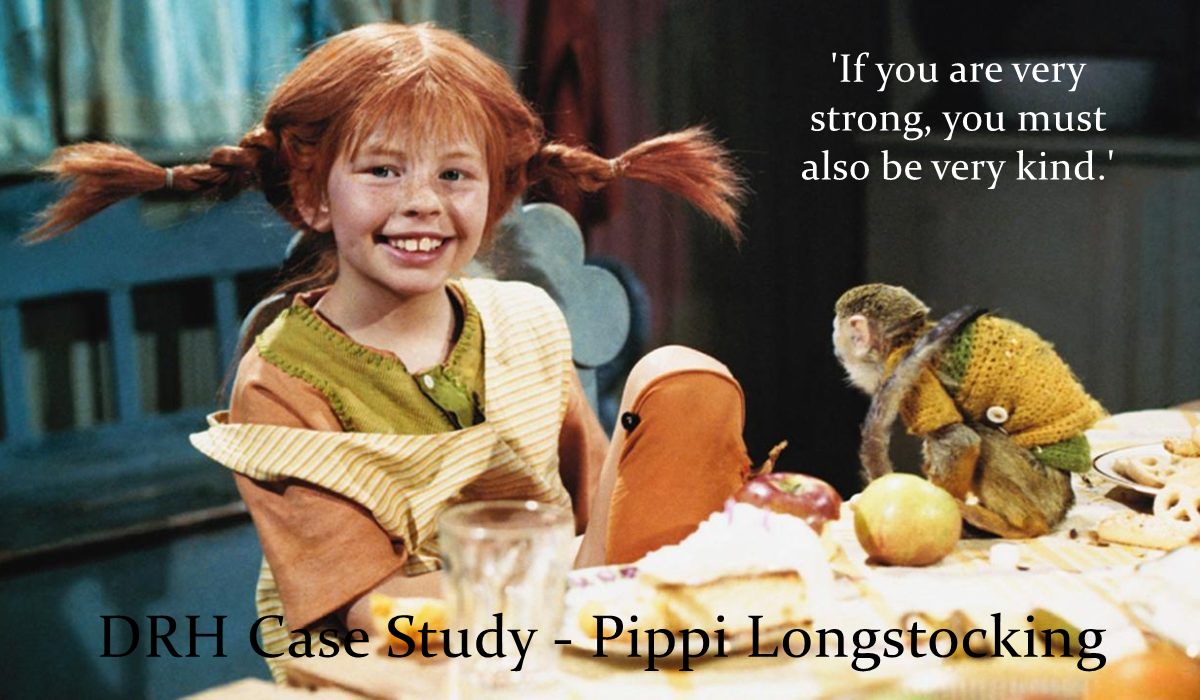
From a DRH/NSM perspective, Pippi Longstocking would probably be one of the clearest fictional examples of an extreme deindividuation resister, and perhaps even a rare example of what you call a deindividuation exempt.
Pippi and the DRH
Throughout the books, Pippi is almost completely immune to social pressure. What is striking is that this immunity is not presented as rebellion for its own sake. She simply does not regard social expectations as automatically legitimate.
Consider her attitude toward:
School
Adult authority
Social class distinctions
Respectability
Gender expectations
Wealth and status
In each case, she evaluates things according to her own judgment rather than according to what others expect.
A conventional rebellious child often defines themselves against society. Pippi is different. She rarely seems interested in opposing society. Instead, society simply has little power to define her.
That is much closer to the DRH concept of resistance to social conditioning than to ordinary adolescent rebellion.
Resister or Exempt?
The interesting question is whether Pippi is a resister or an exempt.
A resister usually develops through conflict with social conditioning. They struggle against pressure and emerge independent.
Pippi shows very little evidence of such struggle.
She appears to have grown up largely outside the normal mechanisms of social conditioning:
No conventional schooling.
No authoritarian household.
No pressure to conform to peers.
No dependence on institutional approval.
As a result, she often behaves as though many social rules simply never became psychologically binding.
From your framework, that would make her look more like a deindividuation exempt than a resister.
In fact, Astrid Lindgren almost creates a thought experiment:
What would a child look like if she grew up largely free from the social conditioning that normally produces conformity?
The answer is Pippi.
Position on the NSM
On your Neurological Spectrum Model, Pippi would sit extremely far toward the Individual Person end.
Not because she is selfish - quite the opposite.
One of the most interesting aspects of Pippi is that she demonstrates that individualism and kindness are not opposites. She is:
Generous
Compassionate
Protective of weaker people
Deeply loyal to friends
Yet she remains highly independent.
This contrasts with the common assumption that social conformity is necessary for morality.
Lindgren repeatedly shows that Pippi often behaves more ethically than respectable adults because she judges situations directly rather than through convention.
Relationship with Tommy and Annika
Tommy and Annika are fascinating DRH characters as well. Initially, they represent normally socialised children:
Polite
Obedient
Conventional
Pippi functions almost like a minority influence figure.
She does not force them to change. Instead, by consistently acting according to her own principles, she gradually broadens their understanding of what is possible. This resembles the mechanism described in minority influence research: a consistent independent individual causes others to rethink assumptions.
Pippi therefore acts less like a leader and more like a catalyst.
Why Many Autistic Readers Relate to Pippi
Although Lindgren never intended Pippi as an autistic character, many autistic readers have felt an affinity with her.
She often:
Questions arbitrary rules.
Interprets situations literally.
Shows little concern for status hierarchies.
Remains authentic despite social pressure.
Is comfortable being different.
From a DRH perspective, this is exactly why the character can feel so familiar to people who see themselves as resisting social conditioning.
The Shadow Side
Your distinction between resisters and exempts raises an interesting point.
Pippi's independence works largely because she possesses extraordinary advantages:
Enormous physical strength.
Financial security.
Freedom from adult control.
Real-life deindividuation resisters usually lack such protections. Many pay significant social costs for nonconformity.
Pippi therefore resembles an idealised version of the independent individual: someone who can remain fully authentic without suffering the penalties that most real people face.
A DRH Summary
If one were to place Pippi on your framework, she would probably be:
DRH category: Primarily a deindividuation exempt, with traits also seen in strong resisters.
NSM position: Extremely close to the Individual Person end of the spectrum.
Social influence style: Minority influence through example rather than persuasion.
Core characteristic: Evaluates situations according to personal judgment rather than collective expectations.
Moral orientation: Independent yet highly prosocial.
In many ways, Pippi may be one of the most optimistic fictional expressions of a DRH-like worldview ever written: a child who remains completely herself while still caring deeply about other people. That combination - strong individuality coupled with compassion - is precisely what makes her so memorable.