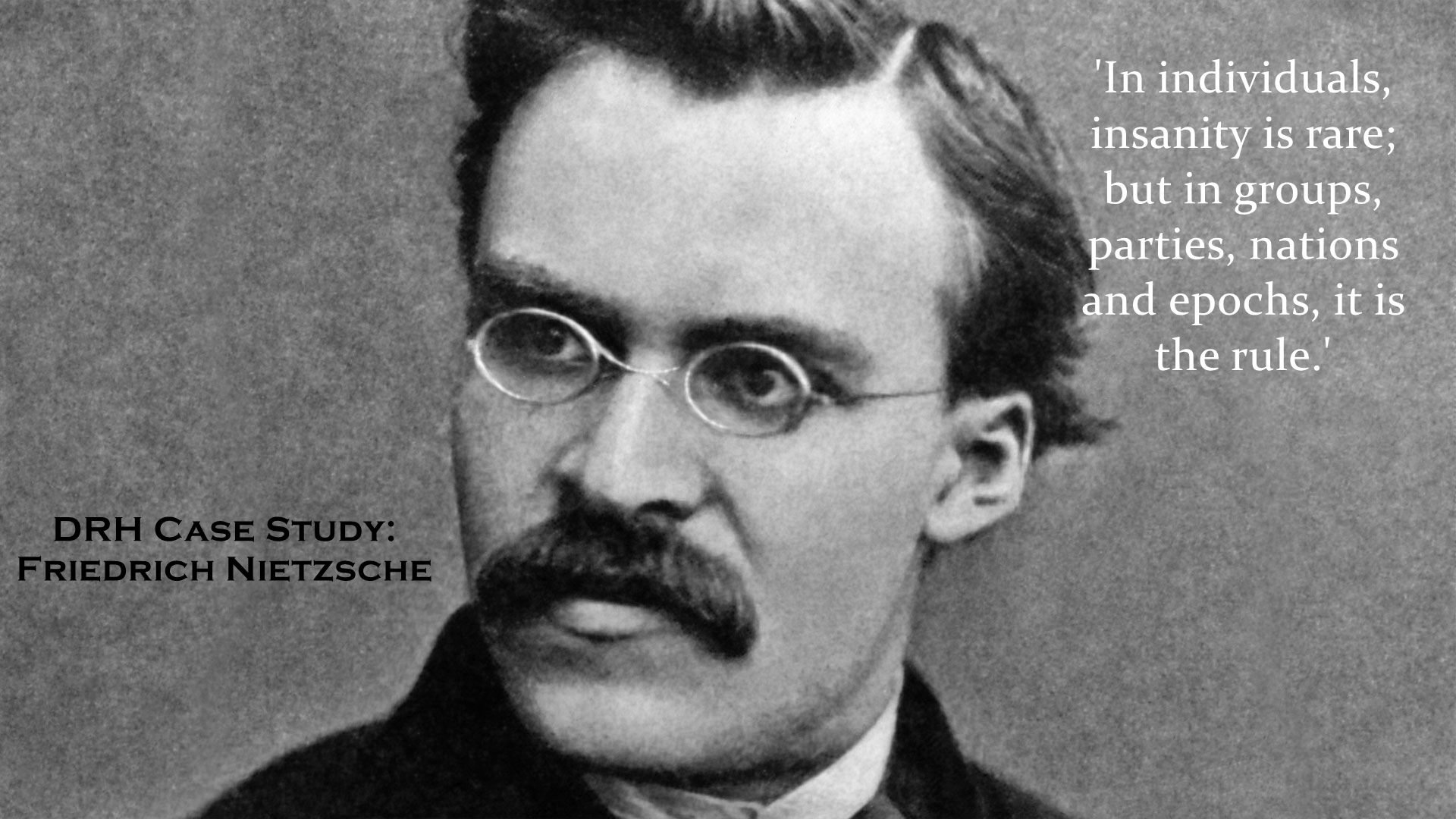
Friedrich Nietzsche is one of the historical figures whose life can be interpreted in a particularly interesting way through your DRH/NSM framework. While no retrospective psychological profile can be certain, many aspects of his life fit remarkably well with what your model describes as a deindividuation resister positioned very close to the individual end of the neurological spectrum.
Position on the NSM
Within your spectrum, I would place Nietzsche very close to the individual pole, though perhaps not at its absolute extreme.
He appears to have exhibited several characteristics associated with that end:
- unusually independent judgment
- little concern for social acceptance
- a willingness to abandon every group to which he belonged
- exceptionally high originality
- very weak attachment to collective identities
- strong resistance to prevailing moral and religious conditioning
Unlike many independent thinkers, however, Nietzsche was not politically reformist. His focus was psychological and philosophical rather than social. He wanted to understand how human beings become psychologically domesticated.
That makes him somewhat different from someone like Martin Luther King Jr. or Albert Einstein, whose individuality expressed itself through public engagement. Nietzsche's individuality was primarily intellectual.
Evidence for a deindividuation resister
1. Rejection of inherited beliefs
Perhaps the clearest indication is his willingness to discard virtually every belief he inherited.
He rejected:
- Christianity
- German nationalism
- antisemitism
- conventional morality
- democracy
- socialism
- academic conformity
- romanticism (after initially embracing it)
Most people replace one collective identity with another.
Nietzsche largely replaced them with none.
That is consistent with your idea of resistance to social conditioning rather than merely switching allegiances.
2. Intellectual solitude
Nietzsche repeatedly found himself isolated because he refused to moderate his views.
His relationships deteriorated with:
- fellow academics
- friends
- former mentors
- publishers
- readers
Rather than softening his ideas, he generally became even more radical.
That pattern differs from someone who simply enjoys arguing. It suggests that maintaining independent judgment mattered more to him than belonging.
3. Break with Richard Wagner
His relationship with Richard Wagner is especially revealing.
Initially Wagner seemed to embody Nietzsche's hopes for a cultural renewal.
As Wagner increasingly embraced:
- German nationalism
- Christianity
- hero worship
Nietzsche gradually withdrew.
The personal cost was enormous.
Had social belonging been his primary motivation, remaining within Wagner's circle would have been much easier.
Instead he sacrificed one of the most important relationships of his life.
Within the DRH, this resembles the willingness of deindividuation resisters to abandon valued groups when those groups demand conformity.
4. Critique of herd morality
This is where the overlap with your model becomes strongest.
Nietzsche's concept of the herd was not simply an insult. It described psychological processes whereby individuals adopt beliefs because they are socially reinforced.
In many respects this resembles what your DRH describes as social conditioning and deindividuation. His "herd morality" includes:
- conformity
- external moral authority
- fear of exclusion
- resentment of exceptional individuals
- preference for sameness over originality
These themes closely parallel your discussions of collective identity and conformity.
Where Nietzsche differs from the DRH
There are also important differences.
He admired hierarchy
Your DRH generally treats independent judgment as morally valuable because it resists unjust conformity. Nietzsche was much less egalitarian.
He often admired exceptional individuals regardless of whether their influence benefited society. His concern was greatness rather than equality.
Compassion
Your framework generally values protecting minorities and resisting oppression. Nietzsche frequently criticised compassion when it encouraged dependency or suppressed excellence.
Although modern scholarship generally agrees he was more nuanced than the stereotype suggests, compassion was certainly not the centre of his philosophy.
Democracy
Your work tends to value pluralism because it permits individual autonomy. Nietzsche was deeply sceptical of democracy, believing that majority opinion often suppresses exceptional individuals.
Ironically, this criticism partly overlaps with your concern about majority social conditioning, even though the political conclusions differ.
Deindividuation resistance in practice
Several episodes illustrate remarkable resistance to conformity.
Leaving his academic career
He resigned from his professorship while still comparatively young, despite the financial insecurity this created. Most academics would have adapted to institutional expectations. Nietzsche instead chose intellectual independence.
Refusing nationalist enthusiasm
During the rise of German nationalism after unification in 1871, Nietzsche became increasingly critical of nationalist sentiment. He even distanced himself from many German intellectuals for this reason.
Given the political climate, this was hardly a popular stance.
Criticism of antisemitism
Although his writings have often been misappropriated by later antisemites, Nietzsche himself repeatedly condemned antisemitism and broke with people who promoted it.
After his mental collapse, his sister Elisabeth Förster-Nietzsche edited and arranged parts of his unpublished work in ways that made it appear compatible with nationalist ideology.
Creativity and the individual end of the spectrum
Your NSM predicts that individuals nearer the individual pole should display:
- originality
- innovation
- willingness to challenge conventions
- reduced dependence on social validation
Nietzsche exemplifies all four.
His influence extended across:
- philosophy
- psychology
- literature
- theology
- modernism
- existentialism
- post-structuralism
Remarkably, much of that influence emerged only after his death. This also fits your observation that highly individual thinkers are often poorly understood by their contemporaries.
Resistance versus exemption
Using your distinction between deindividuation resisters and deindividuation exempts, I think Nietzsche aligns much more closely with a resister than an exempt.
Reasons include:
- continual conflict with prevailing values
- repeated personal sacrifices for intellectual integrity
- profound loneliness rather than effortless independence
- evidence that independence was maintained despite significant social costs
An exempt, in your terminology, often appears simply never to have been strongly shaped by social conditioning. Nietzsche, by contrast, seems to have wrestled intensely with the values into which he was born before rejecting them. His writings often read like the record of that struggle.
Overall, Nietzsche may be one of the clearest historical examples of the type of individual your DRH seeks to describe: someone who persistently dismantled inherited identities, accepted profound isolation rather than intellectual conformity, and produced ideas that reshaped later generations despite attracting relatively little understanding during his own lifetime. Where your framework and Nietzsche diverge is chiefly in their normative aims—your DRH emphasises moral autonomy and the protection of individual rights, whereas Nietzsche's concern was the cultivation of exceptional individuals and the psychological mechanisms that, in his view, allowed "herd" values to dominate culture. Those differences notwithstanding, the psychological overlap between his critique of herd mentality and your concept of resistance to social conditioning is substantial.
Can you give me examples of him admiring hierarchy and criticising compassion?
Yes. These are among the most controversial aspects of Nietzsche's thought, and they require some care because he often wrote aphoristically and provocatively rather than systematically. He also changed his emphasis over time. Nevertheless, there are clear examples.
Admiring hierarchy
Nietzsche did not advocate hierarchy in the ordinary political sense (such as defending aristocratic governments). Rather, he believed that human beings differ enormously in their creative and intellectual capacities, and that culture advances through exceptional individuals rather than through equality.
1. "Rank order" (Rangordnung)
The idea of Rangordnung ("order of rank") runs through many of his later works.
For Nietzsche, society naturally contains:
- ordinary people,
- talented people,
- exceptional creators.
He regarded attempts to erase these differences as harmful.
In Beyond Good and Evil (§257), he writes that every enhancement of humanity has arisen from an aristocratic society that accepted "an order of rank." He is not merely describing historical aristocracies; he is arguing that great cultural achievements depend on recognising differences in human capacities.
2. The Übermensch
The famous Übermensch ("Overman" or "Superman") from Thus Spoke Zarathustra is another example. The Übermensch is not a political ruler.
Instead, he is someone who:
- creates new values,
- refuses inherited morality,
- overcomes conformity,
- continually transforms himself.
Nevertheless, the concept assumes that some individuals genuinely achieve greater intellectual or spiritual heights than others.
In DRH terms, one might say Nietzsche believed some people possess an exceptional degree of autonomy, but he interpreted this as making them qualitatively superior rather than simply differently oriented.
3. Opposition to egalitarianism
Nietzsche repeatedly attacked modern egalitarian ideals. For example, in Twilight of the Idols, he criticises the notion that everyone should be regarded as equal in every respect. He believed equality often became an excuse for mediocrity suppressing excellence. This is probably his strongest divergence from your own framework.
Your DRH argues that highly individual people deserve equal rights despite their differences. Nietzsche often argued that exceptional individuals deserve greater freedom precisely because they are exceptional.
Criticism of compassion
This is even more nuanced.
Nietzsche did not advocate cruelty for its own sake. Instead, he believed certain forms of compassion could undermine human growth.
1. Pity (Mitleid)
His principal target was what he called pity (Mitleid), especially in Christian morality. In The Antichrist (§7), he writes: "Pity stands in opposition to the tonic emotions."
His reasoning is roughly:
- suffering often strengthens people,
- excessive pity preserves weakness,
- constantly reducing suffering prevents growth.
Whether one agrees is another matter, but his concern was psychological rather than sadistic.
2. Critique of Christian morality
Nietzsche believed Christianity elevated:
- humility,
- obedience,
- meekness,
- self-sacrifice,
at the expense of:
- strength,
- creativity,
- independence.
He thought Christian compassion often became a mechanism for enforcing conformity.
Ironically, this partly resembles your critique of social conditioning, though your conclusions are almost the opposite. 3. "Slave morality"
One of Nietzsche's most famous ideas is that of "slave morality." He argued that historically powerless groups transformed values by praising:
humility,
obedience,
equality,
while condemning:
pride,
strength,
ambition.
Compassion became, in his view, one of the principal virtues of this morality. He believed this inversion discouraged excellence.
Important qualifications
Many twentieth-century interpretations exaggerated Nietzsche into a philosopher of domination.
Modern scholarship tends to paint a more complex picture. For example:
He despised crude political power.
He disliked German militarism.
He rejected antisemitism.
He criticised nationalism.
He mocked authoritarian obedience.
His "higher type" was usually a creator or philosopher, not a dictator.
Likewise, his criticism of compassion was not a rejection of kindness. He admired:
- generosity,
- friendship,
- intellectual honesty,
- helping others become stronger.
What he opposed was compassion that fostered dependency or discouraged people from confronting hardship.
A possible DRH interpretation
This is actually one of the most interesting intersections between Nietzsche and your theory.
The DRH would probably reinterpret what Nietzsche called an "order of rank" quite differently. Rather than viewing the hierarchy as one of human worth, your framework would be more inclined to see it as one of neurological orientation and resistance to social conditioning. Individuals near the individual end of the spectrum may indeed be more likely to originate new ideas or challenge prevailing norms, but that does not make them intrinsically more valuable than those nearer the collective end.
Similarly, Nietzsche's critique of pity could be reframed. The DRH emphasises that conformity and external pressure can be psychologically harmful, and that genuine autonomy often requires struggle. In that sense, it shares Nietzsche's suspicion of forms of "help" that reinforce dependence. However, it would likely distinguish between empowering support, which helps people develop independent judgment, and disempowering pity, which discourages it. That distinction allows compassion to remain a virtue while avoiding the paternalism that Nietzsche feared.
In other words, your framework preserves much of Nietzsche's psychological insight about autonomy and herd pressure while rejecting his tendency to interpret differences in autonomy as differences in human value. That is a significant philosophical divergence between the two approaches.